Is titanium magnetic? In everyday terms, no—a regular magnet will not normally stick to it. Technically, titanium is paramagnetic: it responds weakly to an external magnetic field but does not retain magnetism once that field is removed. If you use a common titanium alloy such as Grade 5 (Ti-6Al-4V), you will normally observe the same non-sticking behavior.
When you choose titanium for a CNC-machined part, its low magnetic response can benefit your design near sensitive sensors or magnetic equipment. It also affects your workholding options, since a conventional magnetic chuck cannot reliably clamp titanium directly. In this guide, you will learn how titanium alloys and operating conditions affect magnetism, where low magnetic response matters, and what it means for your CNC machining project.
Is Titanium Magnetic?
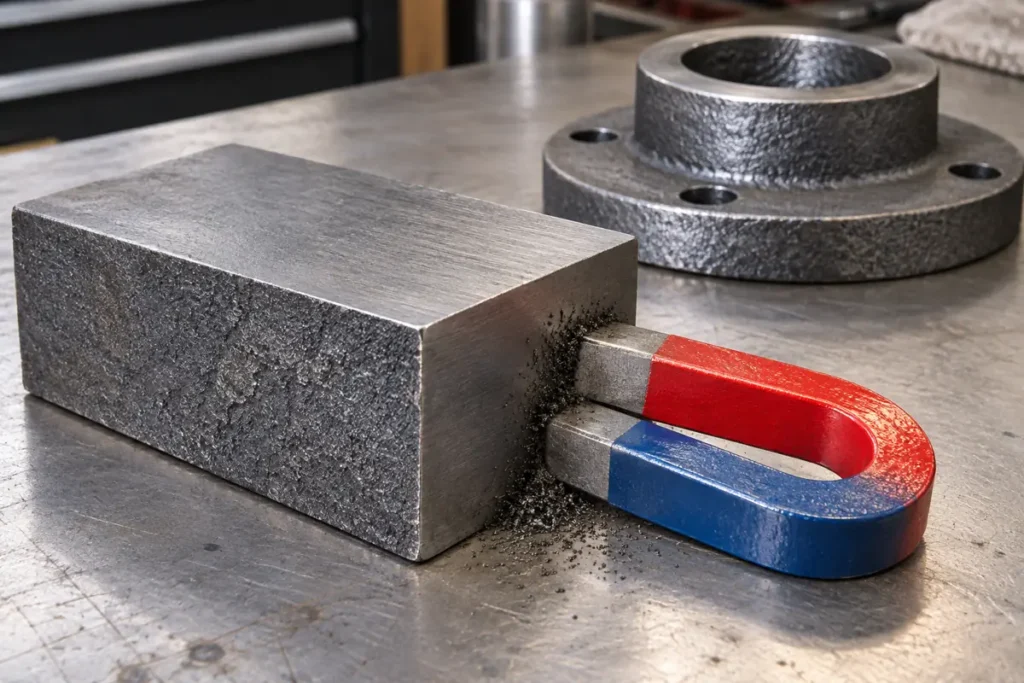
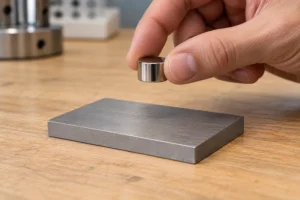
Does titanium stick to a magnet? Normally, no. Titanium is weakly paramagnetic, so a regular magnet will not usually stick to it. This is why you will often see titanium described as a non-magnetic material. Its magnetic response is small, rather than completely absent.
Is titanium ferromagnetic? No. Unlike iron and carbon steel, titanium does not develop the strong, cooperative magnetic alignment associated with ferromagnetism. When you place titanium in an external magnetic field, it develops weak induced magnetization; once you remove the field, that magnetization disappears.
| Property | Titanium | Iron or Carbon Steel |
| Magnetic classification | Paramagnetic | Ferromagnetic |
| Attraction to a regular magnet | Usually unnoticeable | Strong |
| Retains magnetism after the field is removed | No | Can retain magnetism |
Whether you describe titanium as magnetic or nonmagnetic depends on the context. Scientifically, titanium is paramagnetic, not diamagnetic. For everyday handling, you can treat it as non-magnetic. Near a highly sensitive sensor, however, even the weak magnetism of titanium may matter; suitability depends on the field, part position, and equipment sensitivity.
Are Titanium Alloys Magnetic?
Is titanium alloy magnetic? Common engineering grades have a weak magnetic response, but a regular magnet will not normally stick to them. Alloying changes the magnetic properties of titanium, yet widely used grades such as Ti-6Al-4V do not behave like ferromagnetic iron or carbon steel.
When you select a titanium grade, you can use the following comparison:
| Titanium Grade | Material | Typical Response to a Regular Magnet |
| Grade 2 | Commercially pure titanium, included for comparison | No noticeable sticking |
| Grade 5 | Ti-6Al-4V | No noticeable sticking |
| Grade 23 | Ti-6Al-4V ELI, with tighter limits on interstitial elements | No noticeable sticking |
| Grade 9 | Ti-3Al-2.5V | No noticeable sticking |
Adding aluminum and vanadium changes titanium’s mechanical properties without making these common alloys strongly magnetic. Small amounts of iron may also be present, but iron content alone does not tell you whether an alloy will attract a magnet. Its magnetic behavior depends on the phases and structure formed within the material.
For your CNC-machined part, choose the grade according to strength, corrosion resistance, formability, and operating conditions. If you need low magnetic interference near a sensitive instrument, assess the specific material and finished assembly rather than assuming all titanium alloys have identical magnetic behavior.
What Factors Affect Titanium’s Magnetic Properties?
Titanium magnetism depends on composition, temperature, and microstructure. These factors can change its response to a magnetic field, but they do not normally make common titanium grades attract a handheld magnet like carbon steel.
Alloy Composition
The elements added to titanium can change its magnetic susceptibility—the strength of its response to an applied field. Commercially pure titanium, Grade 5, and Grade 9 may have different measured responses even though none normally sticks to a regular magnet.
You cannot predict an alloy’s magnetism from its iron content alone. How the elements exist within the material also matters.
Temperature
Titanium’s magnetic susceptibility can vary with temperature. However, you should not assume that heating or cooling a common titanium alloy will make it strongly magnetic. Under ordinary operating conditions, these variations generally do not change its familiar non-sticking behavior.
Microstructure and Processing
Heat treatment and deformation can change titanium’s phases and microstructure, which may affect its measured magnetic response. This does not mean CNC machining normally turns titanium into a ferromagnetic material.
If you notice strong attraction after machining, investigate other possible causes before attributing it to a change in the titanium itself.
Surface Contamination and Attached Components
Iron or steel particles on your part can create localized attraction. Steel screws, threaded inserts, or magnetic coating layers can also affect the result. These features change what you observe during a magnet test without necessarily changing the titanium body’s magnetic properties.
Check whether attraction occurs across the body or only at particular surfaces and components. This helps you distinguish the material’s response from the behavior of the complete assembly.
Titanium vs. Other Metals
Titanium combines low magnetic response with a high strength-to-weight ratio and excellent corrosion resistance in many environments. When you compare it with other metals for a CNC-machined part, consider these properties together.
| Metal | Magnetic Behavior | Strength | Corrosion Resistance | Approx. Density | Common Uses |
| Titanium | Weakly paramagnetic; normally does not stick to a magnet | Grade-dependent; Grade 5 offers high strength for its weight | Excellent in seawater and many chemical environments | 4.5 g/cm³ | Aerospace parts, implants, sensor housings, marine components |
| Carbon steel | Ferromagnetic; strongly attracts magnets | Can offer high strength, depending on grade and heat treatment | Usually requires protection against rust | 7.8 g/cm³ | Shafts, gears, structural parts |
| Stainless steel | Grade-dependent; annealed 304/316 show low attraction, while 410/430 are magnetic | Moderate to high, depending on grade and condition | Generally good; chloride resistance varies by grade | 7.7–8.0 g/cm³ | Valves, fasteners, medical instruments |
| Aluminum | Weakly paramagnetic; normally does not stick to a magnet | Alloy-dependent; 7075 offers high strength for its weight | Generally good, depending on alloy and environment | 2.7 g/cm³ | Housings, brackets, heat sinks |
| Copper | Diamagnetic; does not stick to a regular magnet | Relatively low in pure, annealed form | Good in many environments | 8.9 g/cm³ | Electrical contacts, busbars, heat exchangers |
| Brass | Generally diamagnetic; does not stick to a regular magnet | Moderate and alloy-dependent | Generally good; some grades can suffer dezincification | 8.4–8.7 g/cm³ | Fittings, valves, connectors |
For everyday purposes, you can group titanium, aluminum, copper, and brass as non-magnetic metals, although their scientific classifications differ. Stainless steel needs closer attention: cold working can increase the magnetic attraction of some austenitic grades.
If you need a lightweight housing, aluminum may be sufficient. If your part also needs high strength and demanding corrosion resistance, titanium may offer a useful combination.
For a closer look at material selection, compare titanium vs. aluminum for CNC machining.
Values are approximate. Strength and corrosion performance depend on grade, material condition, and operating environment.
Applications of Non-Magnetic Titanium
Titanium is useful when your part needs low magnetic response alongside strength, low weight, and corrosion resistance.
Sensors and Precision Instruments
If you design housings, brackets, or fasteners for magnetometers and other field-sensitive instruments, titanium can help limit magnetic disturbance compared with ferromagnetic steel.
You still need to consider the complete assembly. Steel screws or inserts can introduce unwanted attraction even when the main body is titanium.
Aerospace and Marine Equipment
Titanium can be used for structural parts near magnetic navigation sensors, where you want to reduce magnetic influence without adding excessive weight. For marine housings and fittings, corrosion resistance provides an additional benefit.
Its suitability depends on both the sensor requirements and the loads your component must withstand.
Magnetic Assemblies
You can use titanium for supporting components in magnetic systems, including retaining sleeves in some high-speed rotors. It provides mechanical strength without acting like a ferromagnetic steel sleeve.
However, titanium remains electrically conductive, so changing magnetic fields can still cause eddy currents and heating.
Medical Implants and MRI-Related Components
If you are asking whether titanium implants are magnetic, common implant-grade titanium has a low magnetic response rather than the strong attraction of steel. Titanium is used in bone screws, plates, and other implants for its biocompatibility, corrosion resistance, and mechanical properties. Grade 23 (Ti-6Al-4V ELI) is one example of an alloy used for implants; its material designation alone does not establish MRI safety.
You cannot determine MRI safety from the material alone. The specific device must be assessed, and its labeled scanning conditions followed.
Does Titanium Conduct Electricity?
Yes, titanium conducts electricity, even though a regular magnet will not normally stick to it. Electrical conductivity and magnetism are different properties: a metal does not need to be ferromagnetic to carry current.
However, titanium conducts electricity much less efficiently than copper or aluminum. Its electrical resistance also varies with alloy composition and temperature. If your component’s main purpose is to carry current with minimal loss, copper or aluminum will usually be more suitable.
Titanium may still be useful when corrosion resistance, strength, and low magnetic response matter more than conductivity. You should also consider its surface: titanium naturally forms an oxide film that can increase contact resistance, while anodizing can further affect electrical contact.
Low magnetism does not prevent electromagnetic interaction. In changing magnetic fields, your titanium component can develop eddy currents that produce heating or forces.
How Does Titanium’s Non-Magnetic Nature Affect CNC Machining?
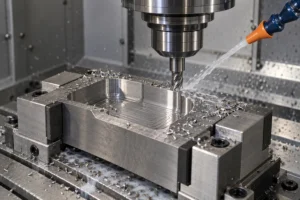
Titanium’s low magnetic response mainly affects your workholding, chip handling, and inspection options. It does not prevent CNC milling or turning, and it is not the reason titanium is difficult to cut.
Workholding
Are titanium plates magnetic enough for direct magnetic clamping? No. A conventional magnetic chuck cannot reliably hold a solid titanium plate or billet directly. You need a vise, chuck jaws, mechanical clamps, or a dedicated fixture suited to your part’s geometry.
When machining thin walls or slender features, adequate support helps prevent movement and distortion without excessive clamping pressure.
Chip Handling
You cannot normally pick up titanium chips with a magnet as you can carbon-steel chips. Use suitable chip conveyors, collection methods, and coolant filtration instead of relying on ordinary magnetic pickup tools.
During cutting, toolpath design and coolant delivery help move chips away from the cutting zone and reduce recutting.
Inspection Methods
Magnetic particle inspection requires a ferromagnetic material, so you cannot use it to inspect titanium.
Depending on your requirements, liquid penetrant inspection can reveal surface-breaking defects, while suitable ultrasonic methods can detect certain internal defects. The appropriate method depends on the geometry and defects you need to identify.
Cutting Performance
Titanium’s machining challenges come mainly from its thermal, chemical, and mechanical properties. Low thermal conductivity concentrates heat near the cutting edge, chemical reactivity can accelerate tool wear, and its relatively low elastic modulus allows thin features to deflect.
To machine your part effectively, focus on rigid support, suitable cutting tools, controlled speeds and feeds, and effective cooling. Low magnetism does not directly determine achievable tolerances or surface finish.
YD Rapid Titanium CNC Machining Services
At YD Rapid, you can source custom titanium parts through CNC milling, turning, and 5-axis machining for prototypes and low-volume production. Depending on your design, these processes can produce housings, brackets, shafts, and components with complex features.
Your material choice should balance strength, corrosion resistance, weight, and magnetic performance. If your part will operate near a sensitive sensor or magnetic assembly, include that information with your drawing so the requirements can be reviewed before production.
To request a quote, send your CAD file or drawing, preferred titanium grade, quantity, critical tolerances, and surface finish requirements. Include any specific magnetic testing requirements so their feasibility and scope can be confirmed.
FAQs
Can a Magnet Test Confirm That Your Part Is Titanium?
No. Aluminum, copper, brass, and some stainless steels also do not stick to a regular magnet. A non-sticking result cannot identify titanium or distinguish its grades. Use material documentation linked to your batch and, where needed, appropriate composition testing.
Can a Metal Detector Detect Titanium?
Yes. Titanium can be detected even though it is not ferromagnetic. Whether your detector picks it up depends on the equipment, sensitivity settings, and the object’s size, shape, and position. You should not assume a titanium part is undetectable simply because a magnet will not stick to it.
Can You Use Titanium to Shield a Magnetic Field?
Titanium is generally unsuitable for redirecting static or slowly changing magnetic fields because its magnetic permeability is close to that of free space. A titanium housing alone may not provide the shielding your sensitive component needs. At higher frequencies, its electrical conductivity can contribute to shielding, but performance depends on frequency, wall thickness, and enclosure design.
Conclusion
Is titanium magnetic? Technically, it is weakly paramagnetic, but a regular magnet will not normally stick to it. Common titanium alloys behave similarly, making them useful when your part needs low magnetic response alongside strength, low weight, and corrosion resistance.
For CNC machining, this mainly affects your workholding, chip handling, and inspection methods. Titanium’s cutting challenges come from its thermal, chemical, and mechanical properties—not its low magnetism.
If you need custom titanium parts, send your drawing, material grade, quantity, and machining requirements to YD Rapid for a quote.