Is tungsten magnetic? Pure tungsten is weakly paramagnetic, while tungsten carbide and tungsten alloys can respond differently depending on their composition. In this article, you’ll learn about tungsten’s magnetic properties and susceptibility, how to test its magnetism, how it compares with magnetic metals, and its practical applications and CNC machining considerations.
Is Tungsten Magnetic?
Whether your tungsten material attracts a magnet depends on its composition. Pure tungsten, tungsten carbide, and tungsten alloys can behave differently, so you need to identify which material you are using.
Is Pure Tungsten Magnetic?
Pure tungsten is weakly paramagnetic. It develops a small magnetization in the direction of an applied magnetic field, but that response disappears when the field is removed. With an ordinary handheld magnet, you generally won’t notice any attraction.
If you are asking whether tungsten is magnetic or nonmagnetic, pure tungsten is best described as weakly paramagnetic but practically nonmagnetic under ordinary conditions. “Nonmagnetic” does not mean its magnetic susceptibility is exactly zero.
Is Tungsten Carbide Magnetic?
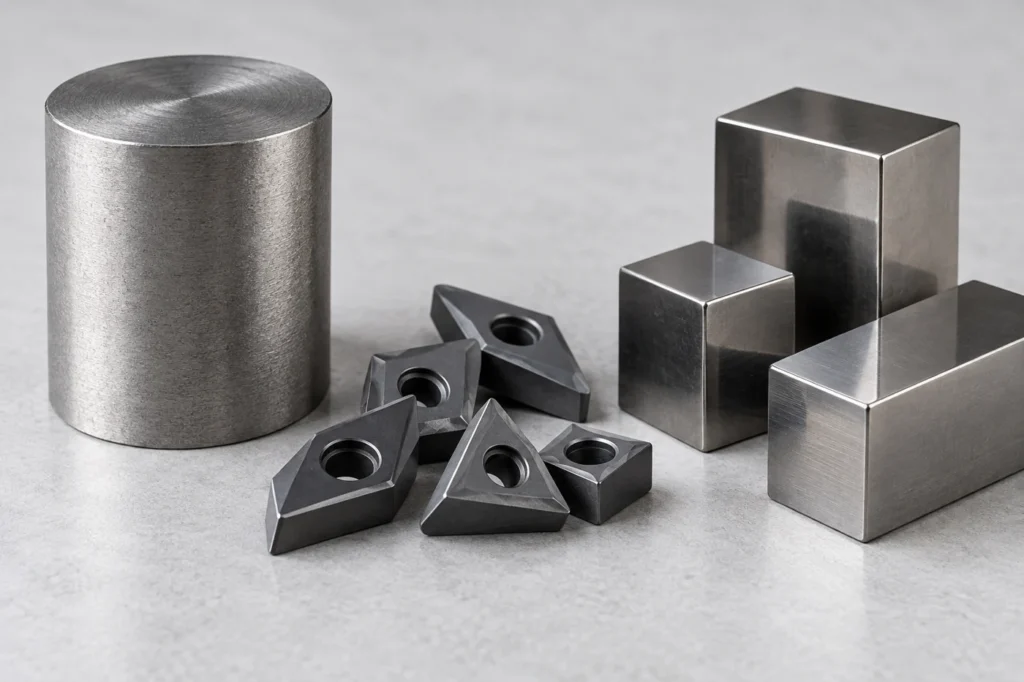
If your tungsten carbide part attracts a magnet, the attraction usually comes from its metallic binder, rather than the tungsten carbide itself. Many cutting tools and wear parts contain tungsten carbide grains held together by cobalt, which is ferromagnetic.
You can therefore notice magnetic attraction when testing cobalt-bonded tungsten carbide. Its response depends on the binder content and composition. Nickel-bonded grades can behave differently, so you should check the specific grade rather than assume every tungsten carbide product has the same magnetism.
Tungsten Alloys
Your tungsten alloy’s magnetic behavior depends on the elements combined with tungsten and the resulting microstructure. A product described as “magnetic tungsten” may contain a ferromagnetic binder; the name does not mean pure tungsten behaves like iron.
- Tungsten–nickel–iron alloys typically show noticeable magnetic attraction because of their nickel–iron binder phase.
- Tungsten–nickel–copper alloys are commonly supplied as nonmagnetic heavy alloys, making them useful when you need high density with low magnetic interaction.
- Copper tungsten composites generally show little response to an ordinary magnet because neither constituent is ferromagnetic. If you need a defined magnetic limit, verify your copper tungsten grade rather than relying on its trade name.
If magnetic performance matters to your design, specify the alloy grade and required magnetic properties. A magnet test alone cannot confirm tungsten content, purity, or material identity.
Magnetic Susceptibility of Tungsten
Magnetic susceptibility tells you how strongly a material becomes magnetized in an external magnetic field. Pure tungsten has a small positive SI volume magnetic susceptibility of approximately +6.8 × 10⁻⁵, indicating weak paramagnetism. This explains why you generally won’t see pure tungsten stick to an ordinary magnet.
For a linear magnetic response, you can express susceptibility as:
χᵥ = M / H
| Symbol | What it means | SI unit |
| χᵥ | Volume magnetic susceptibility | Dimensionless |
| M | Magnetization induced in your material | A/m |
| H | Magnetic field strength inside your material | A/m |
You can also relate susceptibility to relative permeability:
μᵣ = 1 + χᵥ
Using the reference value for pure tungsten gives you μᵣ ≈ 1.000068—very close to 1, consistent with its weak magnetic response.
Use this value for pure tungsten, rather than applying it to every tungsten product. For tungsten carbide and tungsten alloys, you need grade-specific magnetic data because their binders and alloy composition affect the response. When comparing specifications, also check whether you are reading volume, mass, or molar susceptibility; their values and units are different.
How to Test Tungsten’s Magnetism
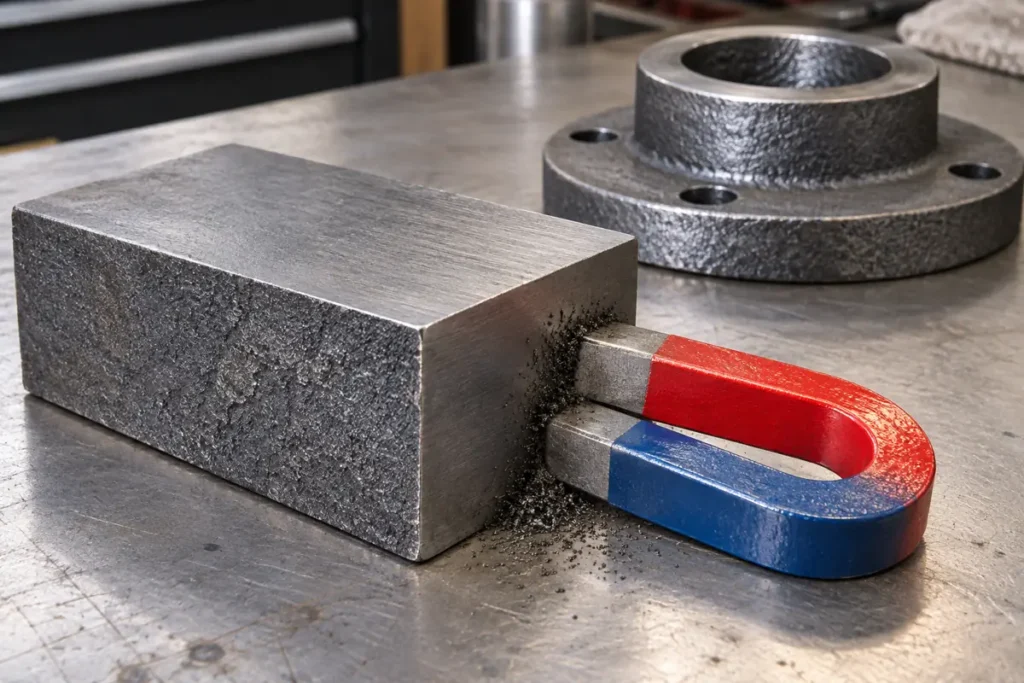
You can use a handheld magnet to check whether your tungsten sample shows noticeable magnetic attraction. However, this simple test cannot measure its magnetic susceptibility or confirm its composition.
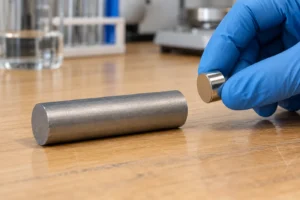
Perform a Simple Magnet Test
- Clean your sample. Remove loose metal chips and surface contamination that could affect the result.
- Place it on a nonmagnetic surface. Use wood or plastic, away from steel benches and fixtures.
- Bring a magnet close. Slowly approach the sample with a strong permanent magnet, such as a neodymium magnet, and check for attraction.
- Check several areas. Test different sides to see whether the response is consistent or limited to an attached component or contaminated spot.
| What you observe | What it may indicate |
| No noticeable attraction | Consistent with pure tungsten or a low-magnetic tungsten material; does not confirm its identity |
| Clear attraction | May indicate a magnetic binder or alloy phase, such as cobalt or nickel–iron |
| Attraction at specific spots | Check for steel inserts, attached components, or ferromagnetic contamination |
A heavy sample may remain still even when some attraction exists. Its weight and friction can mask the response, so you should avoid treating “no movement” as proof that it is nonmagnetic.
Use Instrument Testing When Accuracy Matters
If your application requires a defined magnetic response, use laboratory testing. A vibrating sample magnetometer (VSM), for example, measures magnetization as the applied field changes. This helps you evaluate susceptibility and check for hysteresis or residual magnetization.
For material identification, combine magnetic testing with composition analysis and material certificates. A magnet alone cannot tell you whether your sample is pure tungsten, tungsten carbide, or a particular tungsten alloy.
Practical Applications of Tungsten
Tungsten serves different purposes in aerospace, electronics, medical equipment, and radiation shielding. Depending on your requirements, you can use its high density, heat resistance, or electrical properties to improve component performance.
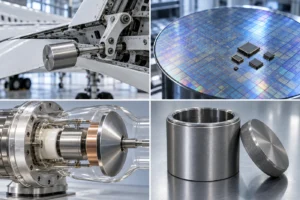
Aerospace
You can use tungsten heavy alloys for aircraft counterweights, control-surface balance weights, and rotating assembly balancing. Their high density helps you achieve the required mass where installation space is limited. If your component sits near a compass or magnetic sensor, you should also consider its magnetic response when selecting the alloy grade.
Electronic Components
Is tungsten conductive? Yes. Tungsten conducts electricity, which supports its use in semiconductor contacts and interconnects. You also need to account for its electrical resistance and operating temperature. Tungsten–copper composites are used in electronic packaging and heat sinks, combining tungsten’s low thermal expansion with copper’s thermal conductivity to help you manage heat and expansion mismatch.
Medical Equipment
In medical imaging, tungsten-based X-ray targets withstand intense heating while supporting X-ray generation. In radiotherapy equipment, tungsten collimators help shape radiation beams to the treatment area. Your material requirements depend on the component’s function, including its heat resistance, dimensional stability, and radiation attenuation.
Radiation Shielding
You can use tungsten-based materials in syringe shields, radioactive-source containers, and shielding housings. Their high density allows compact designs for attenuating X-rays and gamma rays, although the required thickness depends on radiation energy and your protection requirements. When your shield operates near magnetically sensitive equipment, you should specify a suitable low-magnetic grade alongside its shielding performance.
Tungsten vs. Magnetic Metals
When you compare pure tungsten with iron, cobalt, and nickel, the main difference is their response to a magnetic field. Pure tungsten is weakly paramagnetic, while iron, cobalt, and nickel are ferromagnetic at room temperature. You generally won’t notice pure tungsten attracting an ordinary magnet, but you can observe clear attraction with the other three metals.
| Property | Pure tungsten | Iron | Cobalt | Nickel |
| Magnetic behavior at room temperature | Weakly paramagnetic | Ferromagnetic | Ferromagnetic | Ferromagnetic |
| Attraction to a handheld magnet | Generally unnoticeable | Strong | Strong | Noticeable |
| Can retain magnetization after the field is removed? | No | Yes, depending on material condition | Yes, depending on material condition | Yes, depending on material condition |
| Density, approximately (g/cm³) | 19.3 | 7.87 | 8.90 | 8.90 |
| Melting point, approximately (°C) | 3,422 | 1,538 | 1,495 | 1,455 |
If you need substantial weight in a compact component with minimal magnetic interaction, pure tungsten offers a useful combination of high density and weak magnetic response. Iron, cobalt, and nickel are more relevant when your design requires a strong magnetic response, although their suitability depends on the complete material specification.
You should also distinguish pure metals from alloys. Adding tungsten to a material does not automatically make it nonmagnetic. Tungsten heavy alloys containing a nickel–iron binder can show noticeable attraction, while tungsten–nickel–copper grades are commonly selected for low-magnetic applications. Likewise, nickel-containing alloys do not all behave like pure nickel.
For your material selection, use magnetic behavior alongside density, temperature requirements, corrosion resistance, and mechanical properties. A magnet test gives you a preliminary indication; it cannot confirm that a material meets your design requirements.
If you are comparing tungsten and titanium, both pure metals are weakly paramagnetic rather than ferromagnetic. Neither typically sticks noticeably to an ordinary magnet, so you cannot reliably distinguish them using attraction alone. For a closer look at titanium, read our guide: Is Titanium Magnetic?
CNC Machining Considerations for Tungsten
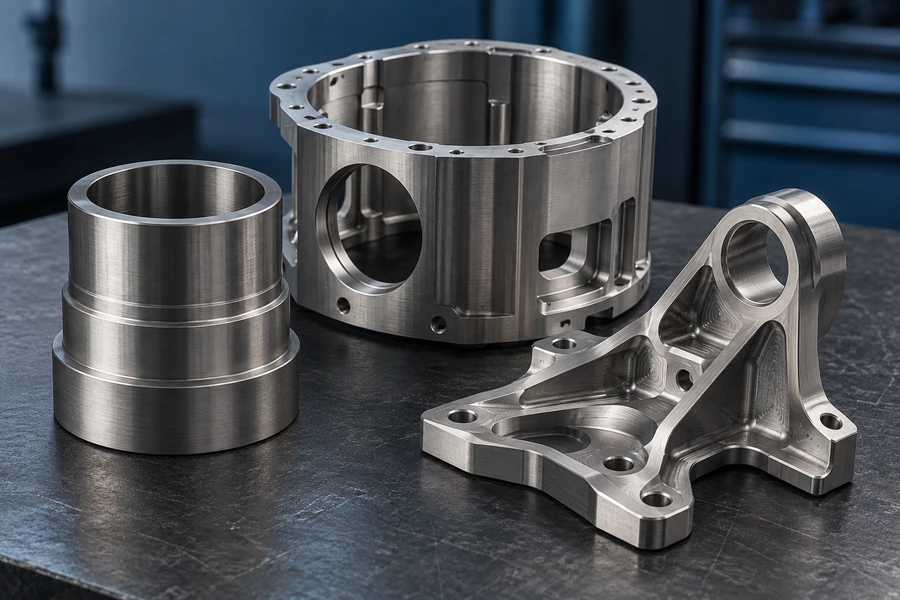
Before you machine tungsten, confirm whether your drawing specifies pure tungsten, a tungsten heavy alloy, or cemented tungsten carbide. These materials require different tooling, cutting conditions, and finishing methods. Their magnetic response alone cannot tell you how they will machine. For your CNC machining project, confirm the available process for the specified grade before ordering.

Material Grade and Brittleness
Is tungsten brittle? Pure tungsten can be brittle at room temperature, making your thin walls, sharp edges, and unsupported features vulnerable to cracking or chipping. Tungsten heavy alloys often offer better machinability, but their behavior depends on the binder and processing condition. For cemented tungsten carbide, you may need diamond grinding or electrical discharge machining (EDM) rather than conventional milling or turning.
Use Secure Workholding
You should support the workpiece close to the cutting area and distribute clamping pressure to reduce vibration and local stress. Tungsten’s high density also means your fixtures must securely support relatively heavy parts.
Do not assume a magnetic chuck will hold your tungsten component. Pure tungsten’s weak magnetic response generally makes direct magnetic workholding unsuitable. Even with a magnetic tungsten alloy, you need to verify holding force under the intended cutting loads.
Match Tooling and Cutting Conditions to the Grade
Choose your tooling, cutting speed, feed, and coolant strategy for the specific material. A setup suitable for a machinable tungsten heavy alloy may perform poorly on pure tungsten or cemented carbide. Keep tools sharp, limit vibration, and avoid cutting conditions that cause edge breakout or excessive tool wear. If your design has shafts, sleeves, or other rotational features, discuss CNC turning and any required finishing operations during the process review.
Specify Critical Requirements Before Quoting
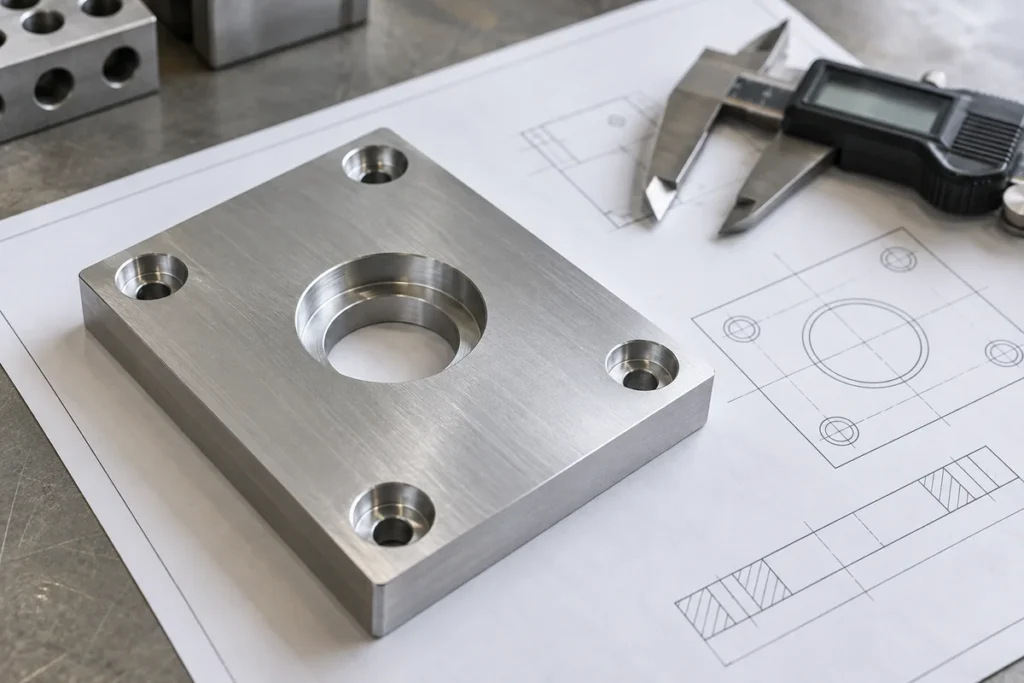
When you send your RFQ to YD Rapid, include your material grade, drawings, tolerances, surface finish, quantity, and any magnetic-property requirements. Identify thin walls, small holes, and sharp internal corners so these features can be reviewed before production.
If your component will operate near magnetic sensors or sensitive equipment, specify an acceptable magnetic limit and test method. This gives you a measurable acceptance requirement beyond a general “nonmagnetic tungsten” description.
FAQs
How Do You Choose Between High-Speed Steel and Tungsten Carbide Tools?
Choose your cutting tool by the workpiece material, machine rigidity, and cutting conditions. High-speed steel generally offers greater toughness and tolerates interrupted cuts or less rigid setups better. Cemented tungsten carbide generally offers greater wear resistance and retains hardness at higher cutting temperatures, allowing higher cutting speeds in a suitable setup. However, its cutting edges can chip under impact or vibration. You should compare the specific tool grades and geometry; magnetic attraction does not tell you which tool will perform better.
Conclusion
Pure tungsten is weakly paramagnetic, so you generally won’t notice it sticking to an ordinary magnet. Tungsten carbide and tungsten alloys can behave differently because of their binders and composition. When choosing your material, consider its magnetic response alongside density, heat resistance, and machining requirements. Use a magnet test as an initial check, then confirm the grade and any critical magnetic properties.
For your next machining project, request a quote from YD Rapid with your drawings, material specifications, and performance requirements so the team can review manufacturability.