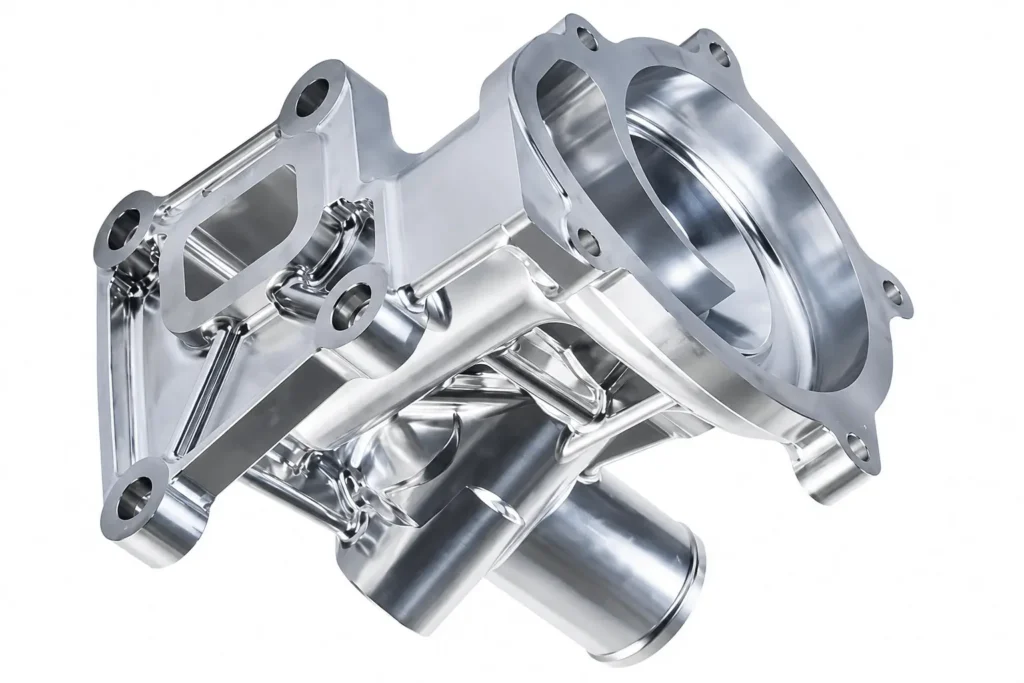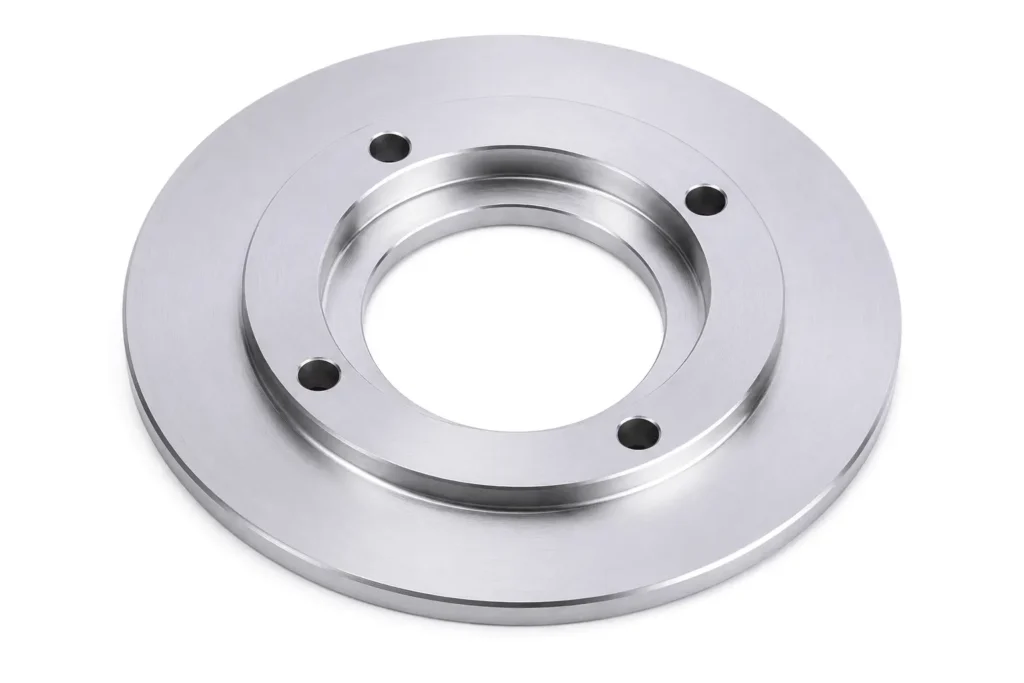
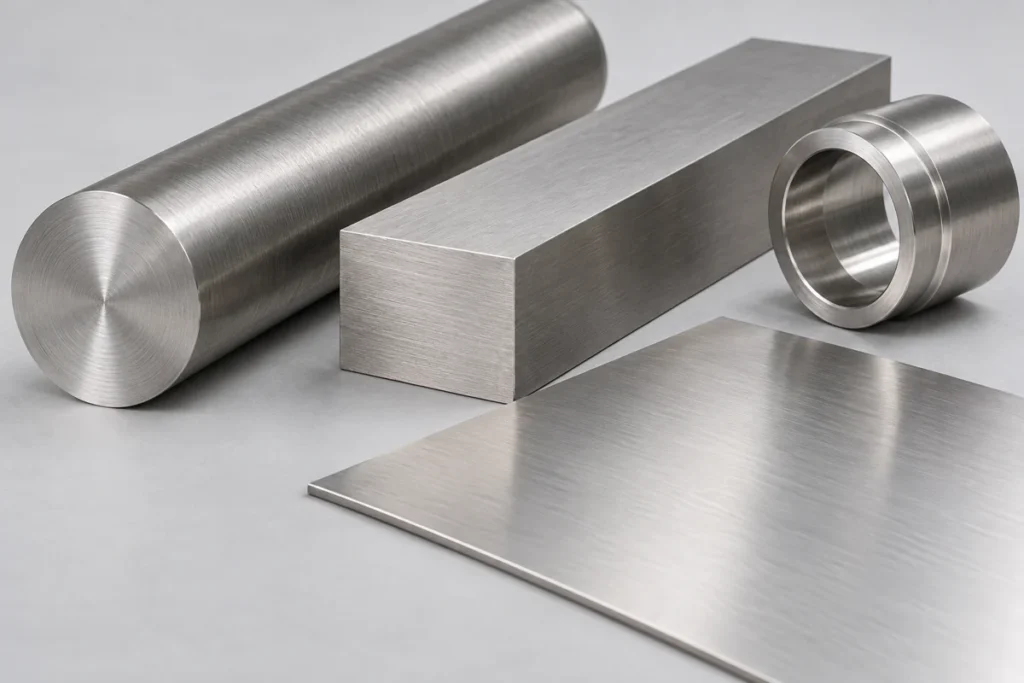
When you assess 304 stainless steel properties, you’re evaluating an austenitic chromium-nickel alloy with good corrosion resistance, toughness, formability, and weldability. For your CNC parts, it offers a versatile material choice, although work hardening and chloride exposure can limit its suitability. Material condition determines the strength and hardness you receive.
What Are the Main Properties of 304 Stainless Steel?
You can assess 304 stainless steel material properties through its strength, ductility, corrosion resistance, and thermal behavior. The tables below show reference values for annealed material; cold working changes the strength and hardness you receive.
304 Stainless Steel Mechanical Properties
You can form annealed 304 while retaining useful strength and toughness. The table distinguishes minimum strength and elongation requirements from the maximum hardness limit.
Chemical and mechanical limits shown follow an ASTM A240/A240M flat-rolled product reference; CNC bar stock may have different requirements. Physical and thermal values are typical for annealed material.
| Property | Annealed 304 Reference Value | What It Means for Your Part |
| Tensile strength | ≥515 MPa | Indicates resistance to failure under tensile loading |
| Yield strength, 0.2% proof stress | ≥205 MPa | Helps you assess when permanent deformation begins |
| Elongation | ≥40% in 50 mm | Indicates ductility under the specified tensile test |
| Brinell hardness | ≤201 HBW | Provides a hardness limit for the supplied condition |
For a load-bearing part, yield strength helps you assess permanent deformation. The ultimate tensile strength of 304 stainless steel describes the maximum engineering stress reached in a tensile test; 515 MPa is the minimum reference requirement here. Neither establishes a safe working load without geometry, loading, and a suitable safety factor.
Elongation helps you compare ductility, but it does not directly specify a safe bend radius. For annealed material, the 304 stainless steel hardness limit shown is 201 HBW, not a typical measured value for every batch. Wear performance also depends on contact pressure, lubrication, and the mating material.
Cold working can increase your material’s strength and hardness while reducing ductility. During CNC machining, work hardening also makes subsequent cuts more demanding, particularly if your tool rubs instead of cutting effectively.
Quarter-hard, half-hard, three-quarter-hard, and full-hard 304 describe cold-worked conditions. Their properties differ from annealed 304 and depend on the governing temper specification; do not apply the annealed table to them.
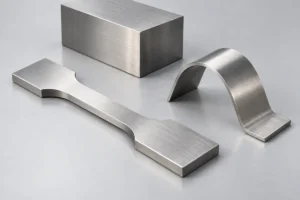
Physical Properties and 304 Stainless Steel Density
The density of 304 stainless steel helps you estimate blank and finished-part weight. Use approximately 7.9 g/cm³, equivalent to 7,900 kg/m³, for the reference material below. Elastic modulus helps you assess deflection, while electrical resistivity describes resistance to current flow.
| Property | Typical Reference Value | Practical Meaning |
| Density | Approximately 7.9 g/cm³ | Helps you calculate blank and finished-part weight |
| Elastic modulus | Approximately 193 GPa | Helps you estimate elastic deflection under load |
| Electrical resistivity | Approximately 0.72 µΩ·m near room temperature | Indicates substantially lower electrical conductivity than copper |
You should distinguish stiffness from strength: cold working increases strength and hardness without a comparable increase in elastic modulus.
Corrosion Resistance
You can use 304 in many atmospheric, freshwater, and mild chemical environments. Its chromium-rich passive film protects the surface, while temperature, fluid chemistry, and crevice geometry determine the limits of that protection.
| Your Operating Conditions | What You Should Consider |
| Mild atmospheric exposure | Generally a suitable starting point |
| Food or process-fluid contact | Check fluid composition, temperature, and cleaning chemicals |
| Saltwater or chloride-containing solutions | Assess pitting and crevice corrosion risks |
| Warm chloride exposure with tensile stress | Evaluate stress corrosion cracking |
| Tight gaps or trapped deposits | Consider localized corrosion beneath deposits or inside crevices |
When comparing 304 vs. 316 stainless steel properties, the key corrosion distinction is molybdenum in 316, which improves resistance to chloride pitting and crevice corrosion. It does not make 316 immune to seawater corrosion. Choosing 304L mainly addresses sensitization, not chloride pitting.
Thermal Properties and High Temperature Behavior
You should consider heat transfer and dimensional expansion separately from melting temperature. A high melting range does not establish a safe operating temperature for your component.
| Property | Typical Value | Reference Condition |
| Thermal conductivity | Approximately 16.3 W/m·K | At 100°C |
| Mean thermal expansion coefficient | Approximately 17.2 × 10⁻⁶/K | Over 0–100°C |
| Specific heat capacity | Approximately 500 J/kg·K | Over 0–100°C |
When evaluating 304 stainless steel properties at high temperature, remember that room-temperature strength values do not apply unchanged. Oxidation-resistance guidance of about 870°C intermittently and 925°C continuously does not establish a safe load-bearing temperature; allowable stress, creep, exposure time, and atmosphere also matter.
For your CNC-machined parts, thermal expansion matters when you inspect tight tolerances. Using the coefficient above, a 100 mm length changes by approximately 0.034 mm over a 20°C temperature rise, assuming uniform heating and free expansion. This illustrates why part temperature can affect dimensional measurements.
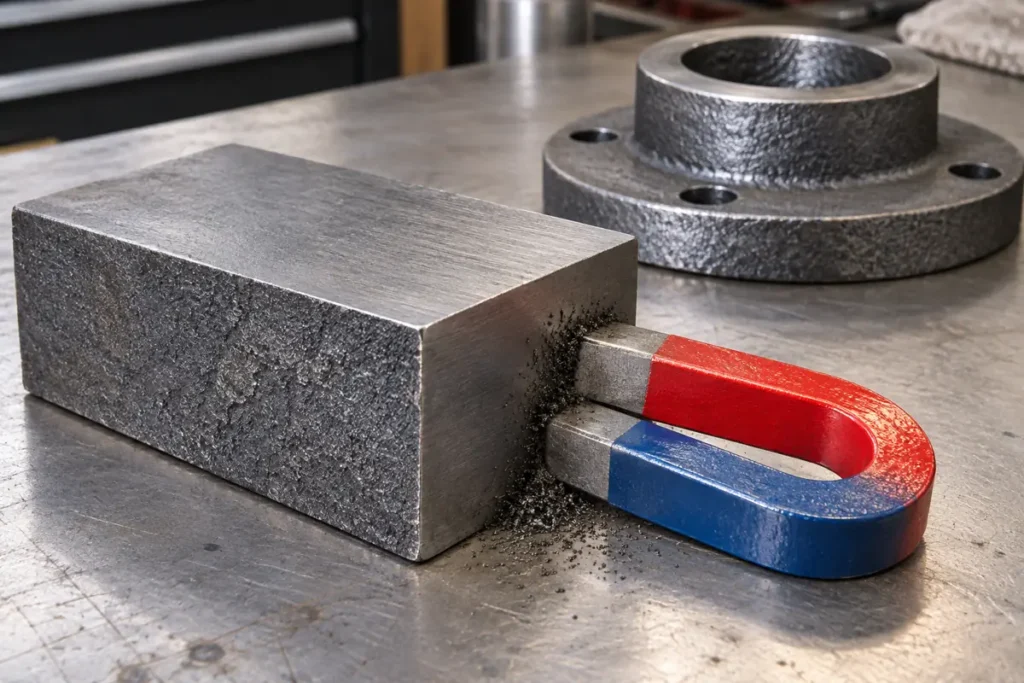
Is 304 Stainless Steel Magnetic?
You can generally expect annealed 304 stainless steel to show little magnetic attraction. However, cold working can transform some austenite into magnetic martensite, so your material may become noticeably magnetic after drawing, bending, or other deformation. Weld regions may also show a magnetic response.
You cannot confirm or reject a 304 grade using a magnet alone. If your application requires low magnetic permeability, specify an acceptance limit and verify the finished part’s condition rather than relying only on the grade designation.
What Are the Differences Between 304, 304L, and 304H?
You can choose between 304, 304L, and 304H based on welding requirements and service temperature. Their carbon limits differ, influencing sensitization after welding and elevated-temperature strength.
| Grade | Carbon Content | Main Characteristics | When to Consider It | Selection Considerations |
| 304 | ≤0.07% | Balanced corrosion resistance, strength, and formability | Your general-purpose CNC-machined parts | Confirm the material condition and applicable specification |
| 304L | ≤0.03% | Lower risk of weld-related sensitization and intergranular corrosion | Your parts require welding, particularly in heavier sections | Lower carbon does not automatically improve resistance to chloride pitting |
| 304H | 0.04–0.10% | Controlled carbon content supports elevated-temperature strength | Your components require sustained high-temperature service | Check temperature, loading, and specification requirements; higher carbon does not mean better overall performance |
For most general-purpose CNC projects, you can start by evaluating 304. Consider 304L when welding is important, and assess 304H when elevated-temperature strength is a design requirement.
Chemical Composition of 304 Stainless Steel
When you select 304 stainless steel, chromium and nickel are its main alloying elements. Chromium helps form the protective passive film responsible for corrosion resistance, while nickel stabilizes the austenitic structure and supports toughness and ductility.
| Element | Content by Weight | Main Role |
| Chromium (Cr) | 17.5–19.5% | Forms a protective passive film |
| Nickel (Ni) | 8.0–10.5% | Stabilizes the austenitic structure |
| Carbon (C) | ≤0.07% | Influences strength and susceptibility to sensitization |
| Manganese (Mn) | ≤2.00% | Supports austenite stability and steelmaking |
| Silicon (Si) | ≤0.75% | Acts as a deoxidizer during steelmaking |
| Phosphorus (P) | ≤0.045% | Controlled impurity |
| Sulfur (S) | ≤0.030% | Controlled to limit effects on ductility and corrosion resistance |
| Nitrogen (N) | ≤0.10% | Supports strength and austenite stability |
| Iron (Fe) | Balance | Forms the alloy’s base |
“18/8” describes nominal chromium and nickel content, not exact batch chemistry.
You may encounter AISI 304, SAE 304, Type 304, SS 304, or CRES 304 in material searches and drawings. UNS S30400 identifies the alloy, while SUS 304 is a Japanese designation for a comparable grade. These names do not replace a product specification or establish automatic contractual equivalence.
Common Applications of 304 Stainless Steel
You can use 304 stainless steel for parts that require corrosion resistance, toughness, and good fabrication characteristics. To decide whether it suits your application, consider what your part contacts, its operating temperature, and how you will manufacture and clean it.
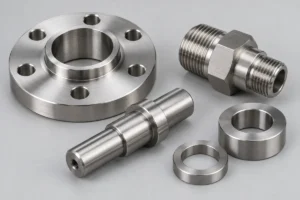
| Application or Part | Relevant Material Properties | What You Should Consider |
| Food-processing components: fittings, guides, and filling-machine parts | Corrosion resistance and suitability for cleanable surfaces | Check food composition, cleaning chemicals, temperature, and surface finish; the grade alone does not establish hygienic suitability |
| CNC-machined fittings, flanges, and valve components | Toughness, ductility, and corrosion resistance | Confirm fluid compatibility, pressure requirements, and sealing-surface specifications |
| Shafts, spacers, and mounting brackets | Balanced mechanical properties and material availability | Check loading, deflection, and wear requirements; annealed 304 may not suit highly loaded wear surfaces |
| Laboratory and pharmaceutical equipment components | Corrosion resistance and ability to achieve smooth finishes | Verify compatibility with process chemicals and sterilization methods |
| Welded assemblies and formed parts | Good weldability and formability | Assess distortion and post-weld cleaning; consider 304L where sensitization is a concern |
| Threaded fasteners | Toughness and corrosion resistance in suitable environments | Consider thread galling during assembly and chloride exposure during service |
For your CNC project, match the material to the finished part’s operating conditions, rather than choosing 304 simply because it is widely used. A suitable grade must meet your manufacturing requirements and perform reliably in service.
Advantages of 304 Stainless Steel
When you choose 304 stainless steel for a suitable application, you benefit from:
- Flexible manufacturing options: You can combine CNC machining, forming, and welding to produce your part.
- Wide material availability: You can source bars, plates, sheets, and tubes, giving you more options when selecting a suitable blank.
- Easier cleaning and maintenance: With an appropriate surface finish and cleaning routine, you can keep your parts clean and reduce maintenance demands.
- Multiple finishing options: You can specify machined, brushed, or polished surfaces to meet functional and appearance requirements.
- Balanced material cost: For environments where 304 provides sufficient corrosion resistance, you can avoid paying for a more highly alloyed grade.
Limitations of 304 Stainless Steel
You should reconsider 304 when your operating conditions or manufacturing requirements involve:
- Chloride exposure: Saltwater and chloride-containing chemicals can cause pitting and crevice corrosion. You may need 316 or a more resistant alloy, depending on temperature, concentration, and exposure conditions.
- Extensive CNC machining: Work hardening and relatively low thermal conductivity make cutting more demanding. Your machining time and tooling costs may justify evaluating 303 if its lower corrosion resistance and poorer weldability are acceptable.
- High strength or wear resistance: Annealed 304 may not provide the strength or surface hardness your part requires. You cannot harden it through conventional quench-and-temper treatment.
- Strict magnetic requirements: Cold working can increase magnetic attraction. If your part requires low magnetic permeability, specify and verify that requirement.
- Sustained elevated temperatures: Oxidation resistance alone does not establish load-bearing capability. You need to assess strength, creep, and corrosion requirements at your operating temperature.
304 Stainless Steel Machining at YD Rapid
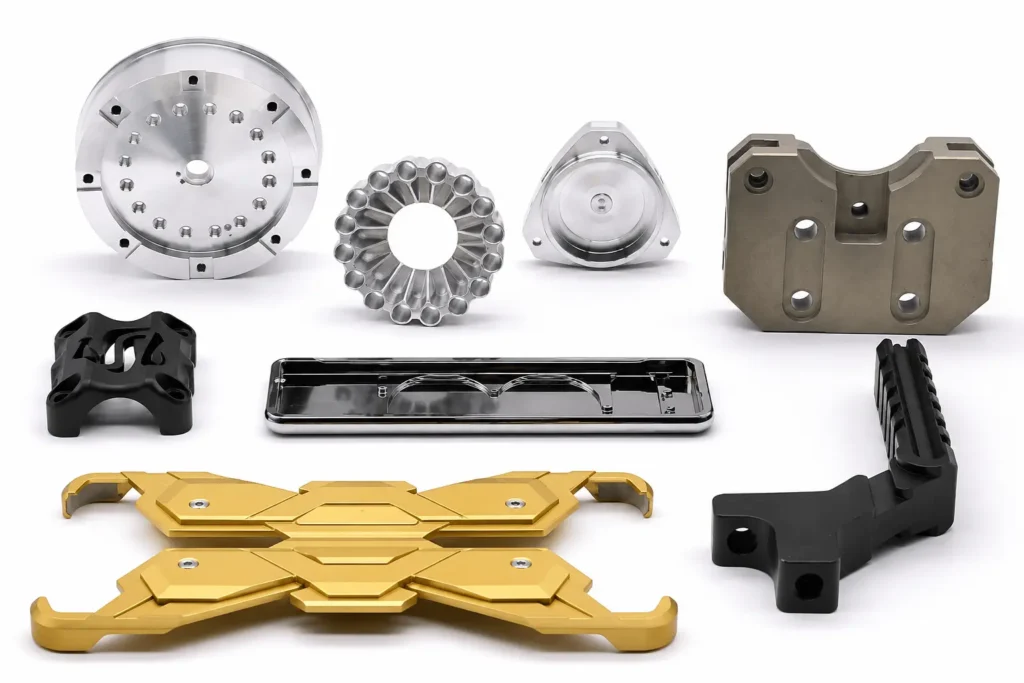
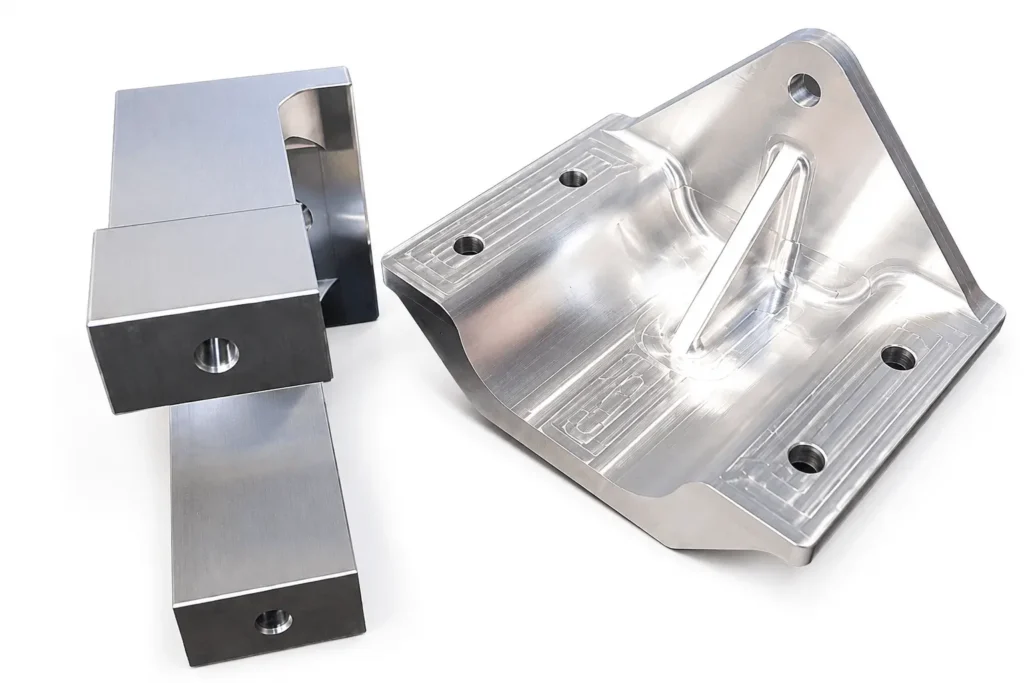
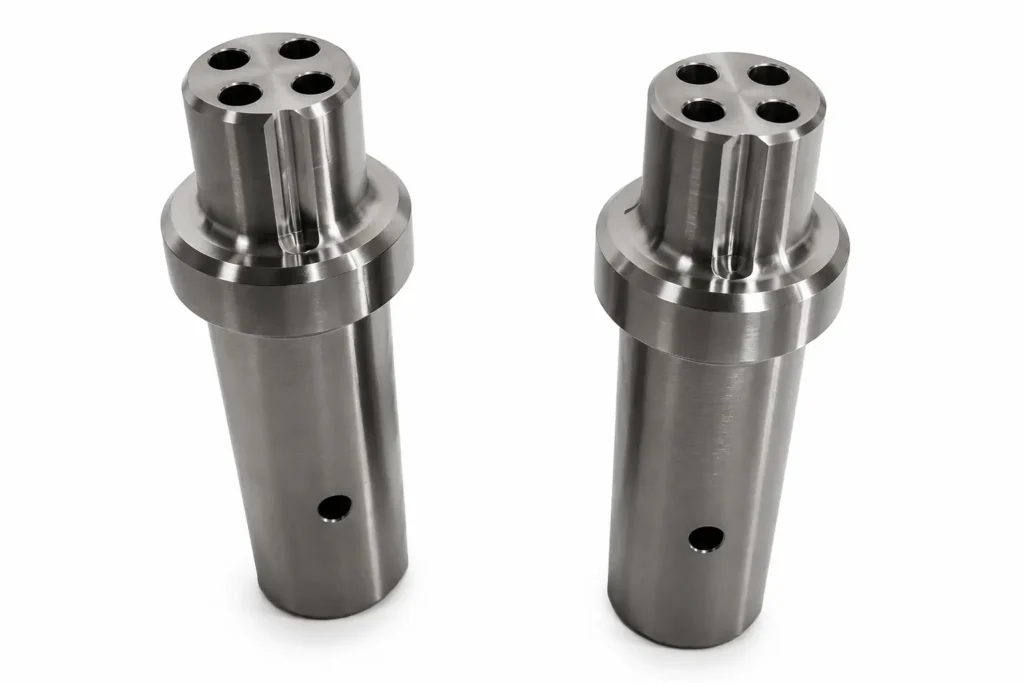
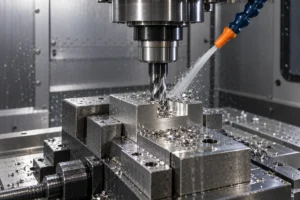
At YD Rapid, you can choose 304 stainless steel for custom parts produced through CNC milling and turning, from prototypes to small production batches. Your part geometry, material condition, and surface requirements guide the machining approach.
When machining your 304 parts, attention to tool sharpness, workholding rigidity, and coolant delivery helps manage work hardening and cutting heat. For thin walls, deep holes, and precision features, machining sequence and chip evacuation are also important considerations. By accounting for these material characteristics, you can better balance your part’s functional requirements with manufacturing practicality.
FAQs
Can an XRF Analyzer Distinguish 304 from 304L?
You cannot reliably distinguish them using standard handheld XRF because it does not measure carbon, their main distinguishing element. Check the material certificate or request a suitable carbon-analysis method, such as spark optical emission spectroscopy.
What Does Dual-Certified 304/304L Mean?
When you purchase dual-certified material, it meets the applicable requirements for both grades. Confirm that your material certificate explicitly lists both designations and that the material satisfies your drawing and purchase specification.
Do You Need to Passivate 304 Parts After CNC Machining?
You may need passivation if machining introduces free-iron contamination or your specification requires it. Passivation helps remove free iron from the surface, but it does not make 304 immune to chloride corrosion. Specify your cleaning, passivation, and verification requirements when ordering.
Conclusion
Understanding 304 stainless steel properties helps you balance corrosion resistance, strength, and manufacturing requirements when choosing material for your parts. While 304 suits many CNC applications, chloride exposure, heavy wear, or sustained high temperatures may require another grade.
Send your drawings, quantity, finishing requirements, and operating conditions to YD Rapid so we can review your project and prepare a quotation.