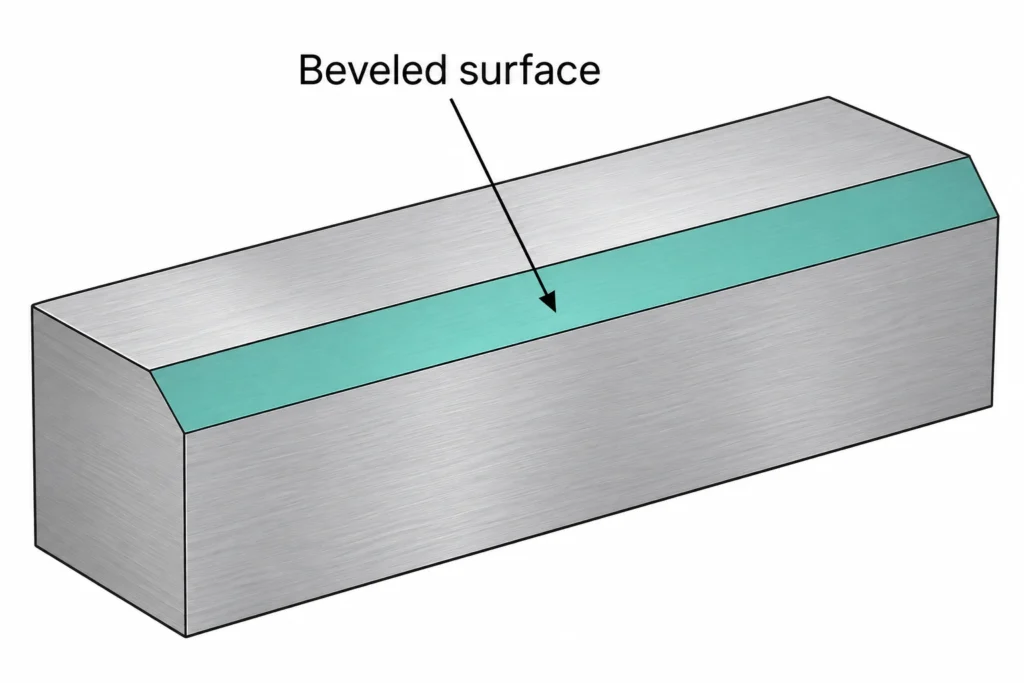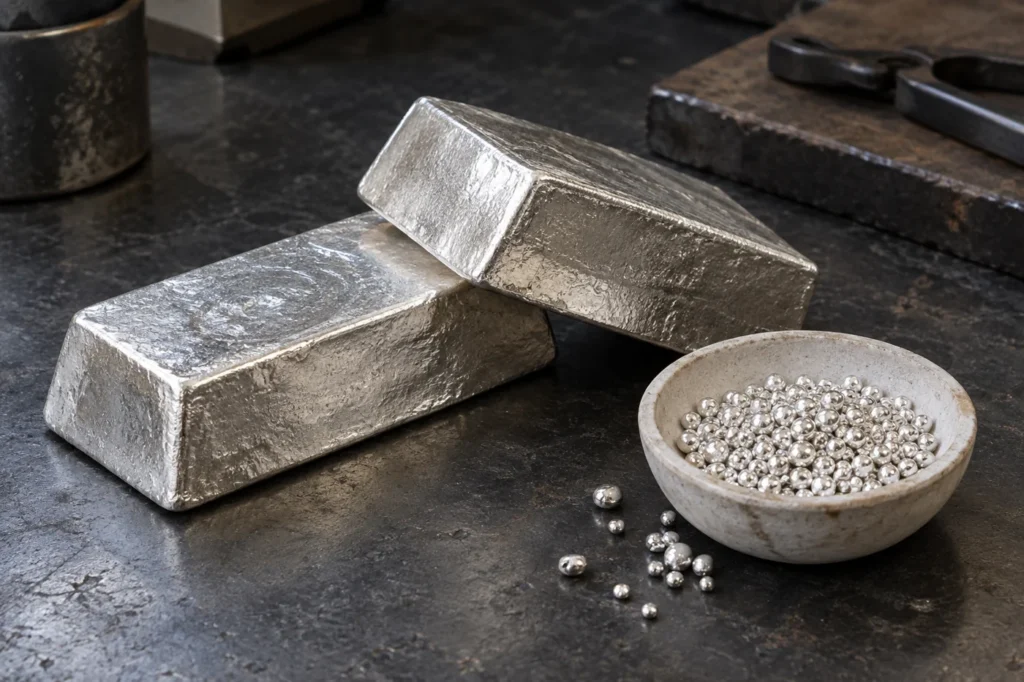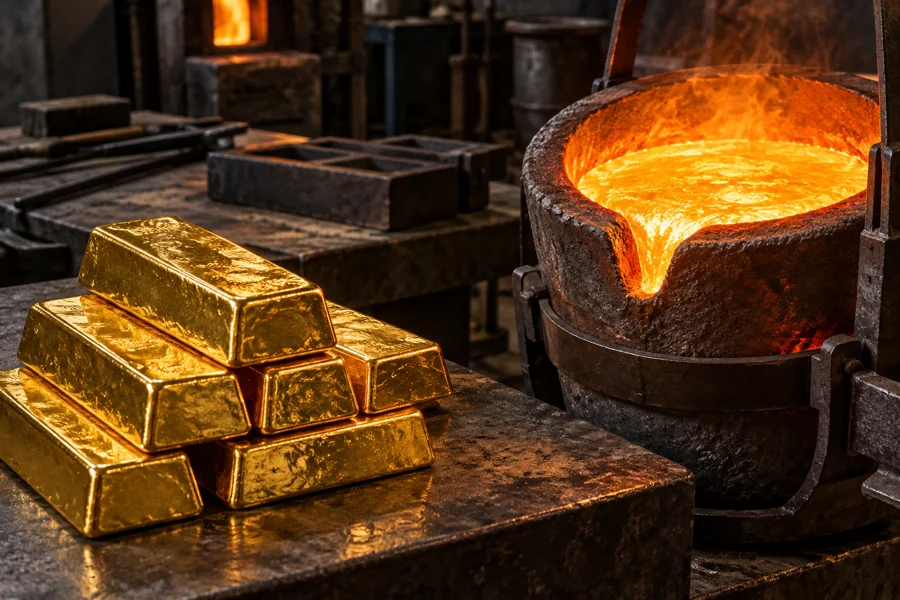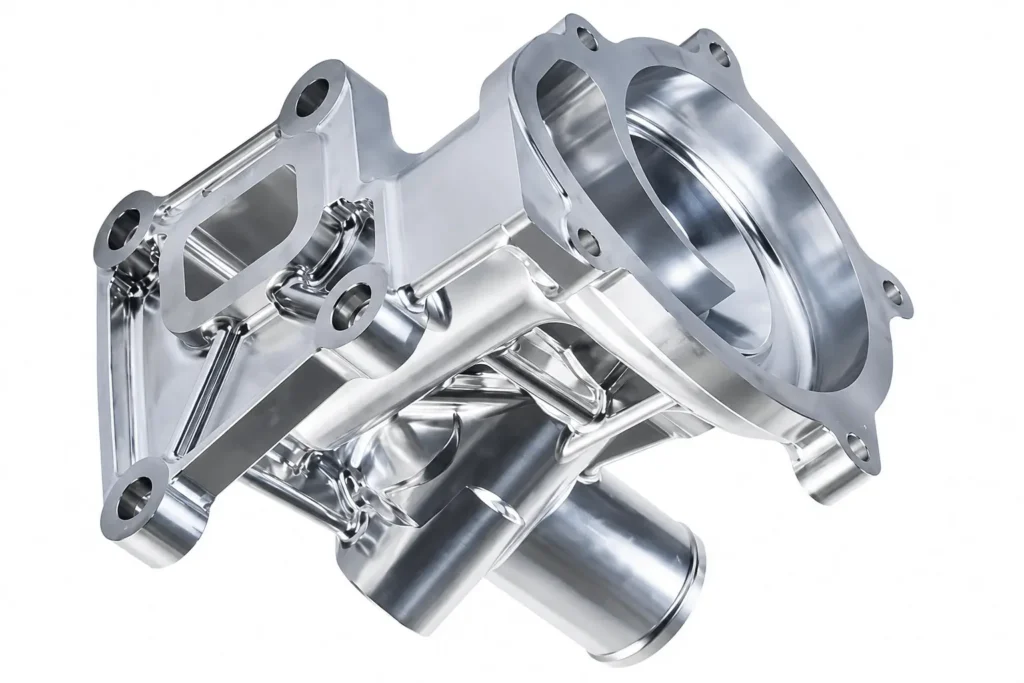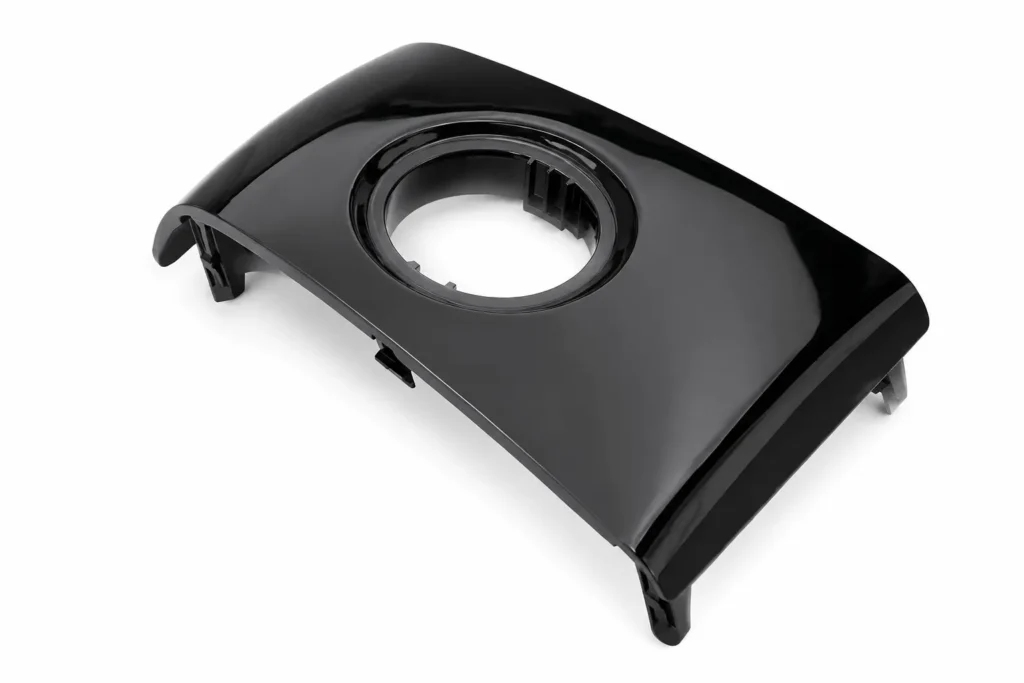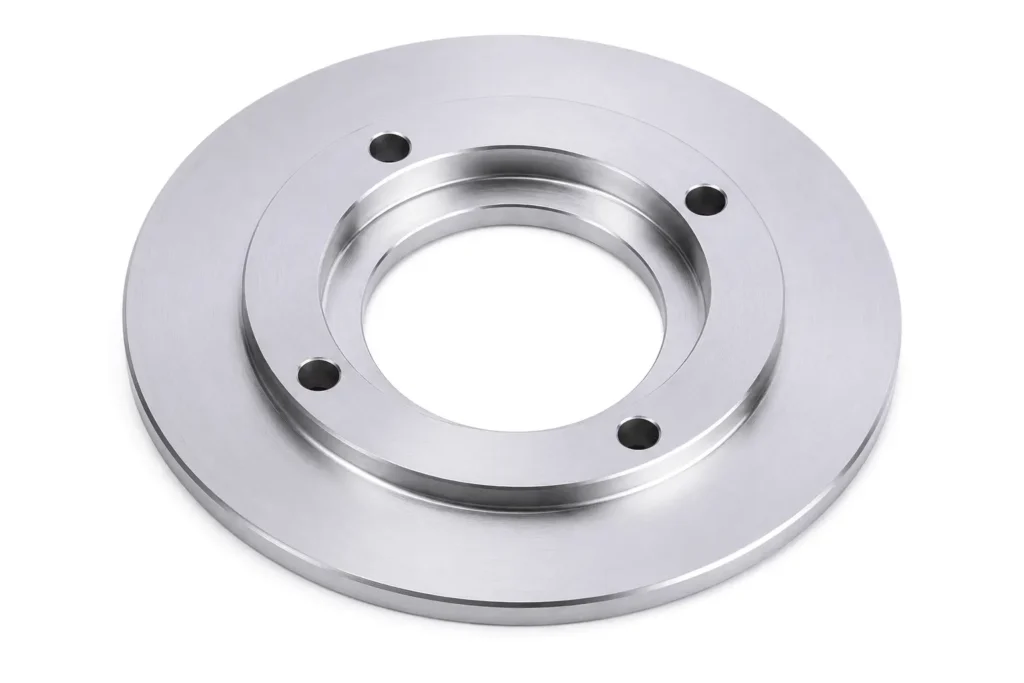
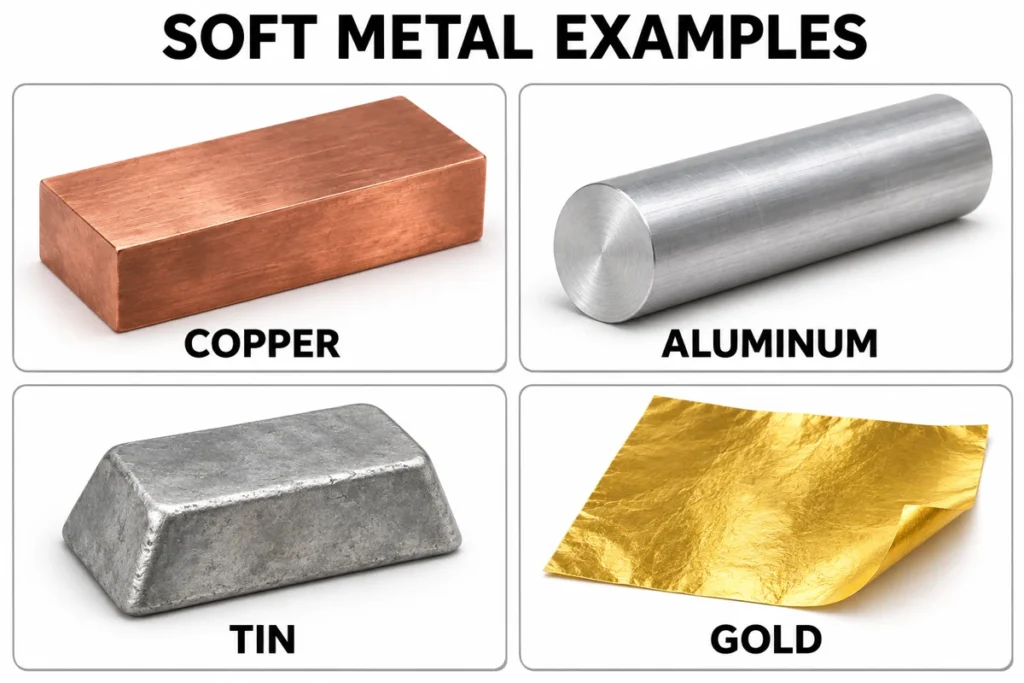
Soft metals have relatively low hardness, making them easier to scratch, indent, or permanently deform. Common examples include cesium, lead, tin, gold, silver, pure aluminum, and pure copper. When choosing a soft metal, you need to consider its grade and condition alongside your part’s performance, machining, and service requirements. This guide explains their properties, applications, and the factors you should consider before selecting a material.
What Is the Softest Metal?
Cesium is generally considered the softest solid metal at around 20–25°C. It is an alkali metal with the symbol Cs and is commonly listed with an approximate Mohs hardness of 0.2. Its melting point is only about 28.5°C (83.3°F), so it can become liquid in a warm room.
Cesium’s extreme softness is associated with its relatively weak metallic bonding, which allows it to deform easily. However, you would not choose it for conventional CNC parts: it reacts violently with water and rapidly with air. Its uses are mainly scientific and specialized, rather than structural.
How Is Soft Metal Hardness Measured?
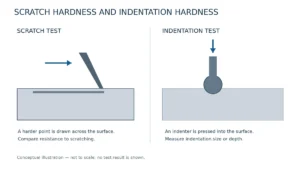
You can assess metal hardness through scratch or indentation tests. The appropriate method depends on your material, sample thickness, and inspection requirements.
Mohs Hardness
The Mohs scale compares resistance to scratching. A material with a higher rating can scratch one with a lower rating. Its ten reference minerals range from talc at 1 to diamond at 10, although very soft metals can have values below 1.
Mohs hardness is useful for general comparisons, but it is rarely used to specify hardness for CNC parts.
Brinell Hardness
The Brinell test presses a tungsten carbide ball into the surface under a specified load, then measures the indentation diameter. Results are reported as HBW.
Its relatively large indentation helps assess bulk hardness, including materials with coarse or uneven microstructures. Your sample must be thick enough to support the test.
Rockwell Hardness
The Rockwell test measures the permanent increase in indentation depth under a defined loading sequence. It provides a quick reading without optical measurement, making it useful for routine production checks.
For soft metals, you need a suitable ball-indenter scale. Values must include the scale designation, such as HRB or HRF, because different Rockwell scales are not interchangeable.
Vickers Hardness
The Vickers test uses a diamond pyramid indenter and calculates hardness from the indentation’s diagonal lengths. Results are reported as HV with the test load.
With an appropriate load, you can test small areas, thin sections, and individual features. Accurate results require a well-prepared surface and an indentation large enough to measure reliably.
For a simple comparison of which metals are softer, you can use Mohs hardness. For CNC material inspection or heat-treatment checks, Brinell, Rockwell, and Vickers tests are more useful. Brinell suits bulk samples, Rockwell provides quick production checks, and Vickers allows measurements on small areas using an appropriate load.
Soft Metals List: 10 Examples and Their Mohs Hardness
Some of the softest metals are highly reactive alkali metals, while others are familiar manufacturing materials such as tin, gold, silver, aluminum, and copper. The table below compares ten elemental metals by approximate Mohs hardness. Engineering alloys can behave differently.
| Metal | Approximate Mohs hardness | Key characteristic |
| Cesium (Cs) | 0.2 | Extremely soft alkali metal; not a conventional CNC material |
| Sodium (Na) | 0.5 | Very soft alkali metal; not a conventional CNC material |
| Indium (In) | 1.2 | Readily deforms under contact pressure |
| Lead (Pb) | 1.5 | Dense and easily deformed |
| Tin (Sn) | 1.5 | Soft metal commonly used in plating and solder alloys |
| Gold (Au) | 2.5 | Highly malleable; alloys are often used for greater durability |
| Silver (Ag) | 2.5 | Soft precious metal with high electrical conductivity |
| Zinc (Zn) | 2.5 | Relatively low scratch hardness does not guarantee room-temperature ductility |
| Aluminum (Al) | 2.75 | Pure metal is relatively soft; alloy and temper change its behavior |
| Copper (Cu) | 3.0 | Relatively soft conductor; cold working increases hardness |
Source: WebElements. Approximate values for elemental metals, not their alloys. Cesium is solid below about 28.5°C. Data: Caesium, Sodium, Indium, Lead, Tin, Gold, Silver, Zinc, Aluminium, Copper
For your CNC parts, focus on the practical materials in this list. Tin is commonly used in coatings and solder alloys, while aluminum and copper are more familiar choices for machined components. The next sections explain how their properties affect applications and machining.
Soft Metals vs. Hard Metals
Soft metals are more easily scratched, dented, or permanently deformed than harder metals. However, hardness alone does not tell you a material’s strength, melting point, conductivity, or cost. Here, “hard metals” refers to harder metallic materials, such as hardened steels, rather than cemented carbides.
| Property | Softer examples such as annealed copper and pure aluminum | Harder example such as hardened steel |
| Surface damage | More readily scratched or indented during handling | Better resistance to indentation and scratching |
| Forming | Annealed copper and pure aluminum can be bent or drawn | Forming after hardening is restricted; shape before hardening where practical |
| Wear | Contact surfaces may deform or wear; inserts or surface treatment may be needed | Often chosen for dies, wear pads, and other abrasive contact surfaces |
| Machining | Adhesion, burrs, and clamping distortion can limit quality | Higher tool wear and cutting loads can limit productivity |
| Typical use | Copper busbars, aluminum housings, and copper sealing washers | Tooling and wear-resistant components |
Melting point, conductivity, and purchase price are separate selection factors. Tin melts at about 232°C, while copper melts at about 1,085°C, although both are relatively soft. Copper is selected for conductivity, while hardened steel is often selected for wear resistance. The softest metal is not necessarily the weakest metal: scratch hardness and load-bearing strength describe different properties.
Melting-point sources: Royal Society of Chemistry — Tin and Copper
Main Applications of Soft Metals
Electrical Conductors and Heat Sinks
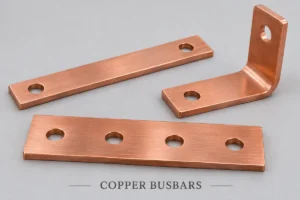
Copper is commonly used in wires, terminals, and busbars because it conducts electricity well. Aluminum is used in power conductors and heat sinks where low weight also matters. You choose these metals mainly for their conductivity; softer material conditions can make bending and forming easier.
Gaskets and Sealing Washers
Annealed copper and soft aluminum are used in metal gaskets and crush washers. When compressed between mating surfaces, they deform to accommodate small surface irregularities and help prevent leaks. Here, softness directly supports the sealing function, although you still need a material suited to the pressure, temperature, and fluid.
Solder and Metal Plating
Tin-based alloys are used to join electronic components because they melt at relatively low temperatures and wet properly prepared surfaces. Tin plating provides a solderable surface, while silver plating is used on electrical contacts for its conductivity. These applications depend mainly on melting behavior and surface properties, rather than softness alone.
Foil, Jewelry, and Decorative Parts
Aluminum can be rolled into thin foil for packaging. Gold and silver can be formed into jewelry and detailed decorative parts because of their ductility and malleability. Pure gold is a soft metal, so jewelry alloys are often chosen when you need greater resistance to scratching and deformation.
Common Problems When Machining Soft Metals
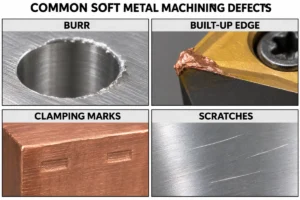
Low hardness does not guarantee easy machining. Depending on the alloy and condition, your material may deform or adhere to the cutting edge instead of forming clean chips.
Burr Formation
Material can bend or smear at an edge instead of separating cleanly, leaving burrs around holes, slots, and tool exit points. These burrs can interfere with assembly, affect seating surfaces, and create sharp edges.
You can reduce burrs by using sharp tools, supporting exit edges where practical, and adjusting the cutting path and feed near vulnerable features. Specify controlled deburring for critical edges: excessive edge rounding can change dimensions or damage sealing surfaces.
Built-Up Edge and Tool Adhesion
Workpiece material can adhere to the cutting edge and accumulate into a built-up edge. This changes the tool’s effective geometry and can cause torn surfaces, inconsistent dimensions, and unstable cutting forces.
Use a sharp cutting edge and tool geometry suited to your alloy. Appropriate lubrication, effective chip evacuation, and adjusted cutting speed can reduce adhesion. Check the cutting edge when surface quality deteriorates; increasing feed or replacing a tool without identifying the cause may leave the problem unresolved. For aluminum parts, review feeds and speeds for aluminum CNC machining as a starting point for your cutting setup.
Clamping Deformation
Clamping pressure can distort thin walls, tubes, or delicate features. Your part may measure correctly while clamped, then spring out of tolerance when released.
Spread the clamping load with suitable soft jaws, fixtures, or additional support, and use only the force needed to hold the part securely. For flexible parts, separate roughing and finishing where appropriate, and verify critical dimensions after releasing the fixture.
Illustrative Check for a Thin-Walled Housing
Suppose your drawing specifies an outside width of 40.00 ±0.05 mm. The housing measures 40.02 mm in the vise but 40.08 mm after release. The clamped reading passes; the released part exceeds the 40.05 mm upper limit by 0.03 mm. These assumed readings illustrate a fixture-sensitive dimension, not a YD Rapid production result.
To investigate, check at the same locations and temperature using a suitable low-force measurement method. Inspect the jaws and supports, then trial a broader contact area or lower clamping force while maintaining secure workholding. Repeat the released measurement. Record the material condition, fixture changes, and both readings so you can distinguish clamping effects from measurement variation or residual stress.
Scratches and Surface Damage
Trapped chips, contaminated jaws, and rough handling can scratch or dent soft surfaces. Damage on a cosmetic face may cause rejection, while marks on a sealing or mating surface can affect function.
Keep fixtures and contact surfaces clean, remove chips without dragging them across the part, and protect finished faces during handling. Identify cosmetic and functional surfaces on your drawing so the machining, deburring, and packing steps account for them.
Which Surface Finishes Are Suitable for Soft Metal Parts?
Your options depend on the base metal and whether you need corrosion protection, wear resistance, electrical contact, or a specific appearance.
| Base material | Finishes to consider | What you need to check |
| Aluminum and its alloys | Anodizing, chemical conversion coating, powder coating | Alloy compatibility, coating thickness, appearance, and masking of threads or mating surfaces |
| Copper and its alloys | Tin, nickel, or silver plating; anti-tarnish treatments; polishing | Electrical contact requirements, coating adhesion, and exposure conditions |
| Gold and silver | Polishing, texturing, or application-specific plating | Material removal, dimensional changes, and whether the finish provides sufficient durability |
| Tin, lead, and other very soft metals | Specialist plating or protective coatings where compatible | Substrate deformation, pretreatment chemistry, and processing temperature |
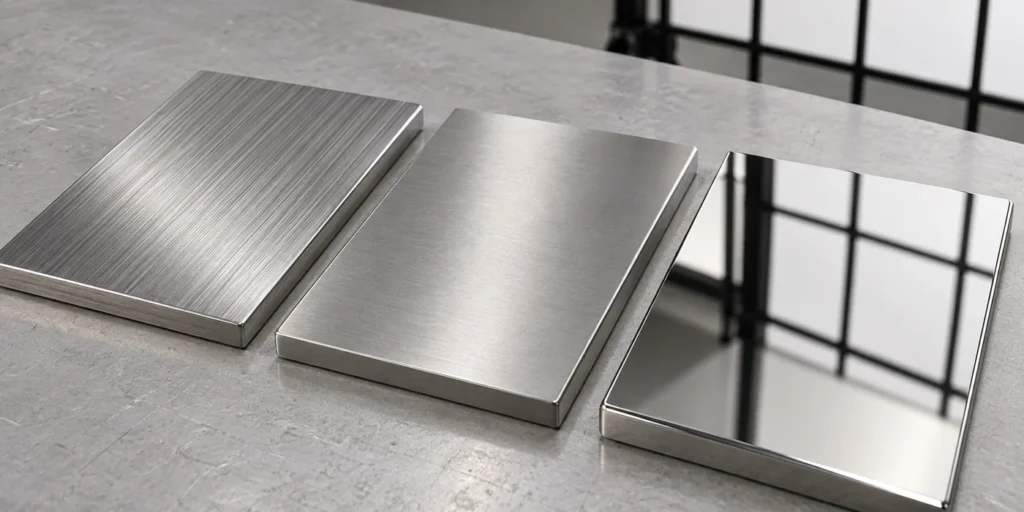
Anodizing can give aluminum a harder surface, but it does not increase the strength of the underlying material. Polishing improves appearance and surface texture, while removing material; it does not provide a protective barrier by itself. You can compare aluminum surface finishing options before selecting a process.
The Aluminum Anodizers Council explains how anodizing forms an oxide finish integrated with the aluminum substrate.
Before you specify a finish, identify critical dimensions, electrical contact areas, and surfaces that require masking. Coating buildup can affect fits and threads, while aggressive blasting or polishing can distort thin features or round sharp edges.
FAQs
Are Soft Metals Magnetic?
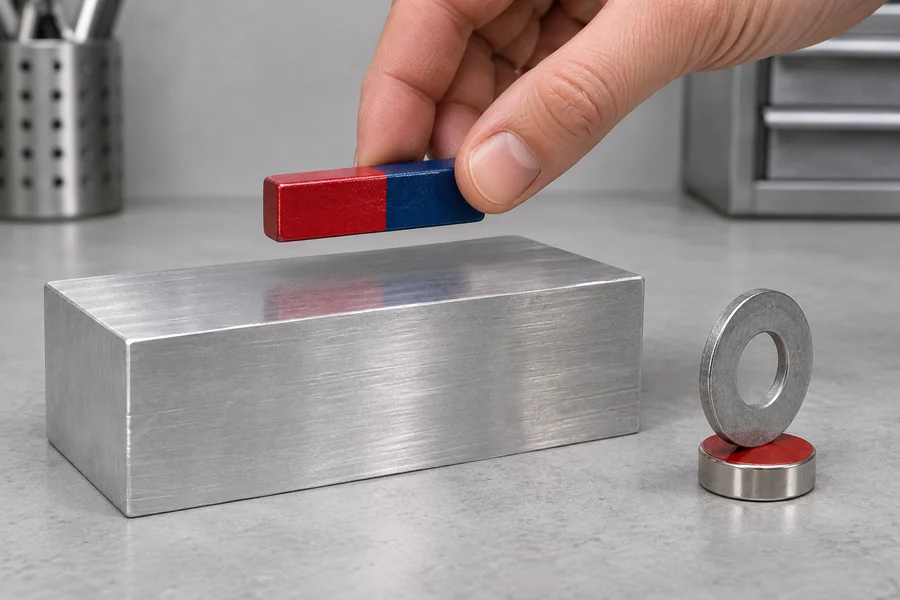
Softness does not determine magnetism. Common soft metals such as copper, aluminum, gold, and silver are not strongly attracted to an ordinary magnet. You cannot use a magnet alone to confirm a metal’s identity or hardness.
Do Soft Metals Rust?
Rust specifically refers to corrosion products of iron. Copper, aluminum, and other nonferrous soft metals do not rust, but they can oxidize or corrode. Their behavior depends on the material and its environment.
Can Soft Metals Be Recycled?
Many soft metals, including aluminum, copper, tin, silver, and gold, can be recycled. If you collect machining scrap, separate it by alloy and keep it free of mixed materials where possible. Contamination can reduce its value and complicate recycling.
Can Soft Metals Deform Under a Constant Load?
Yes. Some soft metals can gradually deform under sustained stress, a process called creep. Its significance depends on the material, temperature, load, and time. You should account for this when a component must maintain its shape or contact pressure over long periods.
Can You Identify a Soft Metal by Its Color?
Color can offer a clue, but it cannot reliably identify a metal or alloy. Oxidation, plating, and surface treatments can disguise the base material. For your CNC parts, use traceable material documentation and appropriate testing when verification is required.
Conclusion
When choosing soft metals, check the specific grade and condition against your part’s function, machining requirements, and surface finish. Low hardness alone does not guarantee easy machining or reliable performance.
For YD Rapid CNC machining services, send us your drawings, material specifications, quantity, critical tolerances, and required finish so we can review your part’s manufacturing requirements.