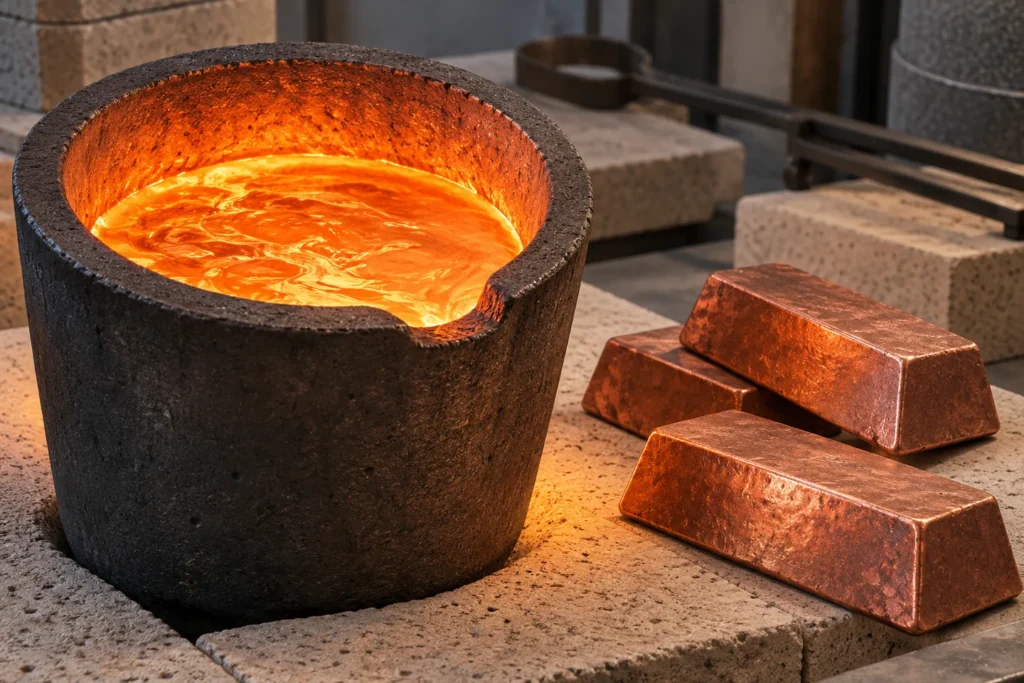
Copper melts at 1,084.62°C (1,984.32°F), usually rounded to 1,085°C. Commercial copper grades can have slightly different melting behavior depending on their composition. If you’re selecting copper for a part, understanding its melting temperature helps you plan casting and joining processes while distinguishing melting from softening and operating-temperature limits.
What Is the Melting Point of Copper?
The melting temperature of copper (Cu) is sharply defined for the pure element at standard atmospheric pressure. Commercial copper grades contain controlled residual elements or small additions that can affect their melting behavior.
Pure Copper Melting Point in Celsius, Fahrenheit, and Kelvin
The melting point of copper in Celsius is 1,084.62°C, equivalent to 1,984.32°F or 1,357.77 K. The same equilibrium temperature is the freezing point of copper, used as a reference in the International Temperature Scale of 1990 (ITS-90).
| Temperature Unit | Reference Value | Rounded Value |
| Celsius (°C) | 1,084.62°C | 1,085°C |
| Fahrenheit (°F) | 1,984.32°F | 1,984°F |
| Kelvin (K) | 1,357.77 K | 1,358 K |
Melting Temperatures of Commercial Copper Grades
C10100 oxygen-free electronic copper and C11000 electrolytic tough-pitch copper are commercial high-copper materials. C14500 is tellurium-bearing copper, a low-alloy copper grade rather than pure copper. These grades should be distinguished from brass and bronze, which are separate copper-alloy families.
| Grade | Material | Solidus — Melting Begins | Liquidus — Fully Liquid |
| C10100 | Oxygen-free electronic copper | ≈1,083°C / 1,981°F | ≈1,083°C / 1,981°F |
| C11000 | Electrolytic tough-pitch copper | ≈1,065°C / 1,949°F | ≈1,083°C / 1,981°F |
| C14500 | Tellurium copper | ≈1,051°C / 1,924°F | ≈1,080°C / 1,976°F |
These commercial-grade values follow a single alloy database. Celsius values are converted from its published Fahrenheit values and rounded to the nearest degree.
Commercial-grade data and the high-purity reference are different datasets; their small differences should not be interpreted as a precise purity test. For production, confirm the applicable melting range with your material supplier.
Copper vs. Brass and Bronze
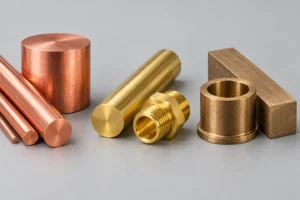
Brass and bronze are copper-based alloys, not interchangeable names for copper. Brass is principally a copper-zinc alloy; the C93200 bronze below is a leaded tin bronze. The following grades are included only for comparison, and their melting ranges do not represent pure copper.
| Grade | Material | Solidus — Melting Begins | Liquidus — Fully Liquid |
| C36000 | Free-cutting brass | ≈888°C / 1,630°F | ≈899°C / 1,650°F |
| C93200 | Leaded tin bronze | ≈854°C / 1,570°F | ≈977°C / 1,790°F |
Solidus vs. Liquidus: When Is Copper Fully Liquid?
The solidus marks the start of melting; the liquidus marks complete melting. Pure copper has a single equilibrium melting temperature. Commercial grades with distinct solidus and liquidus values contain both solid and liquid phases between those temperatures.
For example, the listed C11000 data give a solidus of approximately 1,065°C (1,949°F) and a liquidus of approximately 1,083°C (1,981°F). Reaching the solidus therefore does not mean the entire charge is liquid.
What Factors Affect Copper’s Melting Behavior?
Copper’s composition determines its melting temperature or range. Heating conditions determine how quickly it reaches that temperature and how the molten metal behaves. Understanding the difference helps you avoid treating a slow melting process as evidence of a higher melting point.
Purity and Minor Element Additions
High-purity copper has a sharply defined melting temperature. When other elements are present, they change the material’s phase behavior and can create a melting range.
The effect depends on the element and its concentration. Residual oxygen and deliberate additions such as tellurium can affect phase behavior. You cannot calculate a grade’s melting range simply by averaging the melting points of its ingredients.
Impurities can also affect melt quality. Uncontrolled contamination may change solidification behavior or introduce unwanted phases, making scrap identification and material traceability important when you remelt copper.
Pressure and Processing Atmosphere
Pressure can change copper’s melting temperature, but normal atmospheric-pressure variations have little practical effect. Vacuum processing does not dramatically lower copper’s melting point; it primarily changes the environment in which heating takes place.
The processing atmosphere matters because hot copper can react with surrounding gases. Oxygen exposure can cause oxidation, while suitable protective atmospheres help control it. Atmosphere selection must also match the copper grade: hydrogen-containing conditions can cause embrittlement in oxygen-bearing copper.
Factors That Change Melting Time Rather Than Melting Point
The melting point of copper wire is determined by composition, not wire diameter. The same applies to the melting point of copper pipe and copper tubing: changing the material’s form does not change its intrinsic melting temperature. Differences in mass, wall thickness, and heat transfer explain why these products can melt at different speeds.
| Factor | Effect on Melting Time |
| Copper mass | A larger charge requires more energy to heat and melt. |
| Shape and charge arrangement | Surface area, contact, and packing affect heat transfer. |
| Starting temperature | Preheated material requires less additional energy. |
| Furnace power and heating method | Heat delivery and coupling affect the heating rate. |
| Crucible and furnace heat losses | Energy absorbed by equipment or lost to the surroundings slows melting. |
Reaching the melting temperature does not instantly turn the entire charge into liquid. Copper must absorb additional energy—the latent heat of fusion—to complete the transition. Your furnace therefore needs to supply enough energy for both heating and melting, while compensating for heat losses.
Copper Melting Point Compared with Other Metals
Does copper have a high melting point? Compared with aluminum, zinc, and tin, yes—but it melts below pure iron and 304 stainless steel. The table distinguishes reference melting points for pure metals from the melting range of a specific steel grade.
| Metal | Material Type | Melting Temperature (°C) | Melting Temperature (°F) |
| Tin | Pure metal | 232 | 450 |
| Zinc | Pure metal | 420 | 787 |
| Aluminum | Pure metal | 660 | 1,221 |
| Silver | Pure metal | 962 | 1,763 |
| Gold | Pure metal | 1,064 | 1,948 |
| Copper | Pure metal | 1,085 | 1,984 |
| 304 stainless steel | Alloy — melting range | 1,400–1,450 | 2,552–2,642 |
| Iron | Pure metal | 1,538 | 2,800 |
Pure-metal values are rounded from reference data; Fahrenheit values are converted before rounding. The 304 stainless steel range varies with composition.
For casting, these differences help you assess furnace temperature capability and crucible suitability. Melting copper requires equipment suited to substantially higher temperatures than melting aluminum, tin, or zinc.
When comparing CNC machining materials, use pure-metal figures as a baseline. Alloys can differ substantially from their constituents; the 304 stainless steel row shows why steel needs a grade-specific melting range.
Why Does Copper’s Melting Point Matter in Manufacturing?
Casting, joining, and annealing use heat for different purposes. Each process requires its own temperature controls.
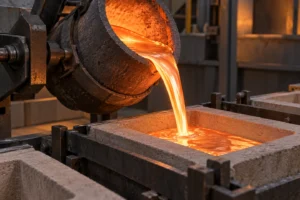
Melting and Casting
Melting point, melt-processing temperature, and pouring temperature describe different things. The melting point—or solidus-to-liquidus range—is a material property. The melt-processing temperature is the metal temperature you target during furnace processing. The pouring temperature is its temperature when you transfer it into the mold.
The temperature to melt copper is a starting reference, not a pouring specification. For casting, the metal generally needs sufficient superheat above its liquidus to remain fluid during transfer and mold filling. The amount depends on copper grade, casting method, mold temperature, and part geometry. Thin sections and long flow paths may require different conditions from thick, compact castings.
Excessive temperature is not a reliable fix for poor filling. It can increase oxidation, equipment wear, and energy use. Set the process around your copper grade and casting requirements rather than using one furnace temperature for every charge.
Welding, Brazing, and Soldering
The key difference between these joining methods is which metal melts.
In fusion welding, the copper base material melts locally to form the joint. Filler metal may also be added, depending on the process and joint design. Copper’s high thermal conductivity carries heat away from the joint, so heat input and any preheating must suit the grade and section thickness.
In brazing and soldering, the filler metal melts while the copper base material remains solid. The molten filler wets the prepared surfaces and flows into a suitably designed joint. Brazing uses filler metals with a liquidus above 450°C (842°F); soldering uses fillers at or below this temperature.
Choose your filler and heating cycle around both the joining temperature and the finished joint’s requirements. A filler that melts below copper does not automatically provide the strength, conductivity, or service-temperature capability your assembly needs.
Annealing and Elevated-Temperature Service
Copper can soften well before it melts. Annealing uses a controlled temperature and holding time to reduce the effects of cold working and restore ductility. The appropriate cycle depends on the copper grade, previous deformation, section thickness, and required final condition.
This matters when you join or heat a machined component. The part may remain completely solid while losing hardness or changing dimensions, potentially affecting its fit or performance.
Likewise, copper’s melting point does not define its allowable operating temperature. For a busbar, connector, or heat exchanger, you need to consider strength at temperature, creep, oxidation, joint performance, and surrounding materials. Specify the expected temperature, exposure time, and mechanical load rather than assuming that any temperature below melting is acceptable.
What Does Copper’s Melting Point Mean for CNC Machining?
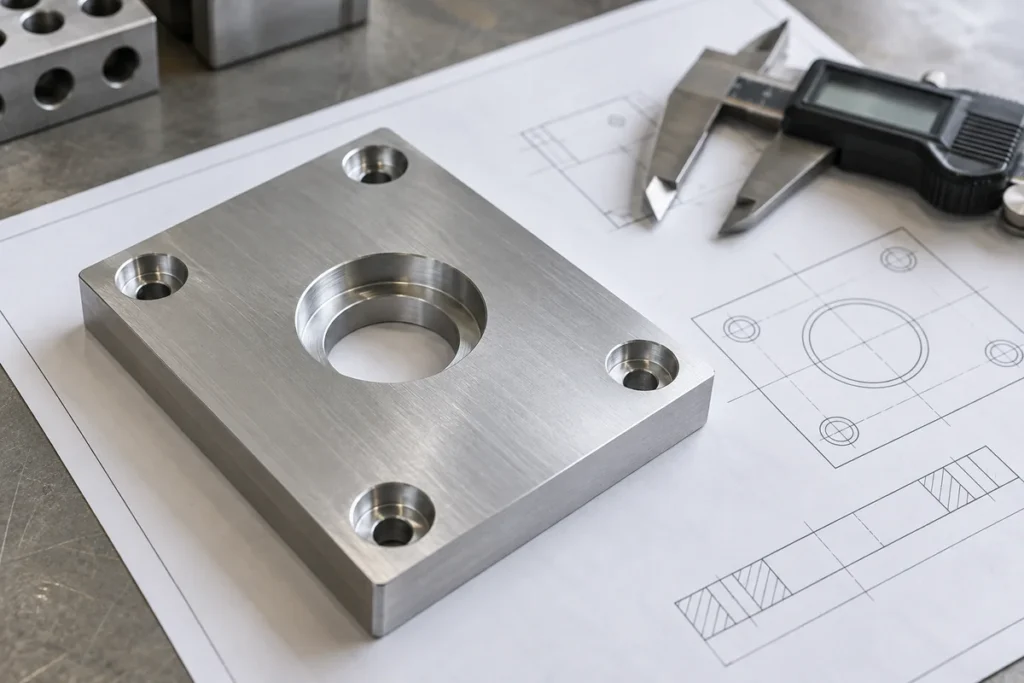
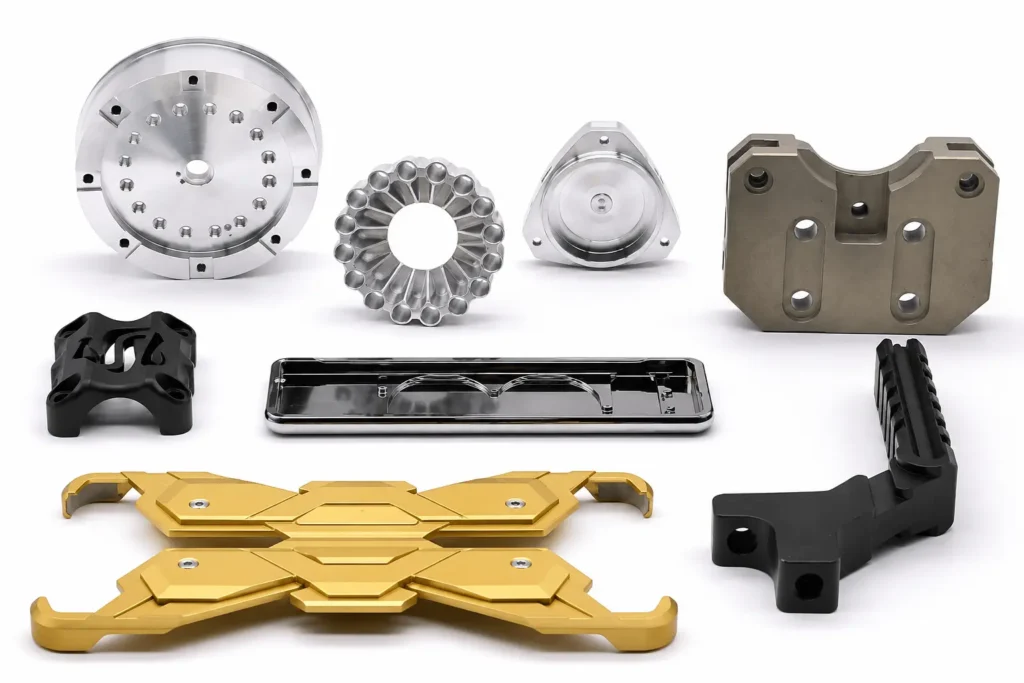
Copper’s melting point does not tell you how easily it machines. CNC milling and CNC turning remove material by cutting, so melting temperature alone cannot determine cutting speed, tool life, or achievable surface finish. You also need to consider the grade’s ductility, chip formation, and tendency to adhere to the cutting tool.
Choose your copper grade around the finished part’s requirements. High conductivity may be essential for a connector or heat-transfer component, while machinability becomes especially important for small threads, deep holes, and detailed features. A grade that cuts more easily may have different electrical or thermal properties, so check both before substituting materials.
If your part will undergo welding, brazing, or heat treatment, include those steps in your machining inquiry. Heating can affect hardness and dimensions, which may influence the manufacturing sequence and when critical features receive their final machining.
For a copper part quotation from YD Rapid, send your drawing, copper grade, quantity, critical tolerances, surface finish, and any subsequent thermal-processing requirements. Include the expected operating temperature if it affects material or joint selection.
FAQs
Can You Melt Copper in a Household Oven?
No. A household cooking oven cannot reach copper’s melting temperature and is not designed to handle molten metal. Melting copper requires suitable high-temperature equipment, a compatible crucible, and a controlled workspace.
Can You Tell Whether Copper Has Melted by Its Color?
No. Copper can glow red or orange while it is still solid. Lighting, surface oxidation, and temperature affect its appearance, so color alone cannot confirm complete melting or provide an accurate temperature reading.
How Do You Measure the Temperature of Molten Copper?
Use a temperature sensor rated for the process, such as a suitable immersion thermocouple with a compatible protective sheath. Infrared instruments require appropriate emissivity settings and a clear measurement target; reflective surfaces and oxide layers can affect their readings.
What Is the Boiling Point of Copper?
Copper boils at approximately 2,560°C (4,640°F) under standard atmospheric pressure. Melting changes solid copper into liquid, while boiling changes liquid copper into vapor. Casting requires molten copper, so reaching its boiling point is unnecessary.
Conclusion
Pure copper melts at 1,084.62°C (1,984.32°F). For commercial copper grades, use the applicable material data. When planning production, distinguish melting behavior from pouring temperature, annealing conditions, and allowable operating temperature.
Request a copper machining quote from YD Rapid with your drawing and copper grade to discuss your part’s manufacturing requirements.
Sources
[1] Fluke — What Is the ITS-90? Copper fixed-point reference temperature.
[2] Copper Development Association — C10100 Alloy Data. Oxygen-free electronic copper melting data.
[3] Copper Development Association — C11000 Alloy Data. Electrolytic tough-pitch copper solidus and liquidus.
[4] Copper Development Association — C14500 Alloy Data. Tellurium copper solidus and liquidus.
[5] Copper Development Association — C36000 Alloy Data. Free-cutting brass solidus and liquidus.
[6] Copper Development Association — C93200 Alloy Data. Leaded tin bronze solidus and liquidus.
[7] PubChem — Melting Point in the Periodic Table of Elements. Reference melting temperatures for pure metals.
[8] Thyssenkrupp Materials UK — Stainless Steel Melting Points. Melting range for grade 304 stainless steel.
[9] Royal Society of Chemistry — Copper, Periodic Table. Copper boiling-point reference.