If you manufacture components using metals, wood, and plastic, ensure that you clean them first before their use. Rust, old paint, and dirt may be present on the outer surface of the raw metal. In this case, it would be advisable not to apply paint over such dirt. This is the reason why surface preparation plays a significant role in manufacturing and metal finishing.
The selection of the right technique for blasting metal surfaces totally depends upon your specific task. Here we provide a complete guide that would help you to compare sandblasting vs shot blasting and choose the most appropriate option.
Key Takeaways
- Sand blasting is based on a simple principle: fine media is sprayed using high pressure from compressed air.
- Shot blasting is a procedure whereby centrifugal force is used to spray heavy metal beads using a rotating wheel.
- Surface finish for sand-blasted parts is smooth and matte. Surface finish for shot-blasted parts is rough with small round indentations.
- The initial cost of setup for sand blasting is cheaper, but more expensive when it comes to media.
- Shot blasting equipment is expensive initially but can be used many times over because metal beads are reusable.
What Is Sandblasting?
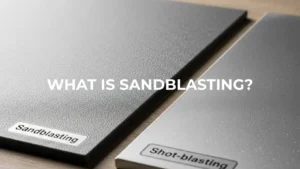
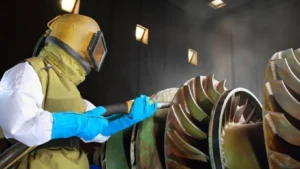
Sandblasting is a process in which sand or other abrasive media is forced through a handheld nozzle under the pressure of compressed air. The high-pressure air from a compressor enters a tank containing small grains. These grains are mixed with air, and then blasted at high velocity from a rubber hose. The media contact results from the natural scrubbing and peeling action of the media and friction.
Equipment Used in Sandblasting
The simplest system consists of an industrial air compressor, a blast pot to store the media, heavy-duty hoses, and a tungsten carbide nozzle. A sealed blast cabinet is used for small parts. The worker enters the work area inside the cabinet, and then blasts the parts safely from the glass window. In large-scale projects such as bridge restoration, the operators wear pressurized suits and have to “blast out” in public.
Common Abrasive Media
Modern operators use safer and more effective media alternatives to sand:
- Glass beads: Small round pieces of glass that will not deeply scratch a surface. They leave a beautiful satin finish.
- Aluminum oxide: A sharp, highly hard angular grit that can cut through hard rust rapidly, leaving a sharp profile for painting.
- Silicon carbide: The toughest blast media possible is silicon carbide. It removes hard metal coatings and hard metals.
- Walnut shells and corncobs: Soft natural filling materials that are used to remove paint from delicate surfaces such as thin car body panels or wood.
How Does the Sandblasting Process Work?
The real work process in a workshop should be well organized and continuously carried out. Let’s take a look at how a typical project flows through a shop:
- Surface Inspection: The part is examined by workers to determine the thickness of the material and to locate the protection necessary. They enclose fragile areas such as screw threads or polished glass with heavy tape so it will not be damaged by the blasting.
- Abrasive Delivery System: The operator loads the desired media into the blast pot. They start the air compressor to create the high pressures, typically 80-120 lbs/in. The operator opens the mixing valve to let the media drop into the fast-moving airstream
- Cleaning and Finishing Stage: The worker directs the nozzle at the part at a consistent distance of 6 to 12 inches. They are responsible for directing the blast stream from side to side over the metal. The sharp grains remove rust, dirt, and old paint in real time luring a clean, uniform matte finish underneath.
How Does The Shot Blasting Process Work?
Because of the different mechanism by which the cleaning media is moved, the shot blasting process is completely different. It can be operated mechanically, and not by high-pressure air currents.
Machine Components
The shot blasting machine consists of a heavy-duty enclosed cabinet with a high-speed wheel inside. This wheel is equipped with in-built blades. There is also a media recycling system, comprising a bucket elevator and an air separator to remove dust from the recycled metal beads, located at the bottom of the machine.
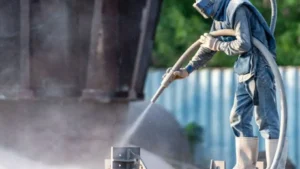
- Surface Inspection: Parts are put in the machine by the operator. Larger steel beams are moved through the blast housing by a roller conveyor. In the tumble-blast machines, workers put parts into a rubber belt that tumbles them to loosen impurities, and the resulting clean parts are collected for use in small batches.
- Blasting Operation: The heavy doors of the machine close, and the electric motor, powered by the internal wheel, begins to run. Overhead, a hopper of steel shot or steel grit falls into the center of the spinning wheel. The blades rotate quickly, trapping the metal media and spinning it outwards by centrifugal force. This forms a dense stream of high-velocity metal beads and gives them a tremendous force to act upon the parts.
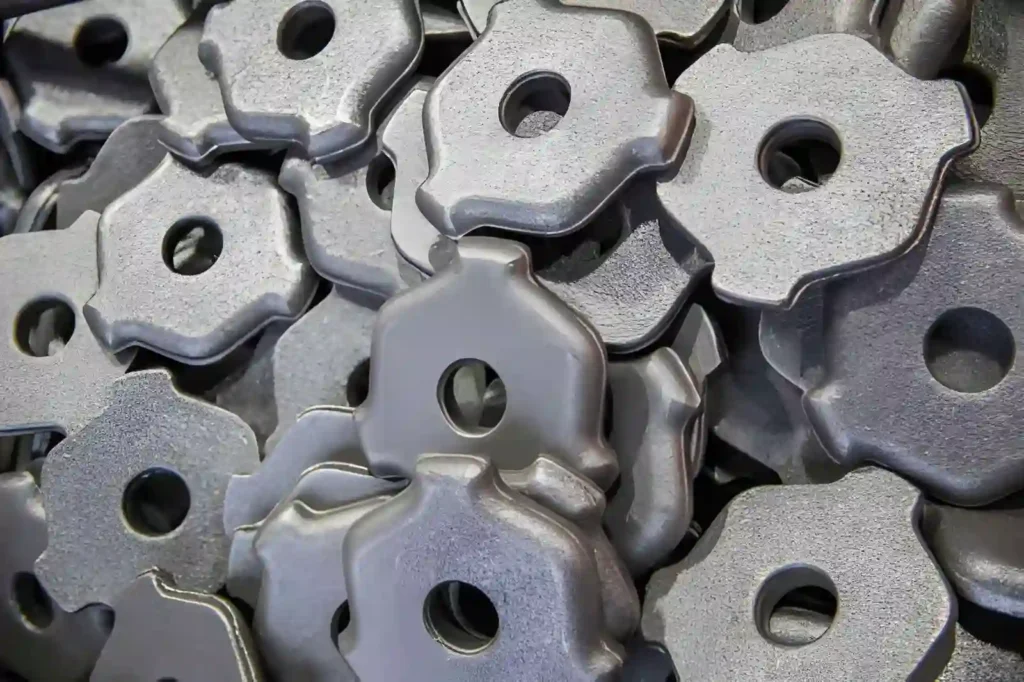
- Post-Blasting Inspection: The machine will halt the wheel and perform a short air cycle to remove excess dust. The doors are opened, and the components are checked. The metal has a fresh, shiny look with thousands of small ‘micro dents’.
What Is The Difference Between Sandblasting And Shot Blasting?
When it comes to selecting the best of the two ways, you will need to compare them carefully on a number of features.
Sandblasting and shot blasting produce different surface textures and are suited to different materials and part requirements. When comparing surface treatment options for machined parts, consider the abrasive media, impact force, required finish, material hardness, dimensional tolerance, and production cost.
Comparison Table 1: Sandblasting vs Shot Blasting Comparison
| Feature | Sandblasting | Shot Blasting |
|---|---|---|
| Abrasive Type | Fine, angular media like aluminum oxide, glass beads, or walnut shells. | Hard metal media such as round steel shot or sharp steel grit. |
| Equipment | Air compressors, blast pots, hand-held hoses, and sealed cabinets. | Large centrifugal wheel machines, tumble blasters, and conveyor lines. |
| Surface Finish | Smooth, matte, satin, or finely etched texture. | Peened, micro-dented, rough, and highly textured finish. |
| Speed | Slower; depends on human operator movement and nozzle width. | Very fast; cleans entire large surfaces or bulk parts in minutes automatically. |
| Cost | Lower initial machine cost; higher labor and media replacement costs. | High initial machine investment; very low operational and media costs over time. |
| Typical Applications | Custom car restoration, aerospace parts, thin sheet metal, and wood. | Structural steel, ship hulls, engine blocks, and large industrial castings. |
Surface Roughness
The physical shape of the media shapes the final roughness of your part. Because sandblasting uses tiny grains, it creates a shallow, tight anchor profile. It is smooth to the touch but has enough tooth for paint to stick to. Shot blasting creates a deep profile.
Texture Uniformity
A shot blasting surface finish is exceptionally uniform when processed in a machine. The spinning wheel distributes the steel beads evenly across every square inch of the part at a fixed angle and speed. A sandblasting surface finish depends on human skill. If an operator holds the nozzle too long in one spot, that area will be etched deeper than the rest of the part.
What Are The Sandblasting Advantages And Disadvantages?
The selection is crucial for product quality, adhesion of coating, and its overall durability
Advantages
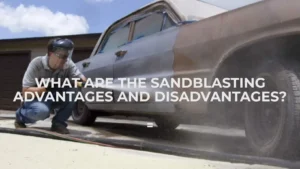
- High precision: An operator can position a small nozzle to a fine blast with precision in order to clean small corners, tight welds, or delicate patterns on a small part.
- Incredible versatility: With only the change of air pressure and media type, it is possible to blast wood, stone, and glass, plastics, or soft metals.
- Low entry cost: Small workshops can purchase a reliable blast pot and compressor system without breaking the bank.
- Portability: The machines can be quickly taken to a job site to clean stationary tanks or buildings, or heavy outdoor equipment.
Disadvantages
- Production speeds: A person has to move the nozzle over each inch of the part- time-consuming on large jobs.
- Costly labour: As it is a manual process, you’ll have to pay an experienced operator for each hour of cleaning.
- Dust generation: Brittle media emits large dust clouds, needs good ventilation and respirator masks.
- Quickly losing media: Media such as glass beads deteriorate rapidly and need to be purchased in new bags often.
What Are The Shot Blasting Advantages And Disadvantages?
If you select the wrong piece, you might bend a fragile piece of metal or not clean a heavy piece of steel.
Advantages
- Blasting speed: A machine with wheels can clean a huge steel beam or fifty iron castings in just a couple of minutes without halting.
- Fully automated operation: The worker feeds the parts onto a belt or conveyor, then closes the door, and pushes a button. No human labor needed for the work to be done.
- No harsh chemicals: The process is purely kinetic energy and does not include any harsh chemical stripping bath.
- Recyclable media: Steel shot can be cleaned and reused up to 3,000 times, which involves tremendous cost savings on media materials.
- Surface strengthening: In hammering, the shot compacts the metal surface, thus enhancing its fatigue crack resistance.
Disadvantages
- Sizable capital expenditure: The cost of industrial wheel-blast machines is high, and they must be used in high production volumes to be economical.
- High electricity demand: The main disadvantages are the high electricity demand, fast wear of internal machine parts, and the total in-container nature. A fixed bridge cannot be taken out to a field to be shot blasted.
- Breaks thin plastic parts: The tremendous impact force will break thin plastic parts, bend thin sheet metal panels, and shatter delicate parts.
- Few material options: Designed almost exclusively for robust parts, made of iron, steel, or heavy hard alloys.
How Much Does Sandblasting Cost?
The ultimate cost will depend on various operating parameters.
Comparison Table 2: Estimated Blasting Cost Factors
| Factor | Sandblasting | Shot Blasting |
|---|---|---|
| Equipment Cost | Low to Moderate ($2,000 – $15,000 for standard professional setups) | High to Very High ($30,000 – $250,000+ for automated industrial systems) |
| Labor Cost | High (Requires dedicated manual labor for every hour of operation) | Low (An operator only needs to load and unload the machine) |
| Operating Cost | High (Continuous consumption of single-use or low-use abrasive media) | Low (Steel shot is highly affordable because it is reused thousands of times) |
| Maintenance Cost | Low (Occasional replacement of worn rubber hoses and ceramic nozzles) | High (Requires regular replacement of internal steel blades and protective liners) |
Is wet blasting better than sandblasting? Wet blasting is a process that combines water and the abrasive media. The water absorbs the shock, reduces heat production, and halts dust cloud formation in the air.
Conclusion
To conclude, there is no one definitive surface treatment that is superior to the other. Many industrial processes seek sand blasting near me services that can provide them with local professionals instead of purchasing their own equipment. Knowing the basics of sand blasting vs shot blasting will help you select the right surface preparation technique to get the best-looking and highest-quality coatings for many years.

Need the Right Surface Treatment for Your Parts?
Sandblasting is commonly used to clean surfaces and create a uniform matte texture, while shot blasting is better suited to heavy cleaning, scale removal, and surface strengthening. Send us your drawings, material specifications, finish requirements, and order quantity for review. YD Rapid manufactures custom CNC parts with surface treatment options selected according to the material and application.
Frequently Asked Questions
Is soda blasting better than sandblasting?
Soda blasting is safer for delicate jobs. It uses baking soda, which is very soft. It will not warp thin metal or scratch glass. Sandblasting is better if you need to cut through thick, heavy rust on tough steel.
Can sandblasting damage metal?
Yes, it can. If the metal is thin, high air pressure and hard grit will warp or bend it. The hard grains can also leave deep scratches or cut away too much metal if you stay in one spot.
Which blasting process produces a smoother finish?
Sandblasting creates a much smoother, satin finish because it uses very fine, light grains. Shot blasting uses heavy metal balls that hit hard and leave thousands of tiny round dents, which makes the metal surface feel rougher.
Is shotblasting better than sandblasting?
Neither is better for every job. Shot blasting is best for thick steel beams because it is super fast and automatic. Sandblasting is better for thin car parts, wood, or small jobs where you need to be very careful.