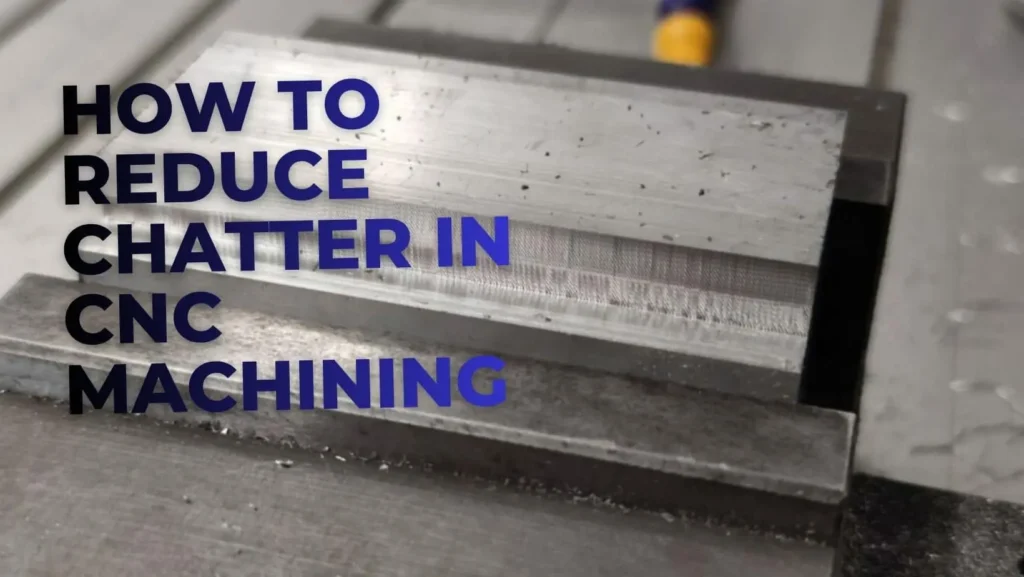
The sound of a high-pitched noise from inside a machine tool is dreadful to every machinist’s ears. If you are experiencing noise during machining, you are suffering from machining chatter. It’s one of the largest challenges in today’s manufacturing facilities.
Once your machine begins to shake, vibrate and become out of control, your whole cutting process suffers. It can be a serious problem that spoils your surface finish, breaks your high-dollar solid carbide tooling, wrecks machine spindles, and causes part rejects.
By learning how to reduce chatter in CNC machining, you can run a fast and efficient industry to produce quality metal parts. To achieve chatter-free machining, it’s necessary to examine all components of your setup. You must check your spindle speed, feed rate, tool-holding system, and raw-material support systems.
Key Takeaways
- Machining chatter decreases surface quality, destroys part accuracy, and shortens tool life.
- Old spindle bearings, loose fixtures, and your machine’s setup all contribute to higher vibration levels.
- Total tool length and your chosen spindle speed are the two major factors that control harmonic shaking.
- Thin walls and long, narrow parts are stabilized by proper workholding and smarter backing materials.
- Appropriate cutting fluid can reduce heat and absorb minute vibrations.
- Smooth, stable cutting selections boost shop productivity and provide great surface finishes.
Why Does Machining Chatter Happen in CNC Machines?
To fix this frustrating manufacturing problem, you must first ask a basic question: What is the cause of tool chatter? In the simplest terms, machining chatter is a type of self-excited mechanical vibration. It happens when the cutting tool and the metal workpiece bounce against each other at a very fast speed. It is a loop in which a minute vibration alters the thickness of the metal chip, which forces the tool to bounce even more on the following pass.
Types of Chatter in CNC Machining
There are three main types of shaking that occur inside a machine frame:
- Regenerative Chatter: This is the most common type. It happens when a tooth cuts into a surface that was left wavy by the previous tooth pass. The changing chip thickness makes the cutting force jump up and down, creating a giant vibration loop.
- Forced Vibration: This type comes from a mechanical source outside the cut itself. Examples include an unbalanced machine engine, bad gears, or a bent cooling pump fan.
- Harmonic Vibration: This happens when the natural frequency of your cutting tool matches the frequency of the spinning machine spindle. When these two numbers align, they amplify each other, causing a massive increase in shaking.
Effect of Tool Stickout
The physical length of your cutter plays a massive role in creating bad vibrations. Having excessive tool stickout causing chatter is a constant problem in deep mold cavities. As a rule of thumb, when you double the length of a tool, it becomes eight times more flexible.
- Regenerative waves form because the tool cuts over a previously uneven surface path.
- Worn spindle bearings allow the tool holder to shift under heavy lateral loads.
- Long cutting tools act like springs, bending away from the material and bouncing back.
- Weak clamping jaws let the metal block shake while the tool attempts to cut it.
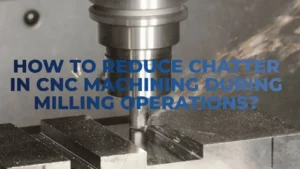
How to Reduce Chatter in CNC Machining During Milling Operations?
Milling operations are highly prone to bad shaking because the teeth of an end mill constantly enter and leave the raw material. This action creates a repetitive pulsing force. If you want to know how to reduce chatter in CNC machining during daily milling tasks, you must learn to fine-tune your cutting parameters.
Reducing vibration during CNC milling requires the right combination of spindle speed, feed rate, depth of cut, tool overhang, workholding rigidity, and toolpath strategy. Adjusting only one parameter may move the vibration to another frequency instead of eliminating it.
Correct Spindle Speed Selection
Adjusting your revolutions per minute (RPM) is often the fastest way to stop a loud harmonic scream. If your machine starts shaking, changing the spindle speed up or down by 10% to 15% can break the bad harmony. Many modern CNC controls have a special feature that changes the spindle speed up and down automatically during the cut to disrupt these harmonic waves.
Feed Rate Optimization
Your feed rate determines the thickness of the metal chip. If your feed rate is way too low, the tool teeth will rub against the metal instead of cutting cleanly. This rubbing action creates massive friction and starts a heavy vibration. Lower friction means lower cutting forces, which directly helps in maintaining chatter-free machining.
Toolpath Improvements
The way your tool travels through the metal block changes how much force hits the spindle. Climb milling is usually the preferred choice for chatter-free machining because it starts with a thick chip and tapers down to a thin chip, pulling the tool into the part and reducing rubbing. You should also lower your radial engagement (the width of the cut) and use adaptive clearing toolpaths.
Ball Endmill Stability
Using rounded tools brings a special set of issues. Dealing with ball endmill chatter is difficult because the cutting speed drops to zero at the absolute tip of the tool. If you plunge a ball end mill straight down into a flat cavity, the center tip rubs and creates a heavy chatter cycle. To keep things stable, you must tilt the tool axis or use an angled entry path to ensure the sharp outer flutes do the heavy cutting.
The table below breaks down common milling issues, their underlying causes, and the best ways to fix them:
Problem | Possible Cause | Recommended Fix |
|---|---|---|
| Loud high-pitched scream | Harmonic frequency match | Change spindle RPM up or down by 10% to 15% |
| Heavy tool deflection | Excessive tool stickout | Push the tool deeper into the collet holder |
| Severe rubbing noise | The feed rate is set too low | Increase the feed rate to create a thicker chip |
| Corner-cutting chatter | Too much tool engagement | Use arc corners or adaptive clearing paths |
| Deep floor gouging | Zero tip speed on the ball mill | Angle the tool entry or tilt the cutting path |
Why Is Tool Stickout Causing Chatter in Deep Cutting Operations?
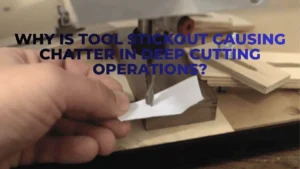
Deep cavity milling forces machinists to use long cutters to reach the bottom of pockets. This is exactly where tool stickout causing chatter becomes a daily nightmare. Without enough structural stiffness, even the most expensive CNC machine will struggle to make an accurate cut. Understanding the basic physics of tool bending will help you configure your tool assemblies correctly.
Shorter Tool Length Benefits
The single best defense against machining chatter is keeping your tools as short as possible. You should always pull the tool shank deep inside the holder until the flutes are just barely clear of the raw workpiece’s top surface. A short tool keeps its structural rigidity under heavy loads. It passes through tough metals without flexing out of alignment, which ensures your parts stay perfectly flat and within tight design tolerances.
Holder and Collet Selection
The type of tool holder you select directly affects your total system stiffness. Cheap, worn-out ER collet systems often suffer from high radial runout, which makes one flute cut deeper than the others and causes a rapid vibration loop. Upgrading to high-rigidity tool holding systems makes a massive difference:
Hydraulic Holders: These use an internal fluid pocket to clamp the tool evenly. The internal oil acts as a natural shock absorber that dampens micro-vibrations during heavy cuts.
Shrink-Fit Holders: These holders use an induction heating machine to expand the bore hole. Once cooled, the metal ring grips the tool shank with immense force, offering near-zero runout and maximum structural stiffness.
Cutting Depth Adjustments
If you are forced to use a long tool to reach a deep floor, you must adjust your cutting depths to stay safe. Taking a deep axial cut with a long tool will instantly cause a failure. Instead, you should decrease your axial depth of cut and take multiple shallow steps down. By reducing the surface area where the tool touches the metal, you lower the total bending force and keep the long tool stable.
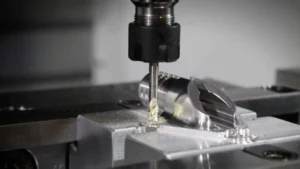
How to Stop Chatter on Thin Wall Parts?
Making thin walls is a big problem for machine shops. When you try to cut a thin rib, the metal wall shakes like a tuning fork. If you want to learn how to stop chatter on thin wall parts, you must support the weak metal during the whole cut. Also, using the right coolant for chatter reduction is a great trick that many people forget to use.
Proper Workholding Methods
Regular vise jaws cannot hold a thin, bendy plate steady. To get cuts with no chatter on weak parts, you must use better tools to hold them. Special vacuum tools hold thin sheets totally flat against a strong base plate by using air pressure.
Step-by-Step Material Removal
The way you cut away metal changes how strong the part stays. If you cut out the whole inside of a pocket first, you leave a tall, weak wall that shakes a lot on the last cut. The best way to machine thin walls without chatter is to keep more bulk material for support.
Thin Wall Toolpath Strategy
The force on a thin part is altered by the trajectory of the tool during cutting. Always make a small cut across the sides and a deep cut across the top of bendy walls. This trick is used to apply the heavy cutting forces downward on the solid machine table rather than sideways on the weak metal wall.
Super Glue Fixturing Methods
If you are using very thin sheets and don’t have a vacuum table, consider chatter reduction using super glue fixturing. You should place a thin layer of super glue between your raw metal plate and a flat base plate. The dry glue gives a tight bond where each individual piece of the thin sheet stays safe and still.
The following table lists specific thin-wall issues and their solutions:
Thin Wall Problem | Recommended Support Method | Result |
|---|---|---|
| Wall flexing sideways | Custom aluminum soft jaws | Holds the part profile securely and stops bending |
| High-frequency ring noise | Reducing chatter with super glue fixturing | Eliminates gaps and dampens ultrasonic sound |
| Floor lifting up | Multi-channel vacuum grid table | Holds thin sheets flat with continuous pressure |
| Top edge curling | Multi-stage height roughing paths | Keeps the bulk base metal strong until the final pass |
| Corner blowout | Constant-engagement corner loops | Prevents sudden load spikes on fragile wall edges |
Conclusion
Mastering how to reduce chatter in CNC machining is a basic skill for any manufacturer who wants to improve its production quality and save money. You have to take into account the overall stiffness of your machine base, the choice of high-quality tool holders, the speed and feed optimization of your cutting tools, and the use of rigid workholding fixtures.
Through careful attention to excess tool stickout, selection of a sharp tool geometry, and the use of high-pressure coolant, you can eliminate chatter-free, noisy, and unpredictable cuts.

Having Chatter Problems With Your CNC Parts?
Chatter can affect surface finish, dimensional accuracy, tool life, and production time. Send us your drawings, material, tolerance requirements, critical surfaces, and expected quantity. Our team can review the part geometry, tool access, and workholding requirements before production. YD Rapid manufactures custom CNC parts for prototypes and low-volume production.
Frequently Asked Questions
How to fix chatter in aluminum machining?
Use sharp tools with polished grooves so sticky metal does not clog them. Spin the tool very fast but take thin, quick cuts. This carries heat away in the flying chips and keeps it quiet.
How do you remove chatter marks after machining?
Sand the metal smooth by hand with fine paper if the waves are shallow. For a perfect fix, run a light final cut with a brand-new, short tool at a fast speed to shave away the bumps.
How to reduce CNC noise and machine vibration?
Keep your machine flat on level feet with rubber pads beneath them. Clean out the spindle daily, use balanced tool holders, and tighten your clamps so nothing shakes or makes a loud scream.
What causes chatter in turning operations?
Long, skinny metal bars bend away from the tool lathe insert and snap back fast. Using dull inserts with large, rounded tips or long, unground boring bars also makes the whole machine shake out of control.