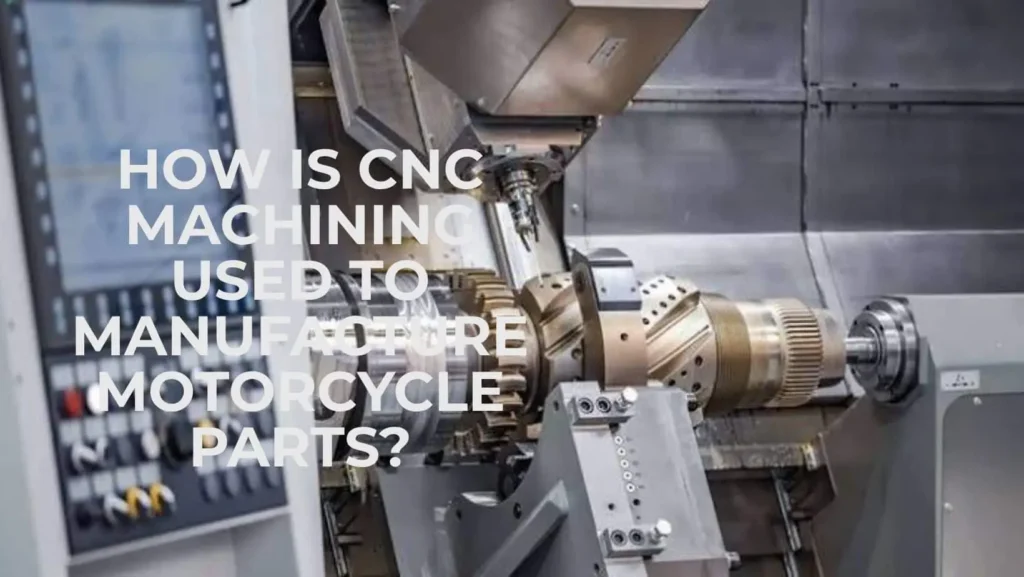
With CNC Robotics, the operation has become automated, whereby one just needs to press a button until the operation is completed. In diverse industries, robots are being used along with CNC machines at this time.
This kind of technology is utilized everywhere in different branches of industry, such as the manufacturing of components of cars and medical equipment. CNC Robotics‘ main purpose is to boost the production capacity, speed, and accuracy of factories.
Key Takeaways
- The word “CNC robotics” refers to the application of robots in the CNC business.
- The technology has been mainly applied to the automotive industry, aerospace industry, and electronics industry.
- These involve loading, navigating around sharp corners, and examining items.
- Automation is important in today’s world. No business can stand out in the international arena without automation.
What Is CNC Robotics and Why Is It Important?
Let’s first understand by getting to know the technology that is connecting two fields: traditional machining and CNC robotics. Thanks to the advent of robotics in manufacturing, plant owners are able to operate their manufacturing works day and night.
CNC Robotics
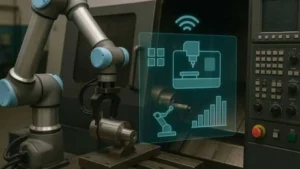
It is a technology that utilises a robotic arm along with a machine tool that is typically controlled by a computer. These are all performed with great accuracy by the machine, and the robot is used for part movements, flipping, and cleaning.
How Do Automated CNC Machines and Robotics Work Together?
Automation, CNC machines, and robotics are all about speedy networks, intelligent software, and simple physical arrangements.
Machine Communication
Industrial cables are used to exchange data between the robot and the machine. After cutting a part, the machine will issue a digital message: “I am done. The robot hears it, opens the machine door, and picks up the completed item.
Robotic Integration
Place the robot in the correct physical location. It can be set to the floor, hung from the ceiling, or installed on a rail system that can move it between three or four cutting stations simultaneously.
Production Workflow
The automated workflow is a very rigid and repeatable process with no room for error:
- The robot picks up a piece of metal from a storage tray.
- The machine door opens automatically with the help of air pressure.
- The robot deposits the raw part in the clamping vice of the machine.
- The part is gripped by the vice, which is able to pull back without harm.
- The machine cuts the part as the door closes.
- The door opens, the robot picks up the finished part, and the debris of unused chips is removed.
Common Automation Components
A few essential tools are essential to the automated system to do its job properly. These include pneumatic grippers (hands which use air pressure), safety light curtains (invisible beams which stop the robot if a human walks near), and PLC controllers (the brain which commands the robot).
What Are the Most Common CNC Robot Applications?
In today’s production floors, there are numerous unique CNC robot applications. Today, robots don’t just load steel blocks; they perform extremely complicated operations in numerous applications.
Machine Loading and Unloading
This is the number one task for robots. Humans get bored and are not very strong when they are required to move heavy, oily metal pieces into a confined machine enclosure. Robots do it without a single complaint every few minutes.
Material Handling
Raw materials are delivered to the robots, who deliver the material to the storage shelves, which are then delivered to the machines. They are capable of using basic physical guides and smart vacuum cups to sort parts by size, weight, or shape.
Assembly Operations
After cutting, robots can insert pins, fasten bolts, or connect plastic parts together. This transforms raw machined pieces into finished products for sale in the store.
Packaging and Stacking
Heavy boxes are loaded by robots onto wooden pallets at the end of the line. They pack them in impeccable formations to prevent them from getting damaged in transit on big trucks.
Welding and Cutting Support
A robot can secure a part in a fixed position to which a second machine can weld a seam, or the robot can mount a plasma torch onto itself and move it over a thick steel plate to cut a seam according to a pre-programmed line.
Table 1: Common CNC Robot Applications Across Industries
| Application | Robot Function | Industry | Main Benefit |
|---|---|---|---|
| Part Tending | Loads raw blanks, removes hot parts | Automotive | Eliminates human strain and keeps the spindle running |
| Degating | Trims excess plastic from molded parts | Medical Devices | Creates smooth edges without manual sanding |
| Sorting | Separates good parts from scrap pieces | Electronics | Stops bad parts from reaching the final assembly lines |
| Palletizing | Stacks heavy metal blocks onto shipping trays | Heavy Machinery | Prevents back injuries among warehouse staff |
How Do CNC Robots Improve Manufacturing?
Efficiency is the elimination of wasted time, waste material, and waste movement.
- Fewer stoppages: Robots don’t go for lunch or change shifts.
- Optimal Spindle Time: The cutting tool has more minutes of contact with metal per hour.
- Fewer Damaged Parts: Accurate positioning reduces waste in the form of defective parts.
- Compact robot arms: This saves space compared to human paths.
Faster Production
A human may start to slow down at 4:00 PM after a long day of lifting, but a robot works at the same speed as it does after just one minute.
Higher Accuracy
A robotic arm is capable of putting a part in the same position within a fraction of a millimeter. This guarantees that the cutting tools punch the target spot accurately and minimizes the variation among parts.
Reduced Human Error
Humans get distracted, forget to drop parts, or forget to tighten the vice completely. A robot reads the code line by line, and errors made due to lack of concentration are gone.
Improved Workplace Safety
Machining comes with sharp metal chips, flying sparks, and heavy lifting. People will be less injured if the first cutting area is removed, insurance bills will be reduced, and the employees will be much happier.
Why Are Robotic Machine Tending Benefits Important?
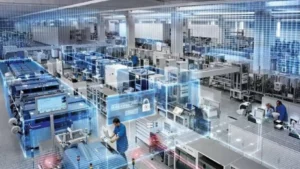
Managers can better appreciate the principal advantages of robotic machine tending and validate the high investment cost of purchasing these types of robots. This alters the way a business makes a profit. So let’s dissect the specific steps of robot loading CNC machines to understand how it can save valuable seconds on every cycle.
Continuous Operation
This is sometimes referred to as “lights-out manufacturing,” as a shop can operate around the clock without anyone being present in the facility. At 5:00 PM, the owner walks out and, the next morning, returns to discover hundreds of “perfect parts” in the bin.
Labor Cost Reduction
Robots are not taking the place of all workers, but they can be operated by just one worker, whereas they can handle four or five machines. The human is no longer a manual mover but rather becomes a supervisor.
Consistent Product Quality
Each individual piece is identical to the others. This uniformity helps to easily pass stringent quality exams set by top-tier clients.
Flexible Production
Modern robots are able to switch jobs easily. When the shop changes from car parts to bicycle pedals, all the operator has to do is load a new program and swap out the gripper fingers.
Better Equipment Utilization
Capital equipment loses value annually regardless of whether it is in use or not. The machines operate 24 hours a day in order for the business to realize its return on investment before the machine becomes obsolete.
What are the Advanced CNC Robotics Technologies?
Automation is an ever-evolving field. Nowadays, systems are able to think, see, and adapt with state-of-the-art tools.
Robotic Deburring
Metals will have sharp edges that are referred to as burrs after cutting. This is achieved through robotic deburring and CNC machining. The robot makes contact with the metal and holds it against a spinning wire brush or small router. This takes just a few seconds.
Vision Inspection Systems
The latest cameras are fitted in the robots. Robotic quality inspection for CNC is a quality control inspection process carried out by a robot on a CNC machine by inspecting the final product based on the dimensions of the product and the number of visual scratches. The product is sorted in the reject bin in case of a product fault.
AI-Based Process Monitoring
AI has the capability of hearing the sound produced by the cutting machine. This alerts the robot to stop loading the parts in case of a poor cut and also warns the machine in case it is worn out or produces strange sounds.
Digital Twins
The digital twin is a virtual copy of the physical workspace on the computer. Engineers can test out various robot paths and prevent collisions without turning on the shop floor.
Table 2: Traditional CNC Machining vs CNC Robotics
| Feature | Traditional CNC | CNC Robotics |
|---|---|---|
| Productivity | Limited by human shifts and stamina | Non-stop production through nights and weekends |
| Accuracy | High, but limited by manual parts loading | Ultra-high due to mechanical consistency |
| Labor Needs | One operator is required per machine tool | One operator can manage multiple robot cells |
| Machine Utilization | Roughly 40% to 60% of the daily run time | Up to 90% spindle run time achieved |
| Flexibility | Slow changeovers due to human adjustments | Fast software updates and fast tool changes |
| Workplace Safety | Higher risk of cuts, burns, and back strains | Safe environment with humans out of danger zones |

What Are the Future Trends in Robotics?
The sector is making strides toward smarter, faster, and more collaborative systems.
Artificial Intelligence
Errors made by robots can be rectified through AI. If the robot cannot grab a specified part with its gripper, then it will learn how to do it the next time, without editing the source code.
Collaborative Robots
Their safety measures make them “cobots” or collaborative robots that can operate with humans without the need for safety barriers.
Industry 4.0 Integration
This will result in absolute convergence of three factors: big data, cloud computing, and the actual hardware. This is when the entire supply chain transforms into a living organism and adapts itself to the changing market requirements.
Conclusion
The combination of machine tools and robotic arms has revolutionized the world of production. By adopting CNC Robotics, companies can attain the highest levels of accuracy, productivity, and work safety. Whether it’s loading and unloading machines or more complex applications such as vision inspection and automated deburring, this tech addresses the most pressing challenges facing modern manufacturers.
The initial investment and installation process may be challenging for small business owners, but the benefits are apparent. The world of manufacturing has moved to automation and connectivity at quite a quick pace.
Frequently Asked Questions
What are the 4 applications of robots?
Today, robots are used for so many difficult tasks. The first one is to hoist and carry heavy items. Second, they join pieces of metal together. Third, big boxes are placed on trays. Fourth, they use a scanner to see if there are any errors in the parts.
How does robotic loading work with CNC?
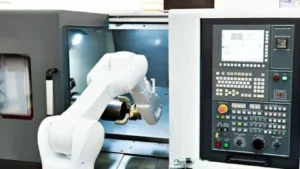
The robot arm is like a human arm. It will take a block of raw metal. Next, the machine door opens up. The robot puts the metal inside the clamp. It is retracted, and the machine begins cutting.
How do circuit breakers protect CNC machines and robotics equipment?
A breaker is a safety switch. Too much current will cause thin wires to melt. The breaker opens on the fly. This eliminates the electricity and prevents the costly components from burning.
What is the future of CNC?
Very soon, they will write code to correct their own errors using brain-based code. They will communicate with other robots via the cloud.
Why are we adopting CNC Robotics?
Robots do not get tired or make mistakes due to fatigue. They can enable a small shop to create as many parts as can a large factory.