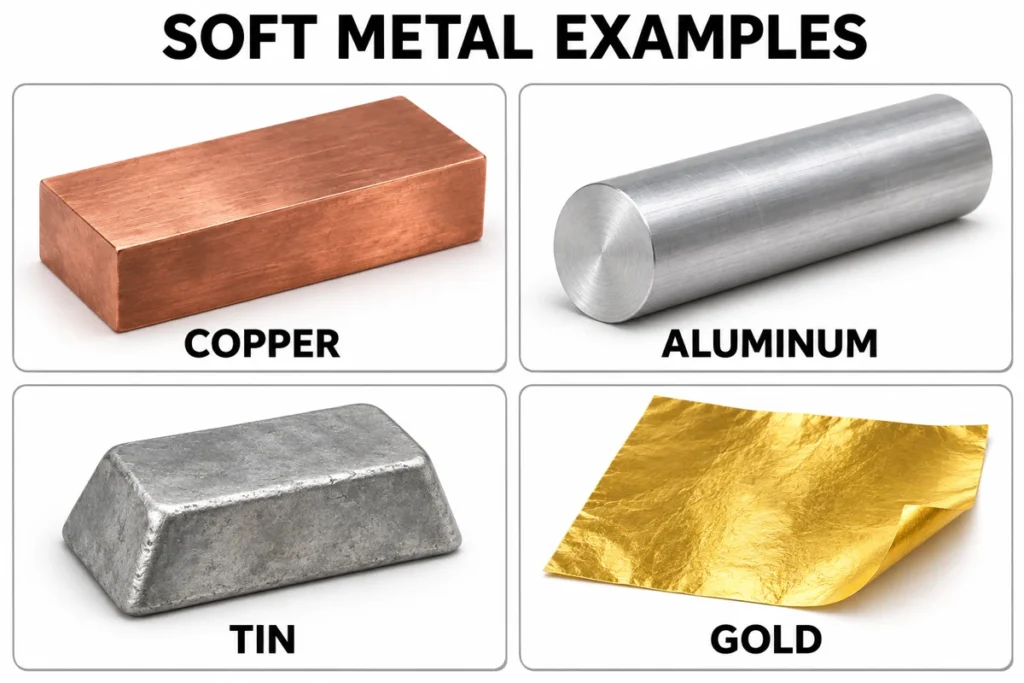
Copper is widely used in electrical, thermal, and industrial components. At room temperature, the density of copper is approximately 8.96 g/cm³ (8,960 kg/m³). You can use this value to estimate CNC part weight and the mass of material needed for machining. This guide explains copper density units, compares common grades and metals, and shows you how to measure density.
What Is the Density of Copper?
The density of pure copper is approximately 8.96 g/cm³ at room temperature, around 20°C (68°F). Expressed in other units, the density of copper in kg/m³ is 8,960, while the density of copper in lb/in³ is approximately 0.324. This means one cubic centimeter of copper has a mass of about 8.96 grams.
Copper has the chemical symbol Cu. Its density is also 8.96 g/mL because 1 mL equals 1 cm³. Whether you use g/cm³, g/mL, kg/m³, or lb/in³, you are expressing the same mass density in different units.
Density reference: Royal Society of Chemistry — Copper
Different Copper Grades and Their Densities
Copper material density varies slightly between commercial grades. When you calculate part weight, you can use the following grade-specific reference values rather than applying 8.96 g/cm³ to every copper material.
| Grade | Type | Density g/cm³* | Density lb/in³ | Temperature | Source |
| C10100 | Oxygen-free electronic (OFE) | ≈8.94 | 0.323 | 20°C (68°F) | CDA C10100 |
| C10200 | Oxygen-free (OF) | ≈8.94 | 0.323 | 20°C (68°F) | CDA C10200 |
| C11000 | Electrolytic tough-pitch (ETP) | ≈8.91 | 0.322 | 20°C (68°F) | CDA C11000 |
| C12200 | Phosphorus-deoxidized, high residual phosphorus (DHP) | ≈8.94 | 0.323 | 20°C (68°F) | CDA C12200 |
| C14500 | Tellurium-bearing copper | ≈8.94 | 0.323 | 20°C (68°F) | CDA C14500 |
*The g/cm³ values are approximate conversions of the published lb/in³ values, rounded to two decimal places. CDA lists a density range of 0.321–0.323 lb/in³ for C11000, with 0.322 lb/in³ as its tabulated value.
These small differences make density useful for weight estimates, but they do not provide a reliable way to distinguish these grades. For your project, use the density stated in the applicable material datasheet and confirm the grade through its material certification.
What Factors Affect Copper Density?
Temperature, pressure, and composition can affect copper’s density. For ordinary CNC work, temperature and grade differences are more relevant than pressure-induced compression.
Temperature and Pressure
As copper heats up, it expands. Its mass remains essentially unchanged while its volume increases, so its density decreases. Cooling produces the opposite effect: the volume contracts and density increases.
Source: International Copper Study Group — The World Copper Factbook 2020, copper properties
Pressure can also change density by compressing the material. However, this effect is small under normal manufacturing conditions, so you generally do not need a pressure correction when estimating the weight of CNC copper parts. If your process involves melting rather than solid-state machining, see our guide to the melting point of copper.
Alloy Composition
Adding other elements changes copper’s density, with the result depending on the elements and their proportions. Brass contains zinc, while tin bronze contains tin; neither should automatically be assigned the density of pure copper.
Copper Density vs. Other Metals
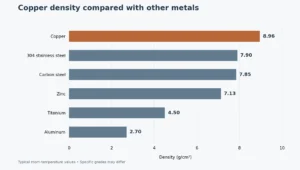
For the same volume, copper is heavier than aluminum, titanium, carbon steel, 304 stainless steel, and zinc. The table compares copper’s density with that of these metals and shows the mass of a 100 cm³ sample.
| Material | Approximate density (g/cm³) | Mass at 100 cm³ |
| Copper | 8.96 | 896 g |
| Aluminum | 2.70 | 270 g |
| Titanium | 4.50 | 450 g |
| Carbon steel | 7.85 | 785 g |
| 304 stainless steel | 7.90 | 790 g |
| Zinc | 7.13 | 713 g |
Values are approximate room-temperature references. Aluminum, titanium, and zinc refer to the unalloyed metals. The carbon steel value of 7.85 g/cm³ is a rounded comparison value for low-carbon steel, not a specification for every carbon steel grade.
Source: National Bureau of Standards — Density of Hot-Rolled and Heat-Treated Carbon Steels
Elemental density references — PubChem
304 stainless steel reference — Outokumpu Core range
For the same volume, copper weighs approximately 3.3 times as much as aluminum and twice as much as titanium. Its weight difference from steel is smaller: approximately 14% compared with typical carbon steel and 13% compared with 304 stainless steel.
You can use these comparisons to estimate how a material change would affect your part’s weight. However, the comparison assumes identical volume; a functional redesign may require different dimensions to meet electrical, thermal, or mechanical requirements. Compare other CNC machining materials against your full design requirements before making a substitution.
How to Measure Copper Density
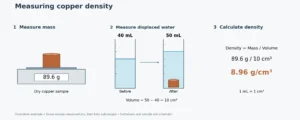
To determine copper density, measure your copper sample’s mass and volume, then divide mass by volume:
Density = Mass / Volume
When you measure mass in grams and volume in cubic centimeters, the result is in g/cm³.
Measure Mass and Volume
First, weigh a clean, dry copper sample using a suitable balance. Then determine its volume. For a regularly shaped sample, measure its dimensions and use the appropriate formula:
Rectangular block: Volume = Length × Width × Height
Solid cylinder: Volume = π × Radius² × Length
Use centimeters for all dimensions to obtain volume in cm³.
For an irregular solid sample, you can use water displacement. Record the initial water volume in a graduated cylinder, fully submerge the sample, and record the final volume:
Sample Volume = Final Water Volume − Initial Water Volume
One milliliter of displaced water equals one cubic centimeter. Remove trapped air bubbles and read the bottom of the water meniscus at eye level. This method is less reliable for very small samples or samples with cavities that trap air.
Source: American Chemical Society — Finding Volume Using Water Displacement
Calculate the Density
For example, if your copper sample has a mass of 89.6 g and displaces 10.0 cm³ of water:
Density = 89.6 / 10.0 = 8.96 g/cm³
Measure near room temperature and use equipment with enough resolution for your sample size. Small errors in volume can noticeably affect the calculated density. The illustrated calculation is an idealized teaching example: report an actual result only to the precision supported by your balance and volume readings.
How Does Copper Density Relate to CNC Machining?
Copper’s density tells you how much mass occupies a given volume, but it does not indicate how difficult the material is to cut. You cannot use density alone to determine cutting speed, spindle power, or tool life. Copper grades with nearly identical densities can have substantially different machining characteristics.
For example, C11000 copper and C14500 tellurium copper have similar densities, yet C14500 is considerably easier to machine. Tellurium improves its cutting characteristics, making it useful for components that require extensive turning, milling, or drilling. This difference comes from alloy composition rather than density.
Machining reference — Wieland Concast C14500
When you select copper for a CNC project, consider its grade, material condition, and machining characteristics alongside density. This helps you choose a material that meets your electrical or thermal requirements while allowing efficient production.
FAQs
Does Copper Plating Change a Part’s Overall Density?
Yes. A copper-plated part contains both the base material and the copper coating, so its overall density depends on the mass and volume of both. You should not assign the density of solid copper to a plated steel or aluminum part. A thin coating usually makes only a small change to the part’s overall density.
Does Cutting Copper Change Its Density?
Cutting changes the sample’s mass and volume, but it does not normally change the density of the remaining copper when compared at the same temperature. A smaller piece therefore has essentially the same density as the original stock.
Do Copper Powder and Solid Copper Have the Same Density?
The copper particles have approximately the same material density as solid copper of the same composition. However, a container of copper powder includes spaces between particles, so its bulk density is lower and depends on particle size, shape, and packing.
Is Copper’s Specific Gravity the Same as Its Density?
Copper’s specific gravity is its density divided by the density of water at specified reference conditions. It has no units. Its numerical value is close to copper’s density expressed in g/cm³, but the two quantities are different.
Does Recycled Copper Have a Lower Density Than New Copper?
Not necessarily. Once recycled copper is refined to the same composition and supplied in a comparable solid condition, its density should be similar. Recycled origin alone does not mean lower density; the final material’s composition and condition matter.
Conclusion
You can use 8.96 g/cm³ as a general reference value for copper density. Understanding this property helps you make informed decisions about CNC part design, production planning, and cost control.
If you need custom CNC machining for copper parts, send YD Rapid your drawings, material grade, and required quantity. Please include critical tolerances and surface finish requirements so we can evaluate your project and provide a quote.