QPQ treatment is a thermochemical surface treatment. It is used mainly for steel components that need better wear resistance and corrosion resistance. QPQ stands for Quench-Polish-Quench, which describes the sequence used after salt-bath nitrocarburizing.
Unlike plating, QPQ does not simply place a separate coating over the steel. Nitrogen and carbon enter the near-surface region during nitrocarburizing and form a hardened compound layer with a diffusion zone below it. Post-oxidation then adds an oxide layer to the treated surface.
The result is a surface structure made up of several layers, each contributing to the final performance of the component.
The article covers the QPQ process, surface structure, suitable materials, applications, and the main points to consider before selecting the treatment.
What Is QPQ Treatment?
QPQ is a salt-bath treatment. It is used to modify the surface of ferrous components. The process combines nitrocarburizing, quenching, polishing, and post-oxidation in a controlled sequence.
During nitrocarburizing, nitrogen and carbon diffuse into the steel. This creates a hard compound layer at the surface and a diffusion zone beneath it. The subsequent polishing and oxidation stages modify the surface condition and improve corrosion protection.
The process is often called QPQ salt-bath nitrocarburizing because nitrocarburizing provides the main hardened surface, while the quench, polishing, and post-oxidation stages complete the QPQ treatment.
What Does QPQ Stand For?
QPQ means Quench-Polish-Quench.
The name comes from the sequence used in the treatment. The component will be nitrocarburized after salt-bath treatment, before the final quench, and polished.
QPQ is actually a process sequence, not the name of a coating that has been deposited. The actual surface of the steel is changed during treatment.
How Does QPQ Differ From Conventional Coatings?
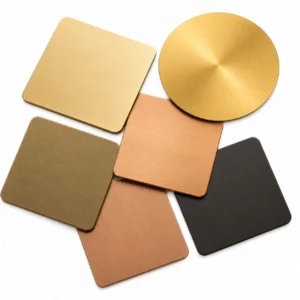
The main difference is in the surface formation. In plating, another material is laid down on the component. PVD also forms a thin film on the substrate.
Unlike these coatings, QPQ does not simply change the surface properties but modifies the near-surface structure by introducing nitrogen and carbon into the steel.
This results in an outer oxide layer, a nitride-rich compound layer, and a diffusion region beneath the compound layer of the resultant QPQ-treated steel. The layers are a component of the treated surface instead of a mere coating applied to untreated steel.
What Materials Can Be Treated With QPQ?
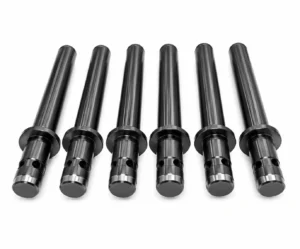
QPQ is typically used on carbon steels, low alloy steels, tool steels, and some stainless steels. The surface structure obtained in the process of treatment is directly related to the steel grade.
The nitrocarburizing process is different for various alloys. Thus, the resulting compound layer, diffusion zone, hardness, and corrosion resistance are dependent on the substrate composition and the process parameters selected.
Thus, the steel grade should be determined before specifying QPQ. Treatment developed for one steel should not be patterned for another grade without checking the suitability of the treatment.
How Does the QPQ Process Work?
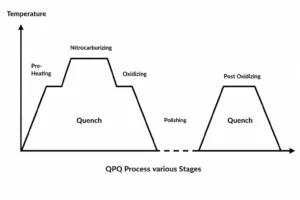
There are multiple phases of the QPQ cycle. The different stages set the conditions for the next stage and at the same time serve the purpose of the overall surface.
Step 1: Surface Preparation
The part is washed prior to being placed into the salt bath. Oil, grease, scale, and other contamination need to be removed from the surface.
This nitrocarburizing process occurs more uniformly over the part when the surface is clean. The polishing and oxidation last steps and are also affected by the surface condition.
Step 2: Salt-Bath Nitrocarburizing
The cleaned part is then put in a salt container where nitrogen and carbon are diffused into the surface of the steel.
The outer surface has a compound layer, and there is a diffusion zone extending deeper into the steel. These regions vary in depth and structure with treatments.
The compound layer is soft and hard on the surface and has high surface hardness, which can increase the wear resistance of the treated layer; the diffusion layer is located under the treated surface, which can support the treated surface.
Step 3: First Quench
The component is quenched during QPQ after nitrocarburizing is performed. This helps cool the treated part prior to polishing.
The quench is thus an integral part of the treatment cycle and not an independent process just used for dimensional cooling.
Step 4: Polishing
The surface is treated to dull out surface irregularities and roughness.
This is a step that serves a purpose. A smoother surface can give better surface-to-surface contact between components like shafts, pins, sliding components, and other components that slide against each other.
The polishing time will vary based on the desired final surface finish of the part and the shape of the part to be polished.
Step 5: Post-Oxidation
Post-oxidation is done after polishing of the component. A layer of oxide is created on the treated steel surface, which is usually Fe₃O₄ on ferrous materials.
This layer of oxide helps to prevent corrosion. It is not a surface film but acts along with the underlying layer of nitride-rich compound.
The oxide will then form a surface that will provide corrosion protection, and the compound will form a surface that will provide the underlying hardened structure.
Step 6: Final Quench and Inspection
The component is cooled following post-oxidation and is then checked against the specification.
Surface hardness, compound-layer or treatment depth, surface roughness, and dimensional checks may be part of the inspection. The geometry of the components should also be examined when the treatment or polishing process might impact critical dimensions.
The typical surface that is generated is often referred to as three distinct regions: outer oxide layer, nitride-rich compound layer, and diffusion zone below.
What Happens to the Steel Surface During QPQ?
QPQ does not produce a single treated layer, but rather a surface structure with layers. Each of the outer oxide layer, compound layer, and diffusion zone plays a role in the final product surface.
The Oxide Layer
The outer oxide layer is generated at the post-oxidation stage. Serves as the initial protection between the surface of the steel and the environment, helping to minimize direct contact of the surface being treated with the corrosive environment.
The Compound Layer
The compound layer is formed in the salt-bath nitrocarburizing. It includes a high surface hardness obtained from QPQ treatment and contains nitrogen- and carbon-rich phases.
The hardened layer protects the component against sliding contact and abrasive wear and is suitable for components with which contact is repeated.
The Diffusion Zone
Under the compound layer, there exists a diffusion zone where nitrogen and carbon have diffused into the steel. Gradually varying composition and not a sharp boundary at depth.
This area is suitable for the harder surface layer and will help to transition into the untreated substrate.
Why the Layer Structure Matters
The three areas are integrated as a surface system. The oxide layer helps to provide corrosion resistance, while the compound layer helps to impart surface hardness and wear resistance, and the diffusion zone helps to support the hardened outer layer.
How Does QPQ Improve Wear Resistance?
QPQ changes the surface that actually makes contact. This is useful on steel parts where the bulk material already has the required strength, but the surface needs better resistance to sliding, abrasion, or repeated contact.
Higher Surface Hardness
The nitrocarburized surface is more resistant than the base material beneath. This minimizes the local indentation and surface deformation under contact areas.
For example, a 42CrMo shaft could have its required mechanical properties kept in its core, while the treated surface is used for sliding contact.
Reduced Adhesive Wear
Local contact points in metal-to-metal sliding may lead to the transfer of material from one surface to the other. This tendency can be minimized on a QPQ-treated surface, especially if the surface finish and mating material are appropriate.
This means that when you have a valve, guide, shaft, or pin that slides against another surface again and again and again, the treated surface will not break down as fast.
Improved Abrasive Wear Resistance
Abrasive wear is caused by scratching and cutting of surface material. This action is resisted better by the hardened QPQ layer than by the untreated steel.
It is not just layer hardness. The treated surface’s uniformity of layering and the surface condition also influence the abrasive contact resistance of the treated surface.
Better Performance in Sliding Applications
A steel surface that is to be repetitively moved against another component can be useful for QPQ. Typical examples include:
- Inside bushings with shafts
- Reworked pins for use in articulated joints.Reworked pins for use in articulated joints.
- Parts that slide in valves
- Components that experience high levels of movement.
- Worn components that come into contact repeatedly during operation
The mating aspect should also be taken into account. Even if the surface of the shaft has been hardened, the shaft can wear if it is running against an inappropriate counterface.
Why Maximum Hardness Is Not the Only Target
The layer thickness, the structure of the compounds, the support of the diffusion zone, the strength of the substrate, the surface finish, and the load applied must be appropriate for the component.
This is supported by the research on 42CrMo steel: Surface hardness should not be treated independently from the steel’s microstructure and the support of the substrate.
QPQ Wear Resistance vs. Corrosion Resistance: How the Layers Work Together
QPQ is useful for steel parts that see both contact and corrosive exposure. The surface is not doing one job. Each region contributes differently to the finished component.
| Surface region | Main function |
| Oxide layer | Corrosion protection |
| Compound layer | Hardness and wear resistance |
| Diffusion zone | Supports the hardened layer |
| Base material | Strength and toughness |
The oxide layer is the first surface exposed to moisture and corrosive media. Beneath it, the compound layer provides the hard-working surface needed for sliding and contact. The diffusion zone supports this layer and provides a gradual transition into the steel core.
For a hydraulic shaft, for example, the outer surface may face moisture and repeated sliding against a seal or mating component. QPQ addresses both conditions through the same treated surface rather than using one treatment for wear and another for corrosion.
Which Steels Are Suitable for QPQ?
QPQ is suitable for several steel groups, but the grade and its existing heat-treatment condition should be checked before specifying the process.
Carbon Steels
Carbon steels are acceptable when a primary concern is increased surface hardness and wear resistance.
Common components are pins and shafts, bushings, and wear parts. QPQ can enhance the working surface while minimizing changes to the bulk steel.
Alloy Steels
These steels (4140 and 42CrMo) are useful when the part requires a strong base and a hard surface.
Prior to QPQ, it is essential that the existing hardening and tempering state is known. The treatment temperature should be selected to meet this requirement, so that the required core properties are not changed.
Tool Steels
Tool steels are used for parts that are subject to repeated contact and surface wear. Their previous heat treatment is particularly relevant, as the heat treatment of the steel should be compatible with the QPQ.
Stainless Steels
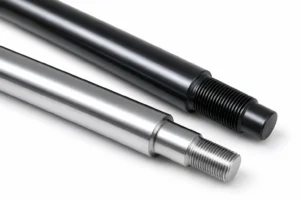
Stainless steels such as 316L and 17-4PH may be processed by QPQ as well. The alloy content will influence the surface reactions with nitrogen, and the resultant compound and oxide films will be different from those of carbon and low-alloy steels.
The process should then be chosen for a given grade of stainless steel and desired surface structure, not for the conventional steels.
What Factors Affect QPQ Results?
The settings used during the treatment cycle and the starting condition of the steel will affect the QPQ results. The surface structure can change if the stage is changed.
Treatment Temperature
The diffusion of nitrogen and carbon into the steel and the formation of the compound layer are influenced by the temperature. The appropriate range is dependent on the grade of steel and the previous heat treatment.
Treatment Time
The depth of the treated area is mainly dependent on treatment time. An extended cycle is not necessarily the best method to get a better surface.
Over-treatment can result in a layer that is not suitable for the desired contact situation. The depth to be used should then be according to the component requirements.
Salt-Bath Chemistry
Active nitrogen and carbon for surface modification are provided by the nitrocarburizing bath. During the process, it must be kept under control both in composition and condition.
Condensation of the layers and diffusion zone can be influenced by the bath chemistry changes.
Post-Oxidation Conditions
The outer oxide layer is formed by post-oxidation. The temperature and time will influence the growth of this layer and thus the final corrosion performance.
The oxidation process should not be adhered to as a “one-size-fits-all” final step regardless of the grade of steel used.
Polishing Conditions
Prior to post-oxidation, the surface is polished to make it smoother. The final condition of the oxide layer can be influenced by the amount of material removed and the oxide surface finish.
The overall surface roughness required prior to finishing should be determined for components having sliding contact.
Substrate Condition
There is far more of an impact on the final result from the starting steel. Before QPQ, check:
- Existing hardness
- Previous heat treatment
- Microstructure
- Alloy composition
These factors influence the response of the steel during nitrocarburizing and whether the desired surface properties are achieved for the component.
How Deep Does QPQ Treatment Penetrate?
No single QPQ depth for all steel or applications. The measured depth is a function of material and treatment conditions.
Compound Layer vs. Diffusion Zone
The region of the surface that has been hardened by nitrocarburizing is known as the compound layer. Below it is the diffusion zone where there is a gradual change in the concentration of nitrogen and carbon in the steel.
These two regions shouldn’t be reported as the same measurement. There should be a clear indication in a specification of which layer or which depth is being measured.
Why Layer Depth Should Be Specified by Function
The depth required will be based on the surface to be protected. In the case of sliding contact, the working surface and its hardness profile are important. If a load is to be applied to the surface, enough treated depth must be achieved to support the surface for wear. The requirements of corrosion are more closely related to the surface condition and the oxide layer.
In cases where components are subjected to fatigue loading, the loading must also be taken into account, as must the substrate condition, and the depth and hardness profile must be taken together.
How Is Layer Depth Verified?
A metallographic cross section and microscopy can be used to determine the depth of QPQ. A micro hardness profile can be used to investigate hardness variations from the surface into the substrate.
If the identification of the phases present in the treated surface is required, then X-ray diffraction (XRD) can be used.
QPQ vs. Other Surface Treatments
QPQ is not interchangeable with every surface treatment used on steel. The choice depends on whether the part needs a hardened case, corrosion protection, a deposited coating, or simply an oxide finish.
QPQ vs. Conventional Nitriding
Both treatments produce a nitrogen-enriched surface and can form a compound layer with a diffusion zone beneath it. QPQ uses salt-bath nitrocarburizing and adds polishing and post-oxidation to the cycle.
That oxide stage is one of the practical differences. It gives QPQ-treated steel an additional surface barrier against corrosion.
QPQ vs. Gas Nitriding
Gas nitriding introduces nitrogen through a controlled gas atmosphere. QPQ uses a molten salt bath and introduces both nitrogen and carbon during nitrocarburizing.
Gas nitriding is commonly used where a nitrided case is the main requirement. QPQ is suited to parts that also need the surface condition produced by polishing and post-oxidation.
QPQ vs. Hard Chrome Plating
Hard chrome is deposited onto the component. QPQ changes the near-surface steel through diffusion.
This affects dimensional control. Chrome adds a measurable coating thickness that may require allowance before plating. QPQ does not build the surface in the same way because its functional layers develop within the steel surface.
QPQ vs. PVD Coating
PVD produces a thin deposited layer, often used where high surface hardness and wear resistance are required with a relatively small coating thickness.
QPQ produces a compound layer, diffusion zone, and oxide surface. It is therefore a different approach for steel parts that need both wear resistance and corrosion protection.
QPQ vs. Black Oxide
Black oxide is primarily an oxide finishing treatment. It gives the steel a dark surface and provides limited corrosion protection, but it does not produce the hardened nitrocarburized structure of QPQ.
For a component that only needs an oxide finish, black oxide may be sufficient. For a component that also has significant surface wear, QPQ provides a much more substantial surface modification.
What Are the Limitations of QPQ?
QPQ can improve the surface of many steel components, but the treatment still has practical limits. The steel grade, previous heat treatment, part geometry, and starting surface condition all affect the result.
Not Suitable for Every Material
The response of the QPQ process is related to the composition of the steel. Carbon steels, alloy steels, tool steels, and certain stainless steels are treatable but will not form the same surface structures.
Therefore, the material grade needs to be verified prior to any treatments being specified.
Treatment Temperature Can Affect Existing Heat Treatment
Certainly, steels that have been hardened and tempered require special consideration. The QPQ cycle has to be compatible with the steel’s existing heat-treatment condition. In cases of critical parts, core hardness must be specified prior to and after treatment.
Geometry Can Affect Treatment Uniformity
Uniform treatment may be more difficult where part geometry is concerned, such as around:
- Deep holes
- Recesses
- Internal surfaces
- Narrow sections
These areas should be taken into account when planning processes, as treatment must be applied evenly to the desired surfaces.
Surface Defects Are Not Automatically Corrected
QPQ is a surface treatment and not a machining correction. Before treatment, any deep scratches, poor machining marks, burrs, and dimensional inaccuracies should be corrected.
The initial surface condition is also a factor in the final surface appearance and roughness following QPQ.
Corrosion Performance Depends on Process Quality
The important role of the oxide layer in the corrosion behavior of treated QPQ steel is not independent of the other aspects of the treatment.
The final result depends on the integrity of the oxides, their surface conditions, the quality of the compound layers, and the environment in which they are used. If a component is exposed to extreme chemicals or to continuous moisture, another corrosion-control strategy may be necessary than if it is exposed to mild chemicals.
Where Is QPQ Treatment Used?
On steel parts where surface wear and corrosion are always present, QPQ would be applied.
Automotive Components
- Common examples include:
- Gears
- Shafts
- Pins
- Valve components
- Hydraulic components
- Hydraulic and Pneumatic Components
QPQ is primarily applied to rods, pistons, cylinders, and valves subjected to repeated motion and contact.
Tooling and Dies
Where repeated contact causes surfaces to wear on untreated steel, such as in wear-prone tooling surfaces and mould components, QPQ can be used.
Industrial Machinery
It can be used in mechanical contact components such as bushings, spindles, pins, etc., which are exposed to repeated sliding or contact loads.
Oil and Gas Parts
Where surface wear and corrosion are issues, valve parts and other steel parts exposed to demanding service conditions can be considered for QPQ.
It has been used in the automotive and industrial sectors for many years due to its combination of surface hardness, corrosion resistance, and the properties of the base steel.
How Is QPQ Quality Inspected?
The properties of the finished part should be the subject of QPQ inspection. The standard tests include hardness, depth of treated layers, surface finish, dimensions, and performance.
Surface Hardness Testing
A hardness test is used to measure the hardness that has been obtained at the surface being treated. It is a rapid test to verify the proper surface condition produced by the QPQ process.
Microhardness Profile
Microhardness measurements are conducted from the surface towards the interior of the cylinder. The results present the variation of hardness with depth, and the hardened region can be determined.
Metallographic Cross-Section
A thin slice of the object is made and then viewed through a microscope. The object is cut open and sliced and then viewed through a microscope. It displays the oxide layer, compound layer, and diffusion zone, and can assist in the identification of any defects or uneven treatment.
Layer-Depth Measurement
The thickness of the layer should be measured in accordance with the required thickness. The report should also indicate if the measurement is on the compound layer or in the deeper diffusion zone.
Surface Roughness Measurement
Functional surfaces like shafts, bores, pins, and sealing surfaces are checked for roughness.
Dimensional Inspection
QPQ is followed by a critical dimensions check. Such as diameters, bores, threads, mating surfaces, and the place where dimensional control is required.
Corrosion Testing
Corrosion testing is employed when corrosion performance is a part of the specification. The test chosen should reflect the service environment it is intended to apply to.
Wear Testing
For parts that come into sliding or rubbing contact, wear testing can be performed. It is helpful when a specific wear performance is specified by the drawing or the customer.
When inspecting for production parts, the plan should be according to the drawing requirements and in actual service conditions. Not all of the tests need to be applied to each component.
QPQ Treatment: Practical Design Considerations
QPQ needs to be done in advance of the part going into the treatment. The final part can be influenced by any of the following: the starting surface, mating features, dimensions, and areas that are not to be treated.
Allow for Pre-Treatment Surface Condition
Machining marks, burrs, and surface damage are still significant issues in the QPQ. Properly machine and clean the component before the treatment, and do not hope that QPQ will rectify the defects in the component.
Consider Mating Surfaces
Inspect surfaces that come in contact with another part, particularly shafts and bores, seals, and sliding surfaces. The final surface finish and hardness of their mating part should match.
Check Critical Dimensions After Treatment
Small clearances and precision fits are of special concern. Inspect diameters, bores, threads, and mating characteristics after QPQ to ensure they are within the drawing tolerances when finished.
Consider Masking Requirements
Surfaces may not have to be treated. Such as threads, precise fits, sealing surfaces, and other functional surfaces. Masking should be determined in advance of the component going into the treatment process.
Plan the Machining and Treatment Sequence
The sequence of machining and QPQ may impact the final size and finish. The surfaces that are to be machined and those to be finished should be evaluated in light of the critical features.
In some cases, the drawing, the treatment specification and the machining sequence should be checked collectively and not as a separate final operation – the treatment being QPQ.
QPQ Treatment FAQs
Can QPQ Be Applied to a Finished Component?
It depends on the required dimensions and surface condition. Critical fits, bores, threads, and sealing surfaces should be reviewed before treatment because the QPQ cycle can affect the finished condition.
Should QPQ Be Specified Before or After Machining?
The treatment should be considered during process planning. Some surfaces may be machined before QPQ, while critical dimensions or finishes may require a final machining or polishing operation afterward.
Does QPQ Require Masking?
Masking can be used when specific surfaces must remain untreated. This may apply to threads, precision fits, sealing areas, or other functional surfaces that cannot receive the treatment.
Can QPQ Be Used on Internal Surfaces?
Internal surfaces can be treated, but geometry affects treatment access and uniformity. Deep holes, narrow passages, and recessed areas should be reviewed with the treatment provider before production.
Does QPQ Affect Surface Roughness?
The final roughness depends partly on the surface condition before treatment and the polishing stage. For sliding and sealing surfaces, the required roughness should be specified rather than relying on the treatment alone.
Can QPQ Replace a Surface Finish Operation?
QPQ is not a substitute for machining. If a component requires a particular diameter, flatness, or surface finish, those requirements still need to be achieved through the appropriate machining and finishing process.
Can QPQ Be Reworked After Treatment?
Rework depends on how much material must be removed and which surface is affected. Removing too much material can alter the treated region, so rework limits should be established before processing.
Does QPQ Affect Fatigue Performance?
The effect depends on the steel, surface structure, residual stresses, surface condition, and loading. For fatigue-critical components, QPQ should be evaluated as part of the complete material and surface-treatment specification.
Can QPQ Be Used With Tight-Fit Components?
It can be used, but the treatment and finishing sequence must account for the required fit. Shaft-to-bore clearance, sealing fits, and mating dimensions should be checked after treatment.
What Should Be Given to a QPQ Treatment Supplier?
Provide the steel grade, heat-treatment condition, drawing requirements, critical dimensions, surfaces to be treated or masked, required hardness or layer depth, surface finish, and service conditions. This gives the processor enough information to select and verify the treatment properly.
Final Section: Is QPQ Right for Your Component?
QPQ is a practical option when the component needs a hardened working surface together with improved corrosion protection. The decision should start with the steel grade, component geometry, mating surfaces, dimensional requirements, and service environment.
Is QPQ Right for Your Component?
QPQ is worth considering when the surface is taking the wear while the component is also exposed to corrosion or repeated contact. Shafts, pins, valve parts, hydraulic components, gears, and similar steel parts can benefit when their service conditions match what the treatment can provide.
The steel grade and its existing heat-treatment condition should be checked first. Part geometry, critical fits, surface finish, and the areas that need masking also need to be settled before processing. These points can affect the final QPQ result just as much as the treatment cycle itself.
For a production part, the drawing should state what actually needs to be controlled: surface hardness, treated depth, dimensions, roughness, and inspection method. Giving these requirements to the treatment supplier before processing avoids leaving the important details to be decided after the part has been treated.
Planning QPQ for a steel component? Send YD Rapid the material grade and drawing requirements so the treatment and inspection requirements can be reviewed before processing.