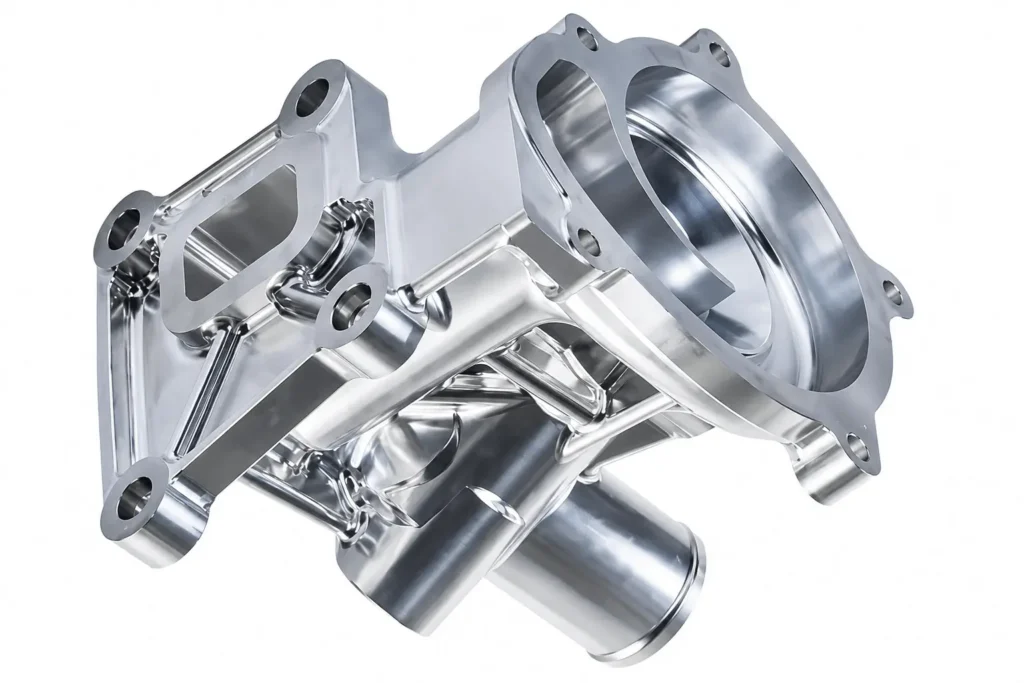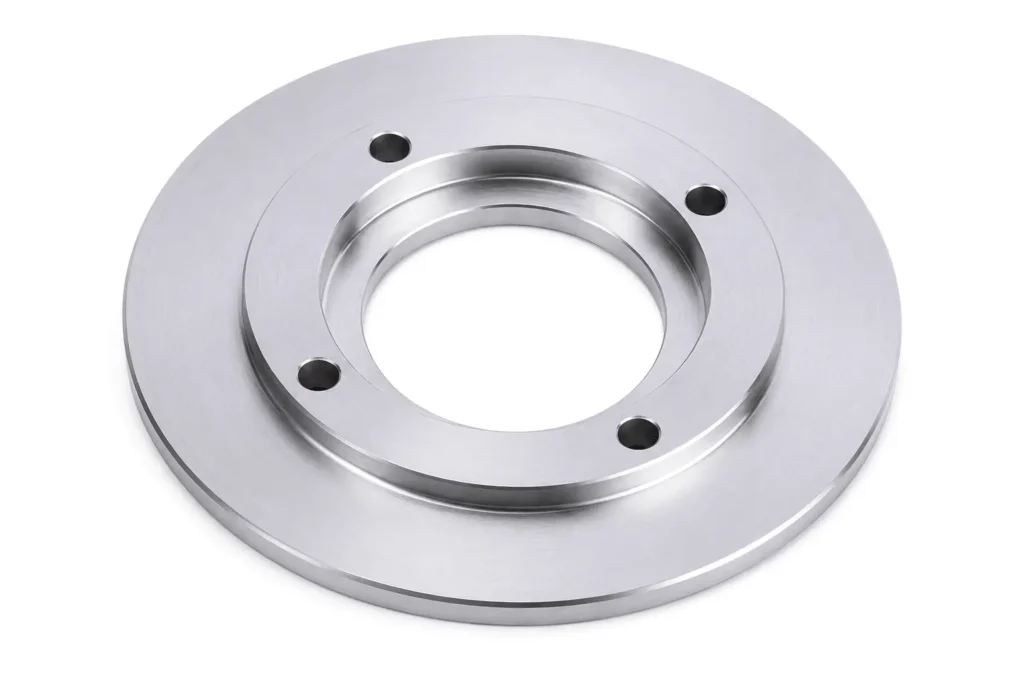
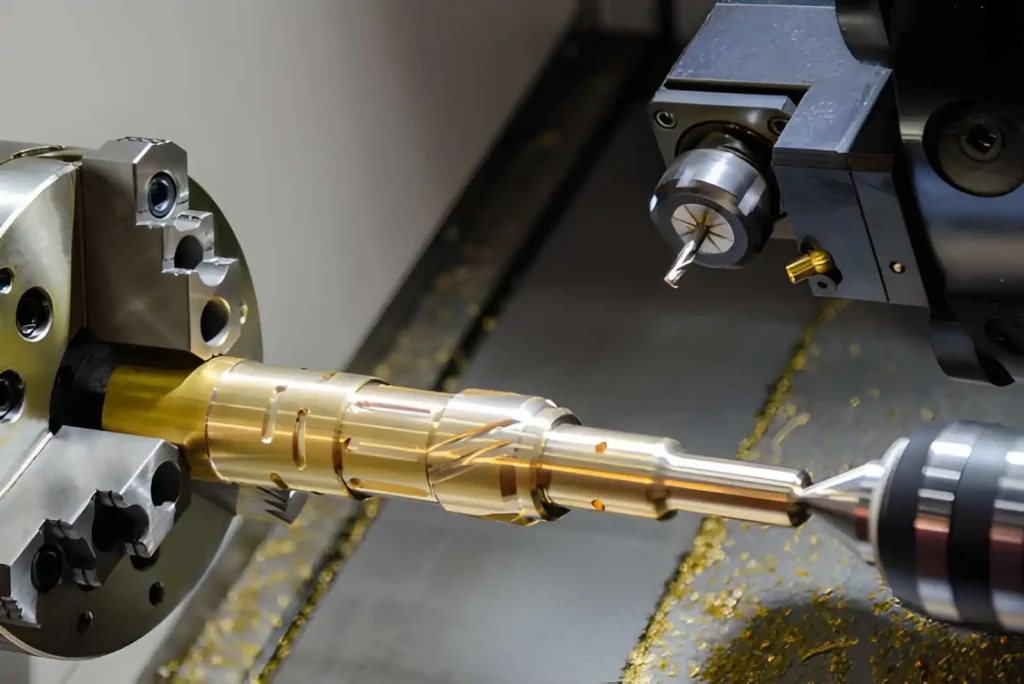
A 4-axis machine can reach more sides of a part without removing it from the fixture. A 5-axis machine goes further by moving the tool and workpiece through multiple angles during the cut. That difference shows up most clearly on parts with angled faces, deep features, curved surfaces, and several machining directions.
A 4-axis setup can handle features that are positioned around its rotary axis, while features requiring several tool orientations, such as 30°, 45°, and 60° faces, can require additional positioning or setups. A 5-axis machine can tilt the tool toward these surfaces without relying on the same fixed orientation.
The machine with more axes is not automatically the better choice. A part with simple features around one rotary axis may be well suited to 4-axis machining. A part with several angled surfaces may need 5-axis movement to keep the cutter properly positioned and reduce extra setups.
For a cost and process comparison, look at the part drawing, feature directions, tool access, number of setups, required tolerances, and production quantity. These points give you a clearer basis for choosing between 4-axis and 5-axis machining than the axis count alone.
What Is 4-Axis CNC Machining & How It Works
A 4-axis CNC machine combines X, Y, and Z linear movement with one rotary axis. The rotary axis lets the machine turn the workpiece to another machining position, and on machines with continuous rotary control, it can also move during the cut.
The exact axis arrangement depends on the machine; rotary axes are commonly designated A, B, or C.
Three Linear Axes Plus One Rotary Axis
X, Y, and Z control the linear position of the cutter. The fourth axis provides a rotation about one of these coordinate directions. A-axis, for instance, rotates around X, and B and C around Y and Z.
This provides the machine with a different approach to the workpiece from the cutter. The cylindrical part can be turned around the centre line of the cylindrical element, and the prismatic part can be turned to show another face. The exact setup will vary depending on whether the rotary unit is a table mount or a machine setup.
Rotary Indexing
The indexed 4-axis machine can rotate a part to a set angle and allow it to remain stationary during the cutting process. In the case of a 4-sided part, for instance, it could be placed at 0°, 90°, 180°, and 270° without taking it apart from the fixture.
This method is suitable for parts with a similar feature located around a cylindrical surface and parts having multiple faces that must be machined from more than one direction. Haas says its 4th-axis systems aid multi-sided machining and minimize the need for multiple setups.
Continuous Rotary Machining
X, Y, or Z can also move while the rotary axis is moving. This is a system where the rotary motion is controlled together with the linear motion to execute the programmed path.
To illustrate, let’s take a look at the machining of a feature around a cylindrical surface. The machine can rotate the workpiece during the cutting operation, instead of stopping at a number of angular positions. One example of this is cylindrical mapping, which is a linear tool path transformed into a path around a cylinder.
Features Suited to 4-Axis Machining
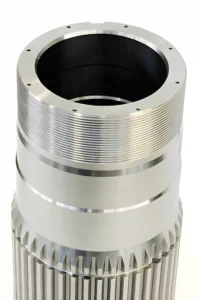
4-axis machining fits parts whose features are distributed around one main rotary direction. Common examples include:
- Holes spaced around a cylindrical body
- Slots running around a shaft or tube
- Flats machined at several angular positions
- Repeated pockets around a central axis
- Profiles wrapped around cylindrical surfaces
- Features that can be reached by indexing the part to different angles
The main limitation is the single rotary direction. If the drawing contains surfaces or holes requiring different tool orientations, rotating around one axis may not provide the required access. That can lead to additional setups or a move to 5-axis machining.
What Is 5-Axis CNC Machining & How It Works
5-axis CNC machining adds two rotational axes to the standard X, Y, and Z movements, allowing the cutting tool to reach complex features from multiple directions.
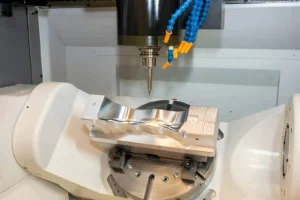
A 5-axis machine adds a second rotary movement to the three linear axes. This gives the control system two rotary directions for changing the tool’s orientation relative to the part.
The actual arrangement varies between machines: some rotate the workpiece on a trunnion, while others use rotary movements in the spindle head.
Three Linear Axes Plus Two Rotary Axes
The two rotary axes adjust the cutter’s rotational angle; the X, Y, and Z axes set the cutter’s position. These rotary axes may be connected to the table, the work, or the head of the spindle, depending on the design of the machine.
This second rotary motion is helpful when the first rotary move isn’t sufficient to access the next feature. For instance, the same part could be at 30° at one surface and 60° at the other. The machine can change the direction of the tool rotation between these surfaces rather than having to rely on one direction of rotation.
The available angle is dependent on the travel of the rotary axis of the machine available, and Haas machines have different tilts and rotations on different models of 5-axis.
Tool Orientation
The machine can even adjust the path the cutter will take to approach the surface. If it is a face at an incline, the tool may be tilted so that the cutting edge operates at an appropriate angle to the face.
According to Siemens, 5-axis machining is about controlling the position of the machining point and the orientation of the tool. In addition, coordinated linear-axis movement is required for rotary-axis movement to maintain the tool tip on the programmed path.
This is helpful for deep cavities, too. A shorter tool may be used to access the feature that requires the clearance between the feature and the tool holder to be less than the tool stick-out.
A shorter tool may be used to access the feature requiring clearance between the feature and tool holder that is less than the tool stick-out if the tool is tilted.
Simultaneous 5-Axis Movement
A 5-axis machine doesn’t have to move all 5 axes for each cut. In 3+2 machining, two of the rotary axes are used to position the part at a desired orientation. The cutting operation is then carried out by the three linear axes. This is a machined suits option that can be cut at a few preset angles.
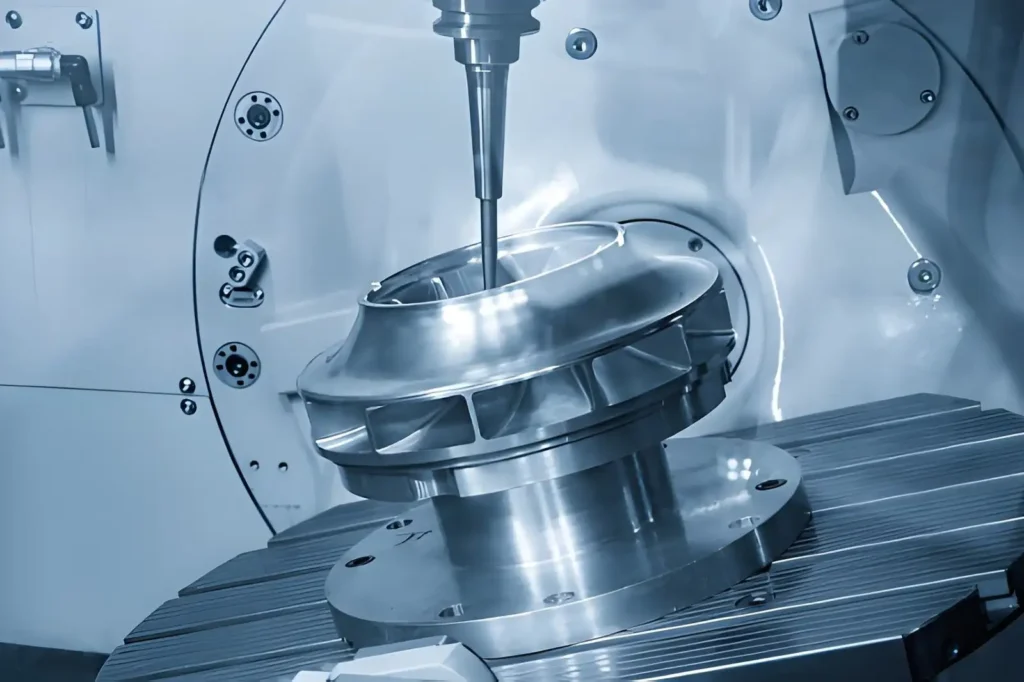
In simultaneous 5-axis machining, the rotary axis, together with the linear axis, moves, and the cutter is programmed to travel the surface simultaneously. This is helpful for continuously changing surfaces like blades, impellers, molds, and other compound contours.
Haas refers to simultaneous 5-axis motion for contouring and complex machining, whereas Siemens talks about controlling the tool orientation during the toolpath.
Angled and Compound Surfaces
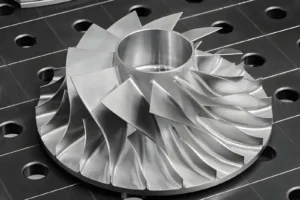
5-axis machining is beneficial for parts with surfaces that can’t be approached economically from a single tool direction.
Examples include:
- Faces that are 30° or 45° slanted so that the cutting edge must lean towards the surface
- The inclined surfaces are located at 60° to the first inclined face
- Angled bores that are not parallel to the primary X, Y, and Z bores
- Blades having continuously changing surface orientation
- Create draft diversions and deep draft holes
- Multi-faceted enclosures, where attributes are spread around different faces
Actual usable angle depends on rotary-axis travel of the machine, fixture clearance, spindle configuration, and part size. Examples include the Haas UMC-750, which offers a dual-axis trunnion of +120° to −35° tilt and 360° rotation, or other machines with varying tilt and rotation ranges.
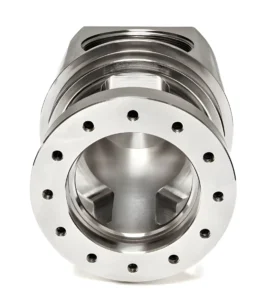
Therefore, if there are a few angled features in a drawing, it may not be necessary to have them cut simultaneously. If every feature can be accessed once you position the rotary axes, then 3+2 machining might be enough. When the orientation of the tool is continuously changing over the surface, continuous 5-axis movement becomes more useful.
4-Axis vs 5-Axis for Different Part Geometries
The part geometry usually gives the first indication of which machine fits. A feature arranged around one rotary axis can often be handled on 4-axis equipment. Features that require several tool directions, deeper access, or changing cutter angles are better suited to 5-axis machining.
Parts With Features Around One Rotary Axis
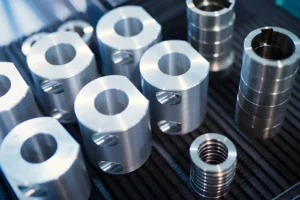
The 4-axis machining is optimal for features that are in one rotational direction. These include holes around a cylindrical body, slots around a shaft, and repeated features spaced 90° apart.
Parts With Multiple Angled Faces
A single rotary axis might not access different surfaces that are pointing in different directions. An example is a part that has faces at 30° and 45° on opposite sides of the part, which will need a different setup on a 4-axis machine. The 5-axis machine is able to approach these surfaces from various directions with the tool.
Deep Cavities and Difficult Tool Access
In a 4-axis with deep cavities, a long cutter may have to be used to reach the bottom. The longer the tool sticks out, the more likely that the tool will deflect. In 5-axis machining, tilting the cutter can give a more direct approach, and also, in some geometries, it can be a shorter cutter.
Complex Curved Surfaces
The cutter orientation may vary across the surface, as in curved surfaces like impeller blades, turbine parts, mold cavities, etc. Simultaneous machining with 5 axes can control the change of orientation along the toolpath, while the 4-axis has limited control.
4-Axis vs 5-Axis CNC Machining Accuracy and Tolerance
5-axis machining does not automatically give a smaller tolerance than 4-axis machining. The useful difference is often the number of times the part has to be located again. If several features are related to the same datum, keeping them in one setup can make that relationship easier to control.
Accuracy Within One Setup
If a drawing calls for a hole of Ø20 mm and has a tolerance of ±0.02 mm, and it is desired that the hole position remain within 0.03 mm of another datum feature, then what is the best value to use for the hole?
The bore and the reference features are machined in one machine setup, which eliminates the need for the part to be moved into another fixture position.
This can be done if the feature is in the rotary axis of a 4-axis machine. The same benefit can be achieved on geometry that needs a different tool direction on a 5-axis machine.
Datum Transfer Between Setups
There are other setups with another locating step added. For instance, a part could be machined and then repositioned in the same setup for an angled feature. If the operations are both accurate, but there are even slight errors in locating them in relation to each other, the position of the final feature can be incorrect.
This set-up relationship may be more important than the selection of 4-axis or 5-axis machines for a drawing that has a 0.05 mm positional tolerance.
Rotary Axis Positioning
For features that have an angle, rotary positioning is important. If the hole is given as 45° ± 0.1°, the rotating axis must move the part in such a way as to ensure the hole is located within that ±0.1° angle.
In the case of less demanding features (45° chamfer with ±0.5°), the same requirement applies for rotary positioning, but it is far less critical.
The tolerance for such an operation should, therefore, be taken from the drawing. Do not choose a machine because it is designed to be able to perform 5-axis machining on all the angled features.
Feature-to-Feature Accuracy
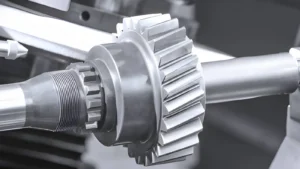
Suppose that you are going to design a part that has a Ø30 mm bore and a mounting face, and it has four holes located within a position tolerance of 0.05 mm from the centre of the bore.
When the bore and hole pattern can be created from a single setup, the datum transfer is reduced. When the hole pattern needs to be set up again, the locating method and inspection process now become a part of the tolerance chain.
Depending on the feature and drawing requirement, for critical relationships, inspection may involve a CMM, a bore gauge, or a dedicated gauge.
4-Axis vs 5-Axis CNC Machining Cost
5-axis machining normally carries a higher hourly rate, but that does not automatically make the finished part more expensive. A 4-axis job may need two or three setups, while a 5-axis machine may complete the same geometry with one setup. The useful comparison is therefore machine time + programming + setup + tooling + inspection, rather than the hourly rate alone.
Machine and Programming Cost
As a budgeting reference, published U.S. machining-rate guides commonly place 4-axis work around $100–$150/hr and 5-axis work around $150–$200/hr. Other 2025–2026 market guides report wider ranges, so these figures should be treated as typical reference values rather than quoted prices.
For example:
- 4-axis machining: $120/hr
- 5-axis machining: $175/hr
- 4-axis machining time: 2.0 hr
- 5-axis machining time: 1.2 hr
The machine-time portion would be:
4-axis: $120 × 2.0 = $240
5-axis: $175 × 1.2 = $210
In this example, the higher 5-axis hourly rate does not produce the higher machining cost because the cycle is shorter.
Programming also needs to be included. Simple indexed 4-axis work can require less CAM preparation, whereas simultaneous 5-axis work can require more toolpath development and verification.
Setup Cost
Setup cost includes fixture preparation, workholding, datum location, probing, tool setting, and operator time.
Consider a part requiring:
- 4-axis: 3 setups × $60 setup cost = $180
- 5-axis: 1 setup × $100 setup cost = $100
The 5-axis process has a higher cost for the individual setup, but the total setup cost is lower.
The actual setup charge varies by shop, so these figures are only an example of how the calculation works.
Tooling and Workholding
4-axis machining can sometimes require longer tools to reach features that are poorly aligned with the rotary axis. A 5-axis machine may tilt the cutter into the feature and use a shorter tool.
The opposite can also happen. A complex 5-axis component may need a dedicated fixture, probing, and more expensive tooling. Therefore, the drawing should be reviewed before assuming that 5-axis will reduce tooling cost.
Cost Per Part at Different Quantities
For a prototype, setup and programming can make up a large part of the total price. A simple 4-axis process can therefore be attractive when the part only needs one additional machining direction.
For larger quantities, the setup cost is spread across more parts.
For example, if a $300 setup is spread across:
- 1 part: $300/part
- 10 parts: $30/part
- 100 parts: $3/part
This is why the cheaper machine rate does not always produce the cheaper part.
| Cost Factor | 4-Axis CNC | 5-Axis CNC |
| Typical U.S. machine-rate reference | ~$100–$150/hr* | ~$150–$200/hr* |
| Programming | Usually simpler for indexed work | Higher for complex simultaneous paths |
| Setup cost | Can increase with multi-face parts | Can decrease when several faces are machined in one setup |
| Workholding | Often simpler | May require more clearance and specialized fixtures |
| Tool access | May require longer tools | Tool tilting can improve access |
| Prototype | Often economical for suitable geometry | Useful when multiple 4-axis setups are required |
| Small batch | Depends strongly on setup count | Can reduce handling and repositioning |
| Larger production | Suitable when geometry is simple | Can become economical when setup reduction saves time |
4-Axis vs 5-Axis CNC Machining Time
The faster machine is not always the one with more axes. The total time also includes setup, repositioning, tool changes, and inspection.
Cutting Time
The amount of time it takes to cut depends on the material, cutter, feed, speed, and amount of material being removed. Although a 5-axis machine may be helpful in difficult areas because the cutter maintains a better angle, it does not necessarily save cutting time.
Setup and Repositioning Time
If a feature in the 4-axis job cannot be accessed from the rotary axis, the part will need to be moved in order to access that feature. Every time the part is moved, time needs to be spent finding and verifying that the part is still in place.
This handling time can be minimized by a 5-axis machine that can access several faces from a single setup.
Tool Length and Cutting Access
If the features are deep, then the long cutter will be used. For instance, an 80 mm tool with a 100 mm stick-out has a tendency to deflect more than a shorter stick-out tool of the same diameter that can reach the same feature.
A 5-axis machine can tilt the cutter into the feature, which might permit the use of a shorter tool.
Total Cycle Time
Compare the complete process rather than cutting time alone:
Total time = cutting + setup + repositioning + tool changes + inspection
For a simple four-sided part, 4-axis machining may be faster. For a part with several angled faces and difficult tool access, 5-axis machining can reduce the total production time.
Indexed 5-Axis vs Simultaneous 5-Axis Machining
A 5-axis machine can be used in two different ways. The rotary axes can first position the part and then stop, or they can continue moving with the linear axes during the cut. The choice depends on the part geometry and the required tool movement.
Indexed 5-Axis
Indexed 5-axis machining involves the rotational axes driving the part or tool to the desired angle and then stopping. The cutting process is then carried out with the three linear axes.
For instance, a face can be put at a 45° angle, machined, and then the rotary axes take the face to a 30° angle for the next feature. This part remains within the fixture during the change of the machine’s machining direction.
This process is referred to as 3+2 machining because the three linear axes are used to perform the cut, while the two rotary axes are employed for positioning.
Simultaneous 5-Axis
Simultaneous 5 Axis Machining: The rotary axis and linear axis move simultaneously, and the cutter is guided by the programmed path.
A cutter may move its angle continuously rather than stopping at different angles. This is helpful when the tool path changes direction on the surface.
When Simultaneous Movement Is Useful
When parts like impeller blades, turbine blades, molds, compound curved surfaces, etc are required, simultaneous motion is helpful.
As an example, the surface of the blade may vary from about 20° to 45° over its length, so that the blade may adjust its position during its travel across the surface. This ensures that the tool is always in the correct position relative to the changing geometry, as opposed to cutting the surface in a series of fixed positions.
When 4-Axis CNC Machining Is the Better Choice
4-axis machining makes sense when the part can be machined by rotating it around one main axis. You do not need a 5-axis process simply because the drawing contains an angled feature. The key question is whether the available rotary movement gives the cutter access without creating difficult setups.
Features Are Arranged Around One Rotary Axis
For features along a common centerline, use 4-axis machining. The simplest example is a shaft containing holes, keyways, or slots at 90° intervals. The part can be turned to each position without removing it from the fixture.
Most Features Are Prismatic
Generally, it is not necessary to tilt the tool continuously in a part that is principally constructed of flat faces, pockets, slots, and drilled holes. If the cutter is able to access these features following indexing of the rotary axis, 4-axis machining is sufficient.
Additional Setups Are Simple
If the part can be relocated from a clear datum without forming a difficult tolerance chain, an additional setup is acceptable. In the first setup, for instance, the three sides can be cut, and in a second setup, the face not prepared the first time is done. This may be easier than creating a 5-axis toolpath.
Production Quantity Favors a Simpler Process
A simple 4-axis process may be simpler and more manageable to program, fixture, and inspect for a small batch. When the part requires only one more setup, the extra machine and programming expenses of 5-axis machining may be a negative factor.
When 5-Axis CNC Machining Is Worth Using
5-axis machining becomes necessary when the cutter cannot reach the required geometry efficiently with one rotary direction. It is particularly useful for multiple tool angles, deep features, and surfaces that change direction.
Multiple Angled Surfaces
Employ 5-axis machining when features are oriented in various directions, with each feature needing a different tool orientation. Different rotary-axis configurations will require multiple setups for a part with surface angles of 30°, 45°, and 60°.
Compound Curved Geometry
For certain surfaces that twist around, 5-axis machining is necessary. They are typically impeller blades, turbine parts, and intricate mold surfaces. The cutter may rotate as it moves across the surface.
Deep Features With Restricted Tool Access
Sometimes the reason that a deep cavity needs a longer tool on a 4-axis machine is that the machine can’t move the tool in a better direction to approach the wall of the cavity. A 5-axis machine can tilt the cutter for better clearances and, thus, a shorter tool.
Several Critical Features Need Common Datums
5-axis machines are useful when multiple features require them to be brought to the same datum. In this case, when a bore and an angled hole pattern are both within 0.05 mm of position, removing a part to make a locating hole is unnecessary.
Avoid Multiple Repositioning Operations
Use 5-axis if the 4-axis process would involve a number of changes in fixtures. When the same part requires four setups only to access four different faces, machining these features from a single 5-axis setup will eliminate a lot of handling and alignment operations.
4 Axis vs 5 Axis CNC Machining at a Glance
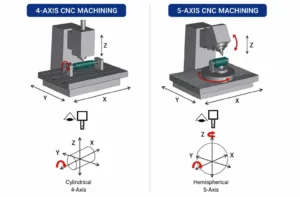
The main difference is the number and type of rotary movements available in addition to the three linear axes. A 4-axis setup adds one rotary axis for positioning or rotary machining. A 5-axis setup adds a second rotary axis, allowing the workpiece or tool to be positioned from more directions.
The table compares the practical differences in axis configuration, positioning, tool orientation, part geometry, setup requirements, programming, and machine cost.
| Feature | 4-Axis CNC | 5-Axis CNC |
| Linear axes | 3 linear axes: X, Y, Z | 3 linear axes: X, Y, Z |
| Rotary axes | 1 additional rotary axis | 2 additional rotary axes |
| Rotary positioning | Rotates the part around one rotary axis | Uses two rotary axes for multiple angular orientations |
| Tool orientation | Tool orientation is more limited by the single rotary axis and setup | Tool can be oriented from multiple directions; full 5-axis systems can change tool orientation during cutting |
| Multi-side machining | Can access multiple faces by rotating the workpiece | Can position the part to multiple faces and angles with fewer repositioning operations |
| Angled features | Best suited to features accessible through the available rotary direction | Better suited to features requiring different tool orientations |
| Compound surfaces | More limited tool access | Better suited to continuous contouring and complex surfaces |
| Setup count | May require additional setups for features outside the rotary axis | Can reduce setups on multi-sided and complex parts |
| Programming | Generally simpler for indexed or rotary work | More involved, particularly for simultaneous 5-axis toolpaths |
| Machine cost | Generally lower equipment cost | Generally higher equipment and programming cost |
How to Choose Between 4-Axis and 5-Axis CNC Machining
Before selecting the machining process, consider these questions:
- How many machining directions are required?
- Are the features arranged around one rotary axis?
- Are any surfaces positioned at 30°, 45°, 60°, or other angles?
- Can the cutter reach every feature without changing the part position?
- Would 4-axis machining require another fixture position?
- Are critical holes or faces controlled from different datums?
- Does the part contain deep cavities that require excessive tool stick-out?
- Would one 5-axis setup replace several 4-axis setups?
- How much additional setup and alignment time would 4-axis machining require?
- Does the production quantity justify the higher 5-axis machining cost?
CNC Machining Services for Complex Parts
YD Rapid provides CNC machining services for prototypes and low-volume parts requiring complex geometries, tight tolerances, and fewer setups.
A complex part can look straightforward in CAD and still create problems during machining. YD Rapid reviews the CAD model and 2D drawing before production to check the required machining direction, tool access, fixture positions, angles, and datum requirements.
If the drawing calls for several setups or difficult 4-axis access, the engineering team can review whether a 5-axis process would be more suitable. You also receive free DFM feedback and a quotation before production.

YD Rapid is an ISO 9001:2009-certified manufacturer. Send your part drawing and CAD model for review.
FAQs
Can a 4-axis CNC machine make angled holes?
A 4-axis machine can produce an angled hole when its rotary axis can position the hole axis correctly. A 45° hole is possible if the machine configuration provides the required approach.
Does a 5-axis machine always use all five axes at the same time?
The rotary axes can be used for positioning on a 5-axis machine. The part is then machined using the 3 linear axes. This is often referred to as 3+2 machining.
Can a 4-axis machine machine five sides of a part?
A 4-axis machine can access multiple faces with rotation of the part. If the rotary axis does not offer the necessary cutter access, then another setup may be necessary on the remaining face.
Does 5-axis machining eliminate all setups?
The part is not clamped or located. The primary advantage is the decreased frequency with which the part needs to be removed, realigned, and inspected.
Why does tool length matter more on complex 4-axis parts?
Cutter access may be restricted and may require a longer tool. For instance, an 80 mm stick-out can deflect less than a shorter tool, especially under heavy cuts.
Can 4-axis machining be cheaper for a complex part?
If the features on a job run in one direction on a 4-axis machine, and the rest of the job is only a simple set-up change, the machine may be cheaper to use. The additional setup may be less expensive than 5-axis programming and machine time.
What is 3+2 machining?
The rotary axes initially position the part or cutter at a specified angle. The axes that are rotating are then held stationary, and the three linear axes are used for the machining.
Is 3+2 machining the same as simultaneous 5-axis machining?
3+2 machining uses fixed rotary positions during cutting. Simultaneous 5-axis machining keeps the rotary and linear axes moving together as the cutter follows the programmed path.
Does 5-axis machining reduce the need for custom fixtures?
A 5-axis process can reduce fixture changes because more features may be reached from one setup. The fixture still needs enough clearance for the cutter, holder, and rotary movement.
Can a 5-axis machine improve access to deep cavities?
Tilting the cutter can provide a better approach to deep cavity walls and may allow a shorter cutter to reach the feature.
Are 5-axis machines suitable for simple parts?
5-axis equipment can machine simple parts, but the additional capability may not be necessary. A straightforward 3-axis or 4-axis process can be more practical when the geometry does not require multiple tool directions.
What information should be included in a drawing for 4-axis or 5-axis machining?
Include the material, dimensions, tolerances, datums, hole locations, threads, surface finish, and angular dimensions. The CAD model should also match the 2D drawing so the machining process can be reviewed correctly.