
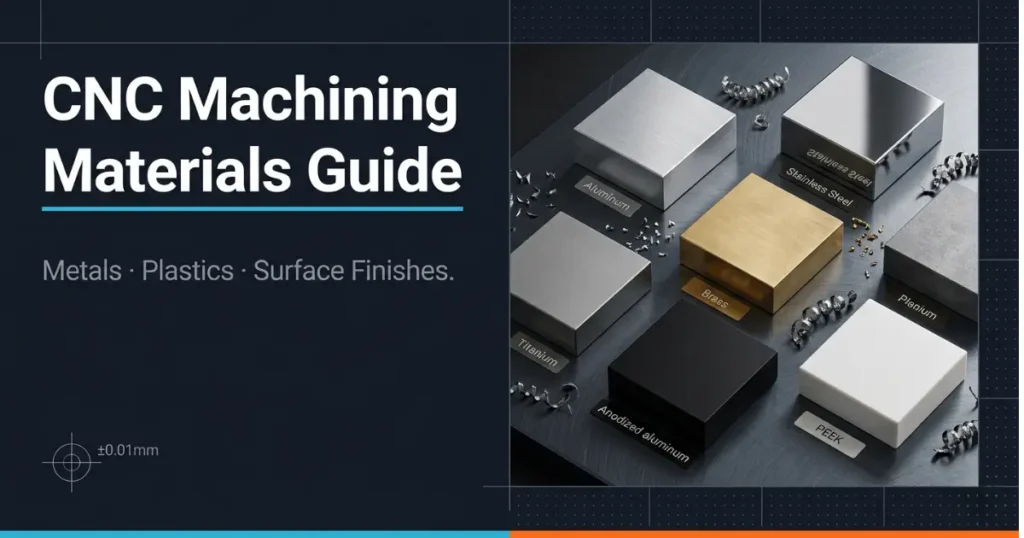
Metals and plastics are two main CNC machining materials. In metals, Aluminum 6061, 7075, Stainless Steel 303, 304, 316, carbon steel, brass and titanium are prominent. In CNC plastics, Acetal, ABS, PEEK, and Nylon are the main types.
Picking the wrong material for CNC machining is a big mistake. It wastes time, is more expensive, and ruins your tools. It can also lead to parts that break easily.
This guide explains the most common CNC materials. For example, you will read the features, pros and cons, and the best ways to use them.
What Is CNC Machining and Why Does Material Matter?
How CNC Machining Works
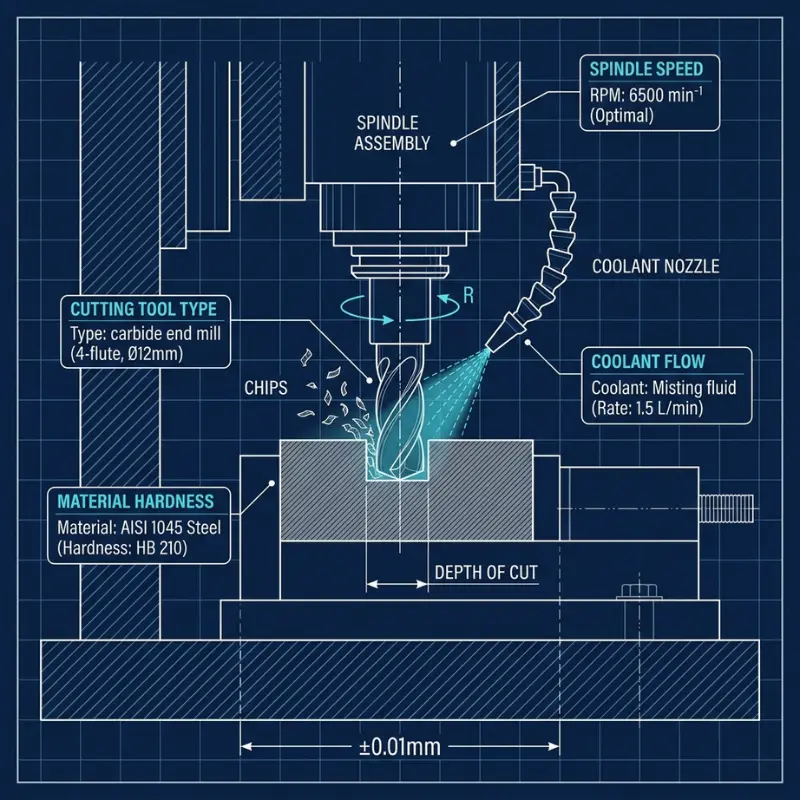
CNC machining removes material from a solid block using rotating cutting tools guided by computer instructions. The process is highly repeatable and capable of tolerances tighter than 0.01 mm. The machine alone, however, does not decide your outcome. The material you select shapes every variable that follows:
- How fast does the spindle run?
- Which cutting tools survive the job?
- How much does the part cost?
- Whether it performs in service?
How CNC Machining Material Affects Cost, Precision, and Lead Time
Impact of Material on Machining Speed
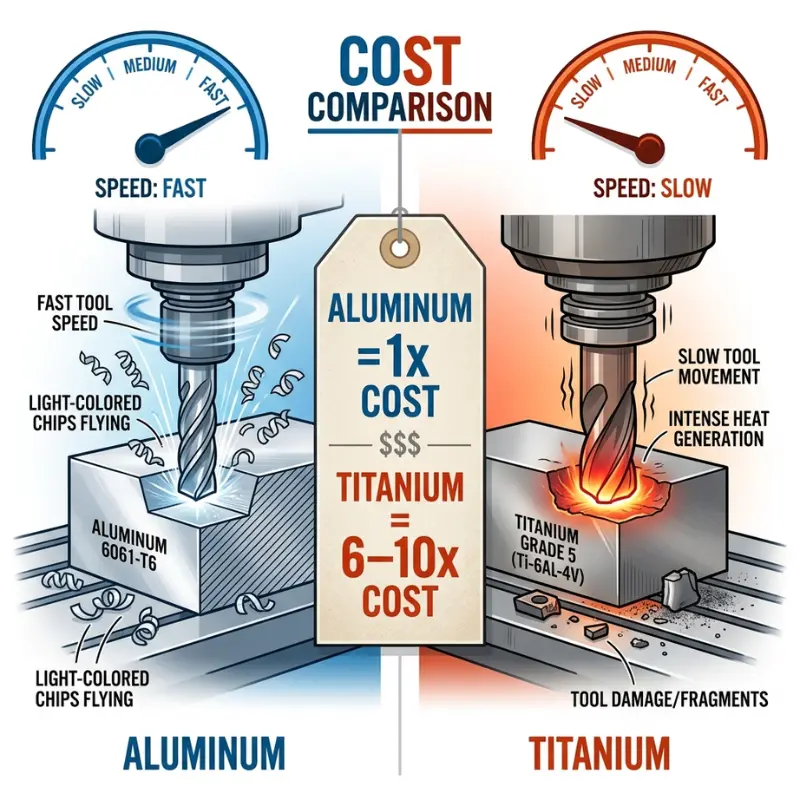
Soft metals like aluminum are easy to cut. You can machine them very fast. Hard metals like titanium are difficult. You must cut them slowly. You also need special tools and high-pressure liquid to keep them cool.
Cost Differences Between CNC Materials
Because of this, titanium parts cost 6 to 10 times more than aluminum parts. This cost is not just for the metal. It is because the machines work longer and the tools break faster.
Dimensional Stability in CNC Plastics vs Metals
Materials also change size. Plastics grow or shrink more than metals. You must be careful if your part needs to be very exact. Plastics like PEEK and Delrin stay the same size well. Standard ABS does not, and you cannot fix this problem with machine settings.
CNC Machining Material Properties You Must Understand
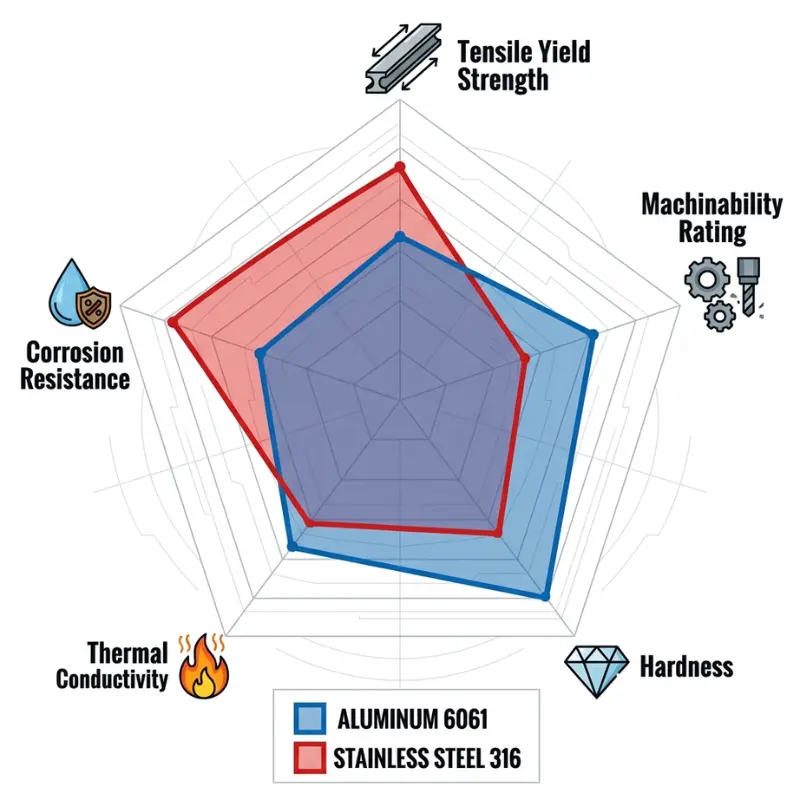
Before you compare CNC materials, look at these five things. These properties help you choose the right one.
- Tensile Yield Strength
- Machinability Rating
- Hardness
- Thermal Conductivity
- Corrosion Resistance:
CNC Material Categories: Metals vs Plastics vs Composites
CNC Machining Metals Overview
Metals are the most popular choice for CNC machining. They are strong, hard, and handle heat well.
CNC Machining Plastics Overview
On the other hand, plastics are lighter and do not rust, but they are not as strong as metal. Composites like carbon fiber are very strong and light. However, they are expensive to machine and ruin cutting tools quickly.
CNC Composites: Benefits and Limitations
For most jobs, you should use metals or plastics. Aerospace and high-end car parts use composites because weight is very important. For other projects, composites are usually not the best choice.
CNC Material Selection Criteria for Manufacturing
Balancing Strength, Weight, and Cost
No single CNC material is perfect for everything. Aluminum is light and easy to cut, but it is not as strong as steel. Titanium is very strong and light, but it is very hard to cut. These trade-offs happen in every project.
Machinability vs Production Time
The price of the raw material is only one part of the cost. The time the machine runs and how fast tools break also cost money.
Trade-Offs in CNC Material Selection
A material with a 40% machinability rating takes 2.5 times longer to cut than one at 100%. This extra time makes the part much more expensive. So important is to ask about the machinability rating early to avoid high costs.
CNC Machining Metals Guide
Metals are a common choice for CNC machining. Each group of metals cuts differently. Even inside one group, different grades change the work a lot.
It is very important to understand the specific grade you are using.
Aluminum 6061 vs 7075 for CNC Machining
Aluminum is the most popular metal for CNC machining. It is light, easy to cut, and does not rust easily.
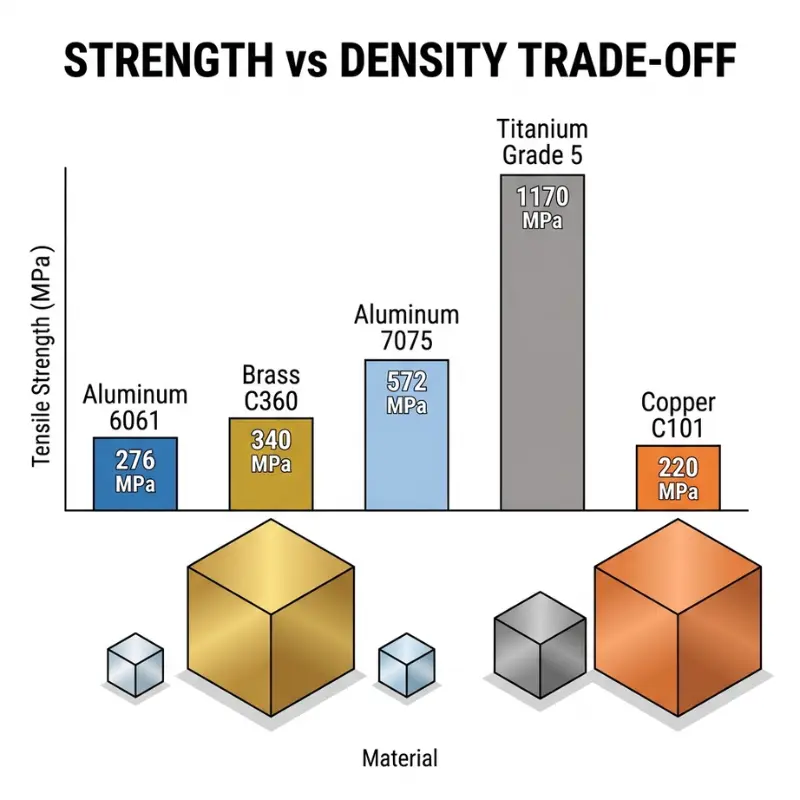
Grade 6061 is the best choice for everyday parts. You can weld it and coat it easily. It is strong enough for car parts, cases, and brackets. Its strength is about 276 MPa.
Grade 7075 is much stronger, with a strength over 500 MPa. It is as strong as some steel but much lighter. It is used for airplane frames and high-stress parts. However, it does not weld well and can rust easier than 6061, so it needs a protective coating.
Carbon Steel and Alloy Steel in CNC Machining
Mild steel, like 1018 or A36, is the standard for CNC work. It is easy to cut, easy to weld, and very cheap. The main problem is rust. You must add a coating if the part will be near water or moisture.
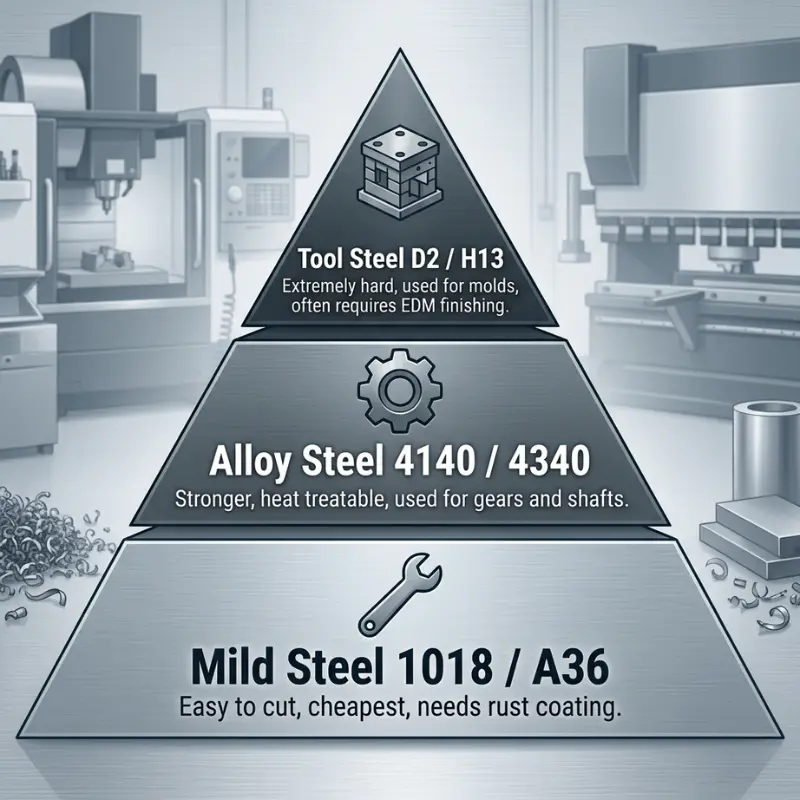
Alloy steels, like 4140 and 4340, are much stronger. After heat treatment, they are very tough. People use them for gears and shafts that must not break. They are harder to cut than mild steel, so they take more time to machine.
Tool steel, like D2 and H13, is extremely hard. It is used to make molds and other cutting tools. This metal is very difficult to machine. Often, you must use a special machine called an EDM to finish the part after the CNC work is done.
Stainless Steel Grades 303, 304, and 316 Comparison
Stainless steel stays clean because it contains chromium 10.5%. Grade 304 is the most common type. It is strong, easy to weld, and does not rust in most places. It is used for food equipment and industrial parts.
Grade 316 has molybdenum added. This makes it much better for salty environments. You must use 316 for boat parts or medical manufacturing. Both 304 and 316 are hard to cut. The metal gets harder while the machine works and cutting speed drops to 40 to 60 m/min. This makes the work slow and takes more time than regular steel.
Grade 303 is easier to cut because it has sulfur. It machines very well, but it can rust a little easier than 304. Use 303 if you want to save time and do not need the highest protection from rust.
| Material Grade | Density g/cm3 | Melting Point ∘C | Tensile Strength | Machinability |
| Carbon Steel 1018 | 7.87 | 1,425–1,540 | 440 | 78% |
| Alloy Steel 4140 | 7.85 | 1,416–1,460 | 655–740 | 65% |
| Alloy Steel 4340 | 7.85 | 1,427 | 745–1,100 | 50% |
| Stainless Steel 303 | 8.00 | 1,400–1,420 | 515 | 75% |
| Stainless Steel 304 | 8.00 | 1,400–1,455 | 515 | 45% |
| Stainless Steel 316 | 8.00 | 1,370–1,400 | 515 | 40% |
Brass in CNC Machining: Benefits and Uses
Brass, usually grade MS58, is very easy to cut. It is twice as fast to machine as standard steel. It leaves a clean finish and allows for very exact sizes.
Common uses include threaded parts, valves, electrical connectors, and decorations. Brass is soft, so you can shape it easily and join parts using a soldering method.
Brass is heavier than aluminum and more expensive than mild steel. However, because it machines so quickly, you can save a lot of money on labor. This is especially true for complex parts made in large numbers.
Copper CNC Machining Applications and Challenges
Pure copper conductivity is 400 W/m·K that is twice compared to aluminum. People use it for heat sinks, electrical parts, and coils.
However, copper is difficult to cut. Because it is soft, it can stick to the tools. You must use very sharp tools and special liquids to keep it cool. If you use the right setup, you can still machine it fast at 150 to 200 m/min speed. This helps keep the cost of the parts reasonable.
Titanium CNC Machining: Strength vs Cost
Titanium Grade 5 is also called Ti-6Al-4V. Its tensile strength is around 880 MPa at a density of only 4.43 g/cm3. It is as strong as steel but weighs much less. This is why it is used for airplanes, medical implants, and boat parts.
However, the cost to machine titanium is very high. Its thermal conductivity is 7 W/m·K and it does not move heat away from the tools. Instead, the heat stays on the tool tip and ruins it quickly. Because of this, the machine must run very slowly. You also need CBN tools and high-pressure liquid to control the heat.
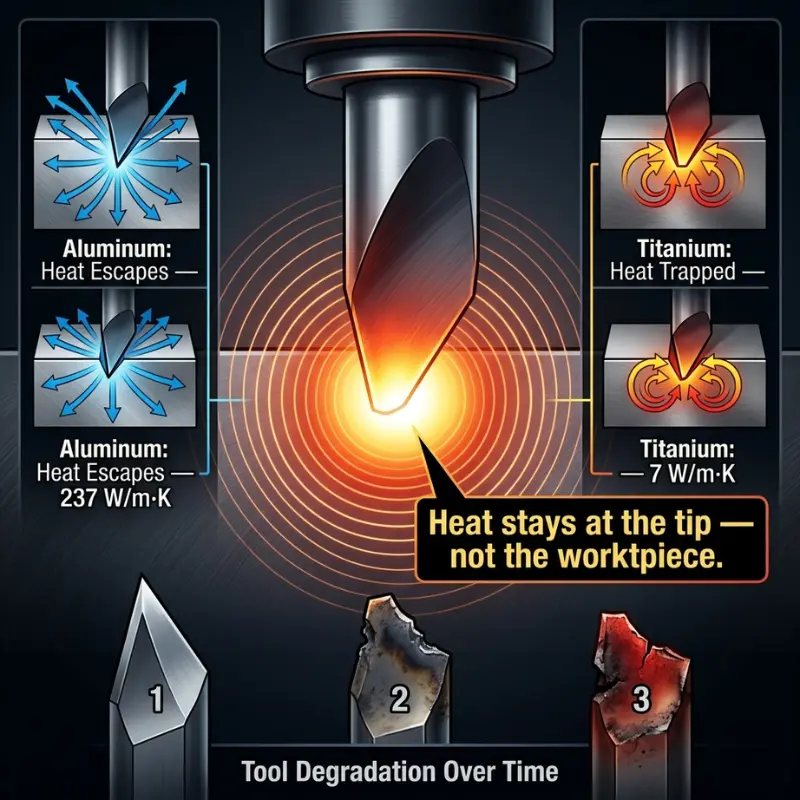
These problems make titanium parts 5 to 10 times more expensive than aluminum parts. There is no cheap way to machine this metal. You should only use titanium if your project absolutely needs its special strength and weight.
| Material Grade | Density g/cm3 | Melting Point ∘C | Tensile Strength MPa | Machinability |
| Aluminum 6061-T6 | 2.70 | 582–652 | 310 | 100% (Ref) |
| Aluminum 7075-T6 | 2.81 | 477–635 | 572 | 70% |
| Titanium Grade 5 | 4.43 | 1,604–1,660 | 1,170 | 22% |
| Brass C360 (Free Cut) | 8.50 | 885–900 | 340 | 100%++ |
| Copper C101 | 8.96 | 1,083 | 220 | 20% |
CNC Machining Plastics Guide: Best Materials and Uses
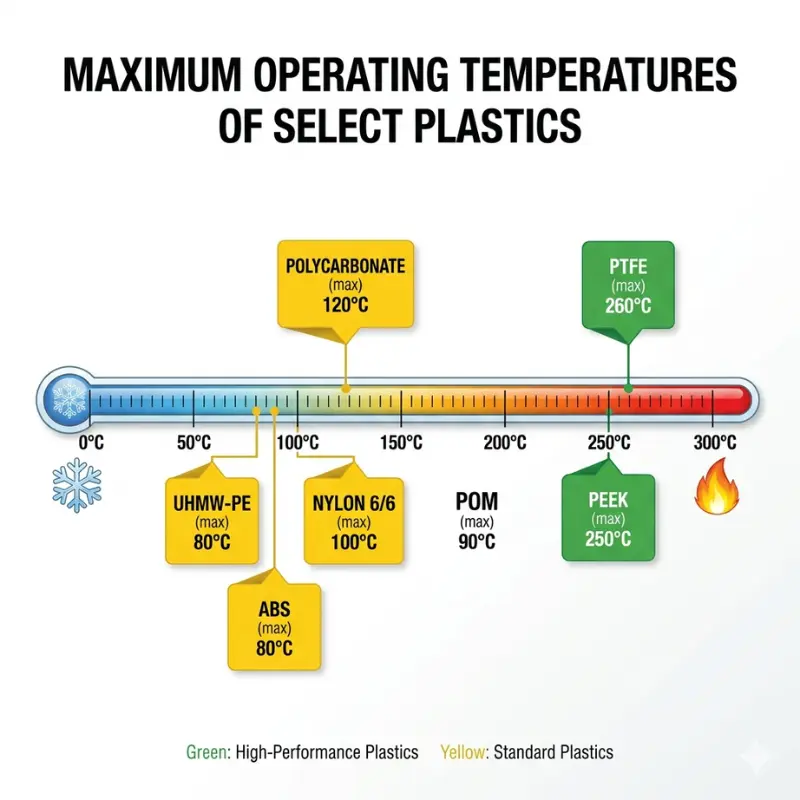
Some high-quality plastics are better than metals for certain jobs. For example, PEEK strength sustains even at temperatures up to 250°C. They can be lighter, resist chemicals better, and provide great electrical insulation. Subsequently, POM is very stable as it doesn’t expand or shrink easily.
The important thing is to pick the plastic that fits your needs. Do not choose metal just because it is what you usually use.
CNC Machining Plastics Comparison Table
| Material | Tensile Strength | Max Operating Temp |
| PEEK | 100 – 110 | 250°C |
| Ultem | 100 – 105 | 170°C |
| Nylon 6/6 | 60 – 85 | 100°C |
| POM | 60 – 70 | 90°C |
| Polycarbonate | 60 – 70 | 120°C |
| PTFE | 20 – 35 | 260°C |
| UHMW-PE | 20 – 40 | 80°C |
ABS for CNC Prototyping
ABS is the most common plastic for prototypes. It is cheap and easy to machine. You can paint or glue it easily. It is good for covers and cases that do not carry heavy weight. However, it cannot handle high heat. Do not use it near hot engines or temperatures above 80°C. It is best for testing how a part looks and fits.
Nylon PA6 vs PA66 Properties
Nylon is much stronger and tougher than ABS. It can handle heat up to 120°C. This makes it a great choice for gears, bushings, and brackets. It is a good replacement for metal when you need a lighter part. PA66 is much better in dimensional stability compared to PA6
Note: Nylon absorbs water from the air, which can slightly change its size over time. You can fix this by painting or sealing the part.
PEEK High-Performance CNC Plastic
PEEK is a high-end plastic. It stays strong even at 250°C and resists chemicals and radiation. It is used for medical implants and airplane parts where regular plastics would fail.
It is very expensive. It is also harder to machine because the material can spring back while cutting. Only use PEEK if your project absolutely needs its extreme features.
Polycarbonate vs Acrylic Comparison
Polycarbonate is very strong as it does not break easily on impact. It is used for protective screens and light covers. You must use sharp tools to cut it so it does not melt.
Acrylic is even clearer but breaks more easily than polycarbonate. It also scratches more often. Use acrylic for decorations or lights, but use polycarbonate if the part will be hit or handled a lot.
Delrin (POM) for Precision CNC Parts
Delrin behaves a lot like metal when you cut it. It stays the same size very well and allows for very exact dimensions. It is also very slippery, so it works great for parts that slide or rotate.
Unlike nylon, Delrin does not absorb water. This means its size stays the same even in damp places. It is perfect for precision gears, valves, and food processing parts. If you need a precision plastic part that moves, check Delrin first.
CNC Material Properties Explained
Technical numbers can be hard to understand. Here is how they work in real life.
Tensile Yield Strength
This shows how much weight a material can take before it bends permanently. If you stay below this limit, the part returns to its original shape. If you go over it, the part stays bent. Engineers usually choose materials much stronger than needed to be safe.
Examples of Strength:
- Mild Steel: 250 MPa
- Aluminum 6061: 276 MPa
- Stainless 316: 290 MPa
- Titanium Grade 5: 880 MPa
- Plastics: 40 to 100 MPa
Machinability Rating
This tells you how easy it is to cut a material. We compare everything to a standard steel.
- Brass 200%: Cuts twice as fast.
- Titanium 20–30%: Takes 3 to 5 times longer to cut.
Because machine shops charge for their time, a low rating means a much higher price. If a rating is 50%, the cost to make the part is usually double.
Hardness Scales in CNC Materials
Hardness shows if a surface is easy to dent. We use the HRB scale for soft metals and the HRC scale for hard ones.
- Above 45 HRC: Very difficult to cut. You need special, expensive tools.
- Surface Finish: Harder materials allow for a smoother, finer finish. This is important for parts that must seal tightly or move against each other
Heat and Conductivity
If your part is heating, there are two reasons:
Max Temperature
What is its highest temperature? For example, PEEK can manage 250°C, while regular plastics fail at 80°C.
Thermal Conductivity
How fast does heat move through it? Aluminum moves heat four times better than steel. Therefore, aluminum is a good choice for heat sink manufacturers.
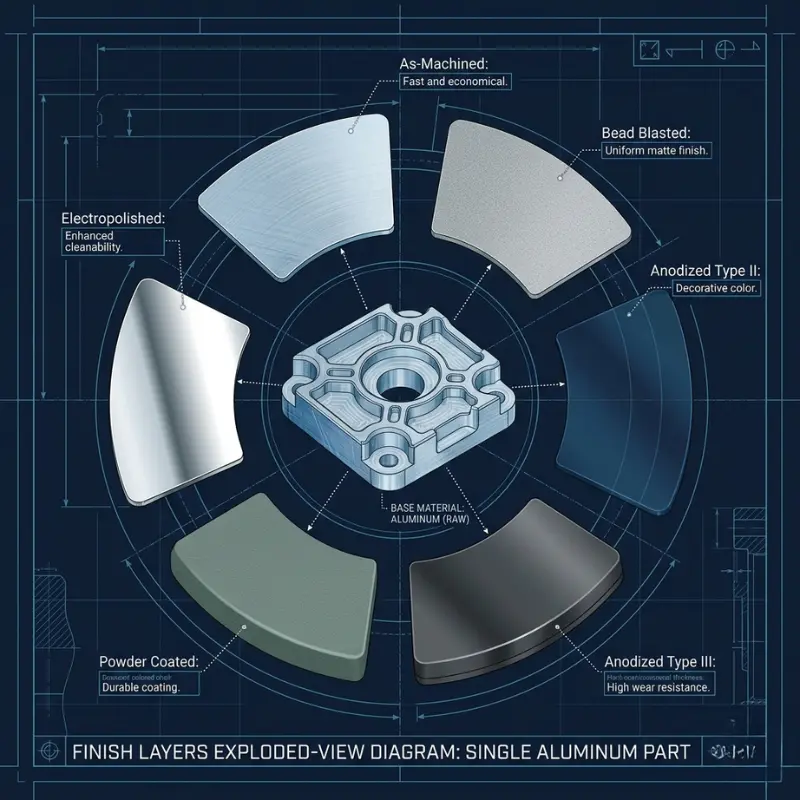
CNC Machining Surface Finishes by Materials Types
Choosing the right surface finishing for your metal or plastic parts is important for how they look and work.
As-Machined Finish
As-machined means you leave the part exactly how it comes out of the CNC machine. This is a good choice for internal parts that people will not see or for early prototypes. The surface will have small lines from the cutting tools. This finish is perfect for parts that must fit together very tightly because adding a coating can change the size of the part.
Bead Blasting Surface Finish
Bead blasting sprays tiny glass or ceramic beads at the part. This creates a smooth, matte texture and hides tool marks. It does not stop rust by itself. Its main job is to prepare the surface so that paint or other coatings stick better. Many companies use this on electronics to give them a soft, non-shiny look.
Anodizing Types II and III for CNC Parts
Anodizing turns the outside of the metal into a hard protective layer. This layer is part of the metal, so it will not peel off.
- Type II: This is used for decoration and basic protection. You can add colors like red, blue, or black.
- Type III: This creates a much thicker and harder layer. Use this for parts that rub against other parts or need to last a long time.
Note on Size: Anodizing makes the part slightly thicker. For example, a thick coating will grow out from the surface and also go into the metal. You must plan for this change in size during design.
Powder Coating for Metal Parts
Powder coating is a dry powder that is baked onto the metal in a hot oven. It creates a very thick and strong layer that resists scratches and fading from the sun. It works well on steel and aluminum. You cannot use it on most plastics because the oven heat will melt them. Because the coating is thick, you must cover (mask) holes and threads so they do not get filled with paint.
Electroless Nickel Plating
This process uses a chemical reaction to coat a part in nickel. Unlike other plating, it covers every area perfectly even. It reaches deep inside holes and threads with the same thickness. It makes parts very hard and protects them from wear. It is a great choice for complex shapes that need to stay a very specific size.
Passivation for Stainless Steel
When stainless steel is machined, tiny bits of iron from the tools can get stuck on the surface. These bits will rust. Passivation uses acid to wash away that iron. This leaves the part clean and helps it resist rust correctly. It does not change the size of the part at all.
Black Oxide Coating
Black oxide turns the surface of steel black. It is very thin and does not change the part’s size. It provides a little bit of protection against rust, but you usually need to add oil to keep it from rusting. It is mostly used for tools and gun parts to reduce light reflections.
Electropolishing Applications
This is like reverse plating. It removes a very thin layer of metal to make the surface extremely smooth and shiny. It is used for food, medicine, and lab equipment. Because the surface is so smooth, it is very easy to clean and bacteria cannot hide on it.
Vapor Polishing for Plastics
This process uses chemical gas to melt the surface of plastic parts very slightly. This makes the plastic look as clear as glass. It is used for windows, light pipes, and medical tools. It does not work on metals or most other types of plastic.
Surface Finish Compatibility by Material
| Finish | Aluminum | Stainless Steel | Mild / Alloy Steel | Brass / Copper | Titanium | Engineering Plastics |
| As-machined | Yes | Yes | Yes | Yes | Yes | Yes |
| Bead blasting | Yes | Yes | Yes | Yes | Yes | Limited |
| Anodizing Type II | Ideal | No | No | No | Yes | No |
| Anodizing Type III | Ideal | No | No | No | Yes | No |
| Powder coating | Yes | Yes | Yes | Yes | No | No |
| Electroless nickel plating | Yes | Yes | Yes | Yes | Yes | No |
| Zinc plating | No | No | Ideal | No | No | No |
| Hard chrome plating | Limited | Yes | Yes | Yes | No | No |
| Passivation | Yes (chem film) | Ideal | No | No | Yes | No |
| Black oxide | No | Yes (limited) | Ideal | Yes | No | No |
| Electropolishing | Yes | Ideal | No | Yes | Yes | No |
| Painting / primer coat | Yes | Yes | Yes | Yes | Yes | Yes |
| Vapor polishing | No | No | No | No | No | PC / Acrylic only |
Best CNC Materials by Industry and Application
Aerospace CNC Materials
Weight is the most important factor here.
- Aluminum 7075
Aluminum 7075 is good for the main structure of airplanes because it is strong and light.
- Titanium Grade 5
Titanium grade 5 is used to make engine parts. These parts can face high heat and extreme stress.
- Composites
CFRP is used to make wings, and tail sections of airplanes. Modern air buses like Boeing 787 and Airbus A350 are using composite parts for up to 50%.
Medical CNC Materials
Medical tools and implants must be safe for the human body and easy to clean.
- Stainless 316L
The most common choice. It is durable and can be sterilized easily in high-heat machines.
- PEEK
Used for spine and bone implants. It does not block X-rays, so doctors can see through it. It also feels more like natural bone than metal does.
Automotive and Robotics Materials
- Steel and Aluminum
Used for the engine and frame where strength and heat resistance are needed.
- Plastics
Used for interior parts and brackets to save weight and money.
Electronics and Consumer Product Materials
- Brass
Brass is used to make electrical connectors. Not only brass is cheap but can also make parts in bulk quantity without any deformation in shape.
- Copper
Used for heat sinks and power parts because copper conductivity is very good as it often reaches at 101% to 102% IACS.
- Polycarbonate and Acrylic
Used for screens, light covers, and cases because they are clear and do not break easily.
Rapid Prototyping Materials
Prototyping is about making parts fast and cheap to test an idea.
- ABS
Best for checking if a part looks right and fits in its place. It is not for heavy testing.
- Aluminum 6061
The standard for testing parts that must work like the final product. It is easy to cut and very predictable.
- Delrin
Use this if your final part needs to slide or move. It behaves the same in the prototype as it will in the final version.
How to Choose the Right CNC Machining Material
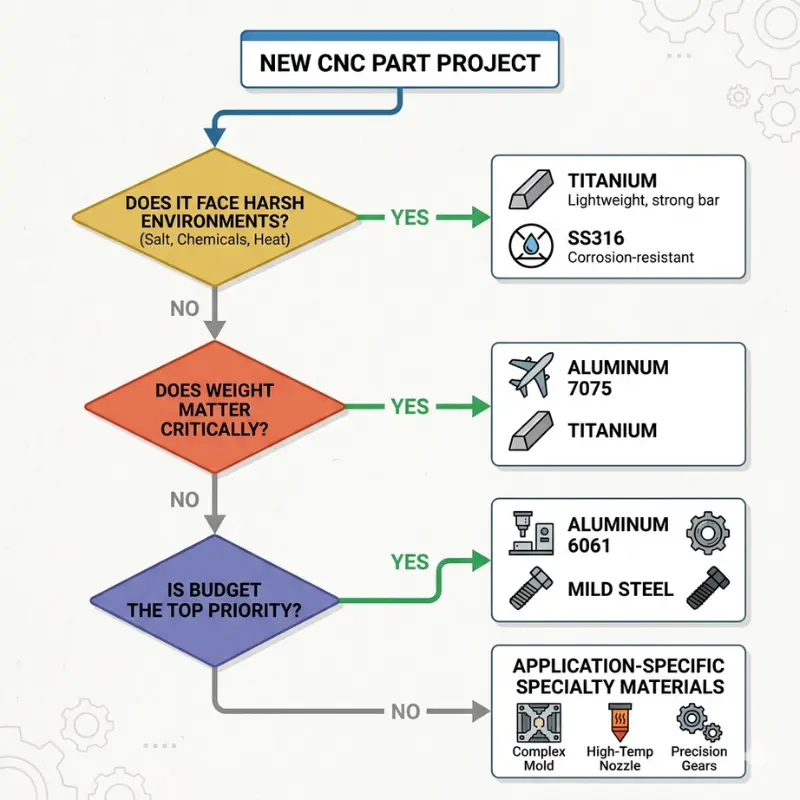
This process works for new and old designs. Use these three steps to find the right material.
Step 1: List Your Requirements
Identify what the part does. Check if it handles heavy loads or high heat. See if it touches water, salt, or chemicals. These needs remove bad options immediately. This makes your search faster and more accurate.
Step 2: Start with the Material Properties
Match your needs to material traits. Find your toughest requirement first. If the part must not rust in the sea, look at titanium or stainless steel. If it must be light, look at aluminum. Starting with your biggest problem prevents costly mistakes later.
Step 3: Check Cost and Lead Time
Compare your top choices by looking at machining costs. Some metals are harder to cut and take more time. A simple part is cheap, but a complex shape in hard metal is very expensive. If the cost is too high, try a cheaper material with a special coating.
CNC Machining Material Selection Summary
One intelligent choice that a procurement team makes is to choose the appropriate material. Start with your main issue. If it is high temperatures, weight or exposure to chemicals. Once you have figured out what the biggest challenge is, find the materials that can deal with it. Before you have finalized your design, you should never forget checking the machining costs.
Youde CNC machining services can advise you on the best material to use to machine CNC parts. We assist you in balancing between low costs and high quality in order to make your design successful.
FAQs
What Is the Best Material for CNC Machining?
There is no single “best” material. The choice depends on your needs. Aluminum 6061 is the top general-purpose choice. It is cheap, fast to cut, and works well for most parts. However, other materials are better for specific goals:
- Stainless 316: Best for resisting rust in harsh areas.
- Titanium: Best for high strength without adding much weight.
- Delrin: Best for sliding parts that need exact sizes.
Aluminum vs Steel for CNC Parts: Which Should You Choose?
Aluminum is lighter and faster to machine. Steel is stronger and handles high heat much better.
- Choose Aluminum if you need to save weight or money.
- Choose Steel for heavy loads or parts that must resist wear.
What Is the Cheapest CNC Machining Material?
Aluminum 6061 and mild steel are usually the cheapest. They have low raw material costs and are easy to cut quickly. Some plastics cost less per pound, but they are often too weak for many jobs.
Can All Plastics Be CNC Machined?
No. Some plastics are too soft or flexible. They bend instead of cutting cleanly, which ruins the accuracy. Other plastics are very brittle and create dusty waste that wears out tools. The best plastics for CNC are PEEK, Delrin, Nylon, Polycarbonate, and ABS. Delrin and Nylon are the most common choices for parts that need to be precise and resist wear.
Why Is Titanium So Expensive to CNC Machine?
Titanium does not move heat away from the cutting area well. While aluminum spreads heat quickly, titanium keeps the heat at the tip of the cutting tool. This heat destroys tools fast. To prevent damage, machines must run very slowly. You also need expensive cooling systems and special tools. Because it takes more time and ruins more tools, titanium parts always cost much more than other metals.
What is machinability rating?
A machinability rating is a score that shows how easy it is to cut a material. It compares the material to a standard steel called B1112.
- Over 100%: The material is very easy to cut.
- Under 100%: The material is difficult to cut
Is stainless steel harder to machine than aluminum?
Yes. Stainless steel is much tougher and stronger. It creates a lot of heat during cutting, which can damage tools. Aluminum is soft and can be machined much faster.
What plastic is easiest to CNC machine?
Delrin is the best plastic for machining. It is stiff, does not melt easily during cutting, and stays exactly the same size. ABS is also a good, easy choice.
What is the strongest CNC material?
Titanium Grade 5 is the strongest CNC material. For pure strength without worrying about weight, Alloy Steels or nickel-based Superalloys are the strongest.
How do I reduce CNC machining cost?
- Pick easy materials
- Simplify the design
- Reduce depth
- Limit setups
Can you CNC machine wood?
Yes. CNC routers are often used to cut hardwoods and softwoods. It is common for furniture, signs, and art. You must use a good dust collection system to manage wood dust.
What is the difference between milling and turning materials?
The difference is which part moves.
- CNC Milling: The part stays still while a spinning tool moves to cut it.
- CNC Turning: The part spins very fast while a still tool cuts it.
What materials are hardest to CNC machine?
-
- Inconel
- Titanium
- Hardened Tool Steel