On average, 3-axis CNC machining costs $75–$200 per hour. 5-axis machines cost $200–$350+ per hour. Simple machined parts can cost as little as $10–$50, and complex parts start from $100. Most people focus only on the hourly rate, but the real price depends on your design and the order size.
A small change in your design can reduce cost by 50%
Most guides don’t explain how does a CNC service charge. Below is a list of everything that changes the price. It uses real math and examples to show you how to change your design to save money.
How CNC Machining Is Priced: Hourly vs Per-Part Quotes
Shop prices work two ways. Prototype and low-volume jobs are generally quoted per hour. This is because machining time dominates, and part quantities are too small to amortize setup meaningfully. Production runs quote per part. Setup, programming, material, machining, and finishing are folded into a unit price that drops as quantity rises.
The formula shops use internally looks like this:
Total Cost = Material + Setup & Programming + Post-Processing
Making a few early prototypes is expensive because the consumption of time is the same for setting up the machines and writing the code to make 2 or 200 parts.
CNC Machining Material Cost
The price of raw metal is not the only cost. A metal that is expensive to buy but fast to cut can actually be cheaper in the end. This is because machinability controls how fast the machine runs, how deep it can cut, and how long the tools last.
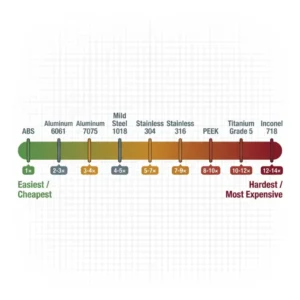
For example, Aluminum 6061 is the standard. It is very easy to cut at 200–400 m/min with carbide tooling. 304 Stainless Steel is much harder to work with; it must be cut slowly, breaks tools faster, and needs constant cooling liquid. Because of this, making the exact same part out of stainless steel takes 3 to 4 times longer and costs more in broken tools.
| Material | Raw Cost | Machinability | Effective Cost Multiplier vs. Al 6061 |
| Aluminum 6061 | $5–$10/kg | Excellent | 1× |
| Aluminum 7075 | $8–$15/kg | Very good | 1.1–1.3× |
| Mild Steel 1018 | $2–$5/kg | Good | 1.5–2× |
| Stainless 304 | $6–$12/kg | Difficult | 3–4× |
| Stainless 316 | $8–$15/kg | Difficult | 3.5–4.5× |
| ABS | $3–$6/kg | Easy | 0.7–0.9× |
| Nylon PA6/PA66 | $5–$10/kg | Easy | 0.8–1× |
| PEEK | $80–$150/kg | Moderate | 4–6× |
| Titanium Grade 5 | $100–$200/kg | Very difficult | 6–10× |
| Inconel 718 | $80–$160/kg | Extremely difficult | 8–14× |
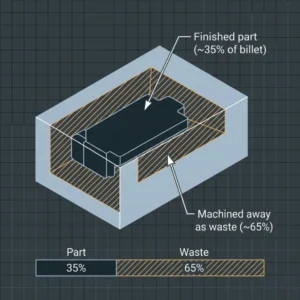
Material waste is a cost many people forget. When a part is made, the machine cuts away 40% to 70% of the metal as waste. You have to pay for the full block of metal the shop starts with, not just the weight of the finished part. For expensive metals like titanium, the cost of this wasted metal can be higher than the cost of the work itself.
Simple advice for choosing materials:
- Aluminum 6061: Use this for brackets or cases to save money.
- Aluminum 7075: Use this if you need something much stronger than 6061 but don’t want the weight of steel.
- Stainless 316L: Only use this if the part faces corrosion.
How Part Complexity and Geometry Affect CNC Machining Cost
Complexity cost comes from three sources:
- Programming time
- Machine time
- and setups.
How to Reduce CNC Programming Costs With Simpler Design
Complex parts take more time to program. A simple part with a few holes, for example, will take only an hour of computer work. However, a complex part with curved surfaces and many details can take 4 to 8 hours. So this time is a one-time cost; you pay the same amount for the programming whether you make one part or a hundred.
Design Features That Slow Down Milling and Increase Cost
If a part has features that are hard to cut, the machine must move more slowly. For example, very thin walls under 1 mm are fragile and will vibrate if the machine moves too fast.
In CNC milling, deep, narrow slots are also difficult because they require long, thin tools that break easily.
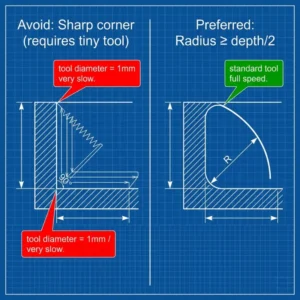
Additionally, the corners inside a part must match the size of the cutting tool. For instance, if a corner is too tight, the machine has to use a tiny tool, which takes much longer to finish the job.
How to Lower Cost by Minimizing CNC Setup Changes
Setups refer to every time a worker has to stop the machine and move the part to cut a different side. Each move adds 30 to 90 minutes of expensive labor where the machine isn’t even cutting.
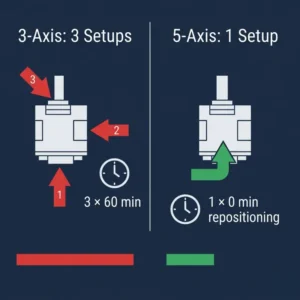
A part that needs to be moved three times on a standard machine will be finished in one go on a more advanced 5-axis machine. Even if the 5-axis CNC machining costs more per hour, it can be cheaper in the end because it will eliminate the cost of multiple setups.
| Machine Type | Rate |
| 3-axis CNC mill | $30–$50/hr |
| 4-axis CNC mill | $50–$80/hr |
| 5-axis CNC mill | $75–$150/hr |
| CNC lathe | $25–$60/hr |
| Swiss-type lathe | $60–$120/hr |
How much does CNC machining cost?
The cost of CNC machining on average ranges from $40 to $150 per hour.
| Machine Type | Hourly Rate (USD) | Best For |
| 3-Axis Milling | $40 – $80 | Simple, flat parts |
| CNC Lathe (Turning) | $35 – $75 | Round parts |
| 5-Axis Milling | $100 – $150+ | Very complex parts |
CNC Cost Per Hour Vs Per Part
To show you how the cost changes, here is an example using a simple aluminum part that takes 20 minutes to machine.
CNC Machining Cost Per Hour
cnc machining cost per hour is different for 3-axis, 5-axis and lathe machines.
- 3-Axis Machine: $40 to $70 per hour.
- 5-Axis Machine: $100 to $150 per hour.
- Lathe Turning: $35 to $60 per hour.
CNC Machining Cost Per Part
CNC machining cost per part is given in the following table:
| Number of Parts | Setup Fee | Machining + Material | Total Cost | Cost Per Part |
| 1 Part | $150 | $30 | $180 | $180.00 |
| 10 Parts | $150 | $300 | $450 | $45.00 |
| 100 Parts | $150 | $3,000 | $3,150 | $31.50 |
What effects CNC Machining Cost
Three main factors change the price of a CNC machined part:
- Material
Aluminum is cheap and easy to cut. Stainless Steel and Titanium are expensive and take a long time to machine, which increases the price.
- Complexity
Parts with many holes, and deep pockets need more setups and special tools. Complex features of the part also increase the price.
- Quantity:
Ordering in bulk reduces the cost. Factories charge a Setup Fee to program the machine. In a large order, this fee is shared across many parts.
How CNC Tolerances Affect Machining Cost
Standard CNC machines can easily reach measurements within ±0.1 mm for milled parts and ±0.05 mm for turned parts at no extra cost. However, the price goes up very quickly as you ask for more precision.
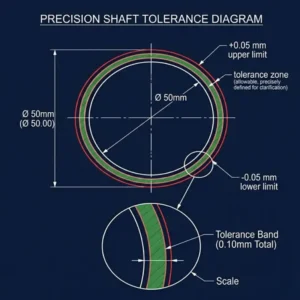
If you ask for ±0.05 mm on milled parts, it adds 10% to 20% to the cost. The reason is that the machine has to take a slow, extra finishing cut. If you tighten it to ±0.02 mm, the cost will increase by 30% to 50% because the metal can expand or shrink with heat, so the shop has to wait for the part to cool down and measure it constantly.
Measurements tighter than ±0.01 mm can double or triple the price. At this level, the work must be done in a room with controlled temperature. Moreover, you need high tech tools to check the parts. Many regular shops cannot even make parts this precise.
Use Targeted Tolerances to Save Cost
A frequent and expensive mistake is applying strict measurements to the entire part. If you mark every single dimension as very tight like ±0.025 mm, the shop will charge you more for every cut. You should only use tight measurements for parts that must fit together perfectly. Checking your design to see which measurements actually need to be precise can easily lower your price by 20% to 30%.
Check Hard Anodize Coating Growth
A common mistake happens when parts are coated with hard anodize. This coating adds about 0.012 to 0.025 mm of thickness to every surface. It grows half into the metal and half out of the metal. If you need a hole to be a specific size after it is coated, you must make it slightly larger during the machining stage. The purpose is to leave room for this growth.
Surface Finishing Cost in CNC Machining
Surface finish requirements apply at the feature level. This means over-specifying one surface does not have to mean over-specifying everything.
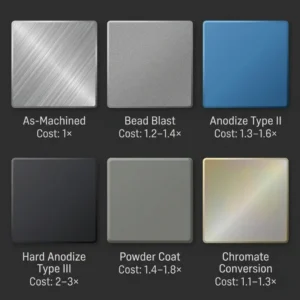
| Finish | Approx. Added Cost | Key Consideration |
| As-machined | — | Ra 1.6 to 3.2 µm. Tool marks are visible. |
| Bead blast | $5–$20/part | Uniform matte. No dimensional change. |
| Anodize Type II | $10–$40/part | 5 to 25 µm layer. Light corrosion protection. |
| Hard Anodize Type III | $15–$60/part | 25 to 75 µm. Wear-resistant. Adds about 0.025 mm. |
| Electroless nickel | $20–$80/part | Uniform buildup. Affects tight tolerances. |
| Chromate conversion | $5–$15/part | Thin and conductive. This is also called Alodine. |
| Passivation | $5–$30/part | Chemical process. This is for stainless steel. |
| Powder coat | $20–$60/part | Cosmetic. 60 to 100 µm buildup. Masks fine threads. |
A common mistake is asking for a special finish on the whole part. Instead, you should only mark the specific areas on your drawing that really need it. Areas that are hidden, inside holes, or parts that don’t touch anything else can be left as-machined. If you are making a large order, like 500 parts, saving a small amount on each one by not finishing every surface increases a lot of money.
CNC Machining Lead Times and Rush Order Costs
Standard CNC Machining Lead Times by Job Type
Most shops take 5 to 15 business days to finish a part. This depends on how busy the shop is and how many steps your part needs.
How Much Does Rush CNC Machining Cost?
If you need parts in 24 to 72 hours, you will pay 25% to 75% extra. This high price covers the risk the shop takes by making other customers wait. For simple parts, a 3-day rush is possible. However, if your part needs a special coating like anodizing, a 3-day rush is usually impossible because the shop has to send the parts to a different company to finish them.
How to Avoid Paying Double on Rushed CNC Orders
If you think your design might change, do not rush the first order. If you pay extra to rush a part and then realize the design is wrong, you have to pay for the rush and the new order. It is better to wait the standard time for the first sample, check it, and then order the rest when you are sure it is perfect.
Full CNC Cost Breakdown: Mid-Complexity Aluminum Housing
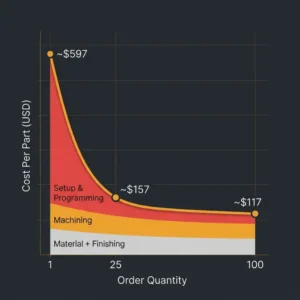
Part spec: 150 × 100 × 50 mm housing, 6061 aluminum, 5 pockets, 12 holes, 2 countersunk, 2 threaded inserts, 2 setups, bead blast finish.
| Cost Element | 1 Part | 25 Parts | 100 Parts |
| Material (billet + waste) | $22 | $18/unit | $14/unit |
| Setup + Programming | $420 | $17/unit | $4/unit |
| Machining (cycle time) | $140 | $110/unit | $90/unit |
| Bead blast | $15 | $12/unit | $9/unit |
| Total | $597 | $157/unit | $117/unit |
The price of a part will be low for bulk orders. This is because the setup cost is a flat fee. For example, if it costs $420 to set up the machine, that $420 is added to 1 single part. If you make 25 parts, that $420 is shared among them. So it will make the setup cost only $17 per part.
Simultaneously, if you add more parts, the price will be reduced. This happens because the person running the machine becomes faster and more efficient as they work. Also, the shop can buy the raw metal at a cheaper bulk price when ordering larger amounts.
CNC Machining Cost Examples: Prototype vs Production Run
Prototype Cost Example: Aluminum Drone Frame Bracket
For three parts made from Aluminum 6061, the total cost is about $503. This means each part costs $168.
Why is it so expensive?
The price is high because of the setup fee. It costs $260 to program the computer and prepare the machine. When you only make 3 parts, that $260 is divided by 3.
How to make it cheaper
If you order 50 parts instead of 3, the price drops to about $68 per part. The part itself does not change. However, that $260 setup fee is now shared by 50 parts instead of just 3.
Production Run Cost Example: Aluminum Fluid Manifold
This example shows the cost of making 500 complex aluminum parts that hold liquid under pressure.
The Costs:
- Material: $19 per part.
- Setup/Programming: $3.60 per part.
- Machining: $78 per part.
- Hard Anodize: $38 per part.
- Pressure Testing: $14 per part.
- Total Price: About $153 per part.
How to Save $13,500
The team originally wanted a Nickel coating for $65 per part. However, they switched to Hard Anodize for $38 per part because it still protects against rust and wear. By choosing the cheaper coating, they saved $13,500 on the total order.
How to Read a CNC Quote?
Most price quotes show only one final number. This is okay for paying the bill, but it does not help you save money. Before you agree to any price, you should ask for a list that shows the price for the metal, the setup fee, the machine time, and the coating.
You should check:
Unusually High Setup Cost
On a simple part, this usually means the shop is quoting risk. This might be due to an ambiguous drawing, unfamiliar material, or geometry they have not run before. A cleaner STEP files and a tolerancing review often brings this down.
High Material Cost
If it is high relative to part weight, it shows a poor utilization ratio. A 200g part quoted with $35 in material means a large billet with heavy waste. You should ask if a near-net-stock option exists. Sometimes a casting blank or plate section removes 60% of the starting waste.
Finishing Cost
If the price of the coating is higher than the cost of making the part itself, the finish will be expensive. This often happens when people choose nickel or chrome coatings for parts that just need to look good. Using hard anodize gives the same protection and look, but it costs much less.
CNC vs 3D Printing vs Injection Molding
What is the right way to make your part depends on three simple points:
- How many parts do you need?
- What metal or plastic do you need?
- What is Tolerance?
| Factor | CNC Machining | FDM / SLA 3D Printing | Injection Molding |
| Setup cost | $100–$1,500 | $0–$50 | $3,000–$100,000+ |
| Unit cost, 1–10 parts | $50–$800 | $20–$300 | Not viable |
| Unit cost, 500 parts | $30–$200 | $20–$150 | $2–$20 (after mold) |
| Unit cost, 5,000+ parts | $15–$100 | Impractical at scale | $0.50–$5 |
| Achievable tolerance | ±0.01–0.1 mm | ±0.1–0.5 mm | ±0.05–0.3 mm |
| Material options | Full engineering range | Primarily polymers | Thermoplastics, elastomers |
| Lead time for first part | 3–10 days | 1–3 days | 6–16 weeks |
| Part strength | Native billet properties | Anisotropic | Isotropic and consistent |
CNC machining is the best decision to make metal parts unless you need more than 5,000 units. It is also good to make plastic parts that need to be very precise or very strong.
If you are making 500 to 2,000 plastic parts, it is usually cheaper to switch to a different method, like molding.
On the other hand, 3D printing is better for making quick samples to test a design or for parts with complex shapes. 3D printing is also a good way to save money on small amounts of plastic parts.
1. Design Rounded Internal Corners
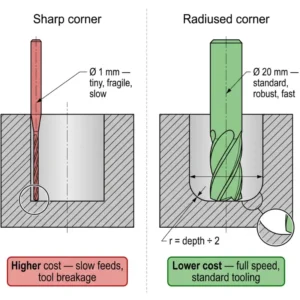
Since cutting tools are round, making sharp square corners inside a part is very difficult and expensive. It requires tiny, fragile tools that work slowly. If you make the corner radius at least half as deep as the pocket, the shop can use standard tools at high speeds. So the price will be low.
2. Order Small Batches for New Designs
The price per part drops when you order 100 instead of 25, but only if the design is perfect. If you order 100 parts and find a mistake, you have wasted a lot of money. It is smarter to order a small test run of 5 to 10 parts first, fix any issues, and then place the large order.
3. Use Standard Metal Thickness
Metal plates come in standard sizes like 12.7 mm or 25.4 mm. If you design a part that is 11 mm thick, the shop has to buy a 12.7 mm plate. You end up paying for the wasted metal and the extra work.
4. Limit Special Finishes to Specific Areas
Do not ask for a special coating or finish on the whole part if it isn’t needed. Mark your drawings to show that hidden areas, internal walls, and screw holes can be left as-machined. This saves a lot of money, especially on large orders.
5. Ask the Shop for Material Advice
Before you decide on a specific metal, ask the machine shop if there is a cheaper or easier alternative available. For example, some types of stainless steel are much easier to cut than others but offer similar strength.
Summary
CNC machining cost can vary according to part size, features and materials. Many customers find it difficult to make the best decision.
Youde CNC machining services help you choose the best material and provides a detailed quote for a custom part.

FAQ
Why is CNC machining expensive for small orders?
Machine cutting is not expensive, but the work is done before the machine starts. A complex part can take 6 hours to program and set up. If you only buy 1 part, you pay for all 6 hours. If you buy 100 parts, the cost is shared, making it much cheaper per unit. This is why the price drops quickly when you go from 1 to 25 parts.
What is the best way to lower CNC costs?
Redesign your part so the machine has to move it fewer times. Every time a worker has to stop and flip the part to a new setup, it adds 30 to 90 minutes of expensive labor. If you can change a design from 3 setups to 2 setups, you save hundreds of dollars.
How do tight tolerances change the price?
The price does not go up slowly; it jumps very fast.
- Standard ±0.1 mm: No extra cost.
- Tight ±0.05 mm: Adds 10% to 20% to the price.
- Very Tight ±0.02 mm: Adds 30% to 60%.
- Extreme below ±0.01 mm: Can double the price.
Is it cheaper to order parts from other countries?
For simple parts, the answer is usually yes. You can save 40% to 60% by ordering from places like China or Taiwan. However, for very precise parts, there will be shipping costs, inspection fees, and the risk of getting bad parts that must be sent back make it more expensive.
How can I tell if a price quote is fair?
Ask the shop to show you different stages of price. It should show separate costs for:
- Material
- Setup
- Machining
- Finishing