Custom Online 3D Printing Services

Get quotes for 3D-printed parts in plastic and metal. Order high-quality prototypes and parts.

Vacuum-Casting
Vacuum-Casting

STEP | STP | SLDPRT | IPT | PRT | SAT files

 All uploads are secure and confidential.

Cost-Efficient

Minimizing material waste

Sophisticated geometries

Beyond traditional methods

Fast turnaround

No mold delays

Design flexibility

Easy iteration

What Is 3D Printing

3D printing creates three-dimensional objects by layering material based on a digital model. The process starts with a CAD file, which is sliced into thin layers. The printer then builds the object layer by layer, using materials like plastics, resins, metals, or composites. 3D printing allows for complex shapes, rapid prototyping, and customized production, making it ideal for various industries.

cnc-3d-printing

How Does YD 3D Printing Work

3D printing is an additive manufacturing process that builds objects layer by layer based on a digital 3D model. The process involves:

  1. Design Creation: A 3D model is created using CAD software.
  2. Slicing: The model is sliced into layers, and a G-code is generated for the printer.
  3. Material Selection: Materials like plastic, resin, or metal are chosen based on the printing method.
  4. Printing: The printer deposits or cures material layer by layer to form the object.
  5. Post-Processing: The printed object may undergo cleaning, curing, or finishing.

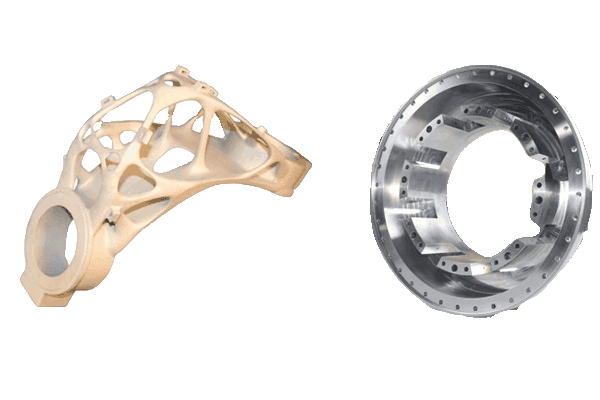
3D Metal Printing Parts Showroom

Our 3D Metal Printing Parts Showroom features a wide range of precision-engineered components, showcasing advanced manufacturing technology, fine details, and exceptional strength for diverse industrial applications.

3D Printing Services for Custom Prints

Experience precision and speed with our 3D Printing Services for Custom Prints. From prototypes to production parts, we deliver superior 3D printed components using SLA, HP MJF, SLS, and SLM technologies. Our process guarantees tolerances as tight as ±0.2 mm, giving you reliable, high-resolution parts exactly as designed.

SLA-parts

SLA

Uses a UV laser to cure liquid resin layer by layer, producing high-precision models with smooth surfaces. Ideal for detailed prototypes and complex geometries.

HP-MJF-parts

HP MJF

Builds parts by fusing powder material layer by layer with multiple jets and heat, offering fast production and high accuracy. Suitable for functional parts and complex designs.

SLS-parts

SLS

Uses a laser to sinter powder materials (like nylon) layer by layer, creating durable parts without support structures. Great for functional components and intricate designs.

SLM-parts

SLM

Completely melts metal powder with a laser to produce dense, high-strength metal parts. Widely used in aerospace and high-performance industrial applications.

3D Printing Materials

Our material selection includes plastics and metals such as ABS, PA (nylon), aluminum and stainless steel suitable for a variety of industrial custom 3D printing projects. If you have unique material requirements, we can provide a custom service.

Metals

Plastics

Advantages of YD 3D Printing

Rapid Prototyping

Allows for quick design iterations and testing, speeding up product development.

Cost-Effective for Small Runs

Lorem ipsum dolor sit amet, consectetur adipiscing elit.​

Customization

Enables the creation of highly customized and complex designs without additional costs.

Reduced Waste

As an additive process, 3D printing minimizes material waste compared to subtractive methods

Create Complex Geometries Cost-effectively

This technology lets you easily create custom geometric parts with no extra cost.

Faster Lead Times

Shortens production times, especially for complex or one-off parts.

Custom 3D Printing Applications

Frequently Asked Questions

3D printing can achieve remarkably high levels of accuracy, ensuring that your parts meet stringent specifications. At YD, our standard tolerance for 3D printing is ±0.01mm. However, the exact tolerance can vary depending on the complexity and design of your part. For highly detailed or intricate parts, tolerances may need to be adjusted to ensure optimal results. For the most accurate assessment, you can upload your 2D design files through our platform. Our team of experts will evaluate your design and determine the specific tolerances required to achieve the best possible result for your project.

The time it takes to 3D print parts depends on several key factors, including part size, height, complexity and the printing technology selected. Larger or more complex parts will naturally take longer to print than smaller, simpler parts. At YD, we understand the importance of fast turnaround times. Utilizing advanced 3D printing technologies and efficient processes, we can complete many 3D printing projects in as little as one day. For an accurate time estimate tailored to your specific project, you can upload your design files and our team will provide a detailed timeline based on your unique requirements.

It depends on the specifications of the 3D printer used. At YD, we offer a wide range of 3D printing machines to accommodate various sizes and requirements.

  • Large Format FDM Printers: Capable of printing up to 36 x 24 x 26 inches, ideal for large parts and prototypes.
  • Large SLA Printers: Can produce prints up to 29 x 25 x 21 inches, perfect for high-detail and smooth-surface applications.
  • SLS Printers: Unfilled SLS machines have a maximum build dimension of 13 inches, while glass-filled SLS machines can handle up to 26 x 15 x 23 inches.
  • Industrial Polyjet Printers: Offer a build area of up to 19 x 15 x 7 inches, suitable for high-resolution and multi-material prints.

This diverse selection ensures we can meet your project’s specific size and detail requirements.

At YD, we accept a variety of file formats to ensure compatibility with our 3D printing systems. The recommended file formats are STEP (.stp) and STL (.stl) as they provide the best accuracy and detail. If your design file is in a different format, we recommend that you convert it to either STEP or STL for optimal results. These formats preserve the geometric data and intricate details necessary for accurate, high-quality printing. If you need assistance with file conversion or have questions about specific formats, please contact our support team.

The cost of our 3D printing service depends on several factors. These include the type of 3D printer chosen, the size and design complexity of the model, the material used, and the volume of parts required. Larger and more intricate designs typically require more resources and time, influencing the overall cost. Material choice also plays a significant role; different materials vary in price based on their properties and suitability for specific applications. At YD, we provide detailed quotes tailored to your project’s specifications. Understanding these variables helps you manage capital effectively while achieving high-quality results.

Ask For A Quick Quote

Submission of drawings and detailed requirements via

You can also fill in the contact form below:

Ask For A Quick Quote

Submission of drawings and detailed requirements via

You can also fill in the contact form below: